


 一键配货
一键配货
化合物详情
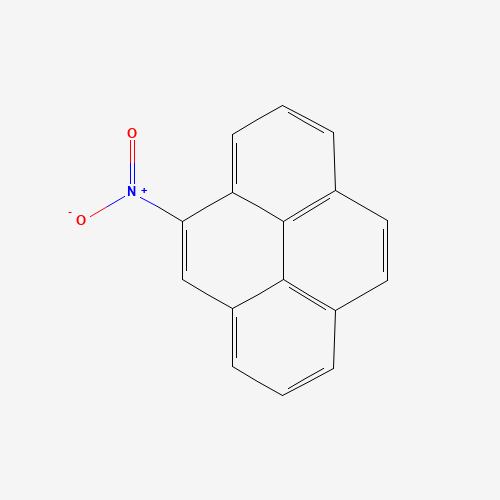
CAS57835-92-4
分子式C16H9NO2
分子量247.25 g/mol g/mol
危化品
4-Nitropyrene can cause cancer according to The World Health Organization's International Agency for Research on Cancer (IARC).
科学粮草官-词典编辑部,修订于:2026-07-06
Toxicity
ToxicityFate Summary
ATMOSPHERIC FATE: According to a model of gas/particle partitioning of semivolatile organic compounds in the atmosphere(1), 4-nitropyrene, which has an estimated vapor pressure of 5.5X10⁻⁸ mm Hg at 25 °C(SRC), determined from a fragment constant method(2), is expected to exist solely in the particulate phase in the ambient atmosphere. Particulate-phase 4-nitropyrene may be removed from the air by wet or dry deposition(SRC). 4-Nitropyrene contains chromophores that absorb at wavelengths >290 nm(3) and therefore may be susceptible to direct photolysis by sunlight(SRC).
Soil Adsorption / Mobility
Using a structure estimation method based on molecular connectivity indices(1), the Koc of 4-nitropyrene can be estimated to be 86,000(SRC). According to a classification scheme(2), this estimated Koc value suggests that 4-nitropyrene is expected to be immobile in soil.
Environmental Bioconcentration
An estimated BCF of 630 was calculated in fish for 4-nitropyrene(SRC), using an estimated log Kow of 4.8(1) and a regression-derived equation(2). According to a classification scheme(3), this BCF suggests the potential for bioconcentration in aquatic organisms is high, provided the compound is not metabolized by the organism(SRC).
Volatilization from Water / Soil
The Henry's Law constant for 4-nitropyrene is estimated as 2.5X10-08 atm-cu m/mole(SRC) using a fragment constant estimation method(1). This Henry's Law constant indicates that 4-nitropyrene is expected to be essentially nonvolatile from water surfaces(2). 4-Nitropyrene's Henry's Law constant indicates that volatilization from moist soil surfaces will not occur(SRC). 4-Nitropyrene is not expected to volatilize from dry soil surfaces(SRC) based upon an estimated vapor pressure of 5.5X10⁻⁸ mm Hg(SRC), determined from a fragment constant method(3).
Environmental Abiotic Degradation
4-Nitropyrene is not expected to undergo hydrolysis in the environment due to the lack of functional groups that hydrolyze under environmental conditions(1). 4-Nitropyrene contains chromophores that absorb at wavelengths >290 nm(1) and therefore may be susceptible to direct photolysis by sunlight(SRC).
Atmospheric Concentrations
URBAN/SUBURBAN: 4-Nitropyrene was detected in an unknown number of ambient air samples of Baltimore, Maryland in January 2001 at concentrations ranging from 1.2-4.2 pg/cu m and in July 2001 at concentrations ranging from 0.2-1.2 pg/cu m(1). 4-Nitropyrene was also detected in an unknown number of ambient air samples in of Fort Meade, Maryland in January 2001 at concentrations ranging from 1.0-2.6 pg/cu m and in July 2001 at concentrations ranging from 0.050-0.30 pg/cu m(1). 4-Nitropyrene was detected in 6 out of 6 airborne samples in air and diesel particulates collected from Baltimore, Maryland at concentrations ranging from 5.5-173 ng/g(2).
Artificial Pollution Sources
4-Nitropyrene's limited production and use as a laboratory chemical(1) may result in its release to the environment through various waste streams. Its presence in the atmosphere due to reactions of parent polyaromatic hydrocarbons released in various manufacturing processes(2) will result in its direct release to the environment(SRC).
Probable Routes of Human Exposure
Occupational exposure to 4-nitropyrene may occur through inhalation and dermal contact with this compound at workplaces where 4-nitropyrene is produced as a contaminant in manufacturing processes. Monitoring data indicate that the general population may be exposed to 4-nitropyrene via inhalation of ambient air and dermal contact with this compound. (SRC)
Environmental Fate / Exposure Summary
4-Nitropyrene's limited production and use as a laboratory chemical may result in its release to the environment through various waste streams. Its presence in the atmosphere due to reactions of parent polyaromatic hydrocarbons will result in its direct release to the environment. If released to air, an estimated vapor pressure of 5.5X10⁻⁸ mm Hg at 25 °C indicates 4-nitropyrene will exist solely in the particulate phase in the atmosphere. Particulate-phase 4-nitropyrene will be removed from the atmosphere by wet or dry deposition. 4-Nitropyrene contains chromophores that absorb at wavelengths >290 nm and therefore may be susceptible to direct photolysis by sunlight. If released to soil, 4-nitropyrene is expected to have no mobility based upon an estimated Koc of 86,000. Volatilization f...
Adverse Effects
NTP Carcinogen - Reasonably anticipated to be a human carcinogen.
RAIS Toxicity Values
Oral Slope Factor Reference: CALEPA
Human Toxicity Excerpts
/GENOTOXICITY/ ... To examine whether the PAH- and nitro-PAH-DNA derived adducts can be further differentiated, hepatocyte cultures were preincubated with 2,3,7,8-tetrachloro-p-dioxin (TCDD) to induce the activity of cytochrome P450 1A1. TCDD pretreatment strongly increased the levels of PAH-DNA adducts, whereas, the levels of nitro-PAH adducts were markedly decreased. NCI-H322 cells, a human lung tumor cell line derived from Clara cells, exhibited PAH-DNA adduct levels between 10 and 100, and nitro-PAH-DNA adducts at levels between 0.2 to about 30 adducts per 108 nucleotides, respectively. In contrast to hepatocytes, incubations with extractable organic matter (EOM) and the neutral aromatic EOM fraction displayed several distinct spots in the chromatograms of NCI-H322 cells. The major...
Carcinogen Classification
IARC Monographs: Volume 105: (2013) Diesel and Gasoline Engine Exhausts and Some Nitroarenes
Non-Human Toxicity Excerpts
/LABORATORY ANIMALS: Chronic Exposure or Carcinogenicity/ 4-Nitropyrene was tested for carcinogenicity in newborn rats by subcutaneous injection, producing an increase in the incidence of mammary tumors. It was also tested by intraperitoneal injection in newborn mice, producing an increase in the incidence of liver-cell tumors in males and of lung tumors in animals of each sex. A study by intraperitoneal injection was inadequately reported.
1 or Cancer Risk Level 1E-06
Fraction of Contaminant Absorbed Dermally from Soil: 0.13
Evidence for Carcinogenicity
4-Nitropyrene is reasonably anticipated to be a human carcinogen based on sufficient evidence of malignant tumor formation at multiple tissue sites in multiple species of experimental animals.
Antidote and Emergency Treatment
/SRP:/ Advanced treatment: Consider orotracheal or nasotracheal intubation for airway control in the patient who is unconscious or is in severe respiratory distress. Monitor cardiac rhythm and treat arrhythmias if necessary. Start IV administration of D5W /SRP: "To keep open", minimal flow rate/. Use 0.9% saline (NS) or lactated Ringer's (LR) if signs of hypovolemia are present. For hypotension with signs of hypovolemia, administer fluid cautiously. If unresponsive to these measures, vasopressors may be helpful. Watch for signs of fluid overload ... . Treat seizures with diazepam or lorazepam ... . Administer 1% solution methylene blue if patient is symptomatic with severe hypoxia, cyanosis, and cardiac compromise not responding to oxygen. DIRECT PHYSICIAN ORDER ONLY ... . Use proparaca...
Hazard Quotient Level 3 or Cancer Risk Level 1E-04
Fraction of Contaminant Absorbed Dermally from Soil: 0.13









