


 一键配货
一键配货
化合物详情
CAS131341-86-1
分子式C12H6F2N2O2
分子量248.19 g/mol g/mol
危化品
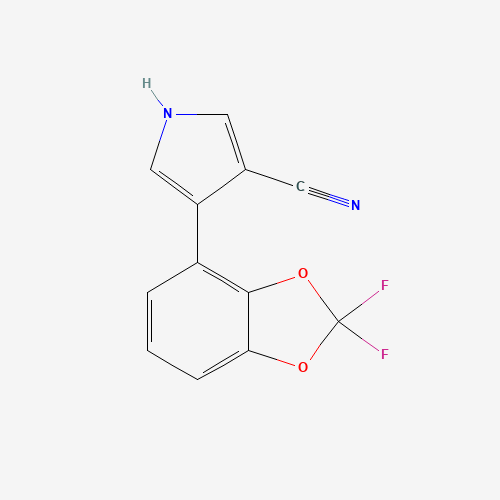
Fludioxonil is a member of the class of benzodioxoles that is 2,2-difluoro-1,3-benzodioxole substituted at position 4 by a 3-cyanopyrrol-4-yl group. A fungicide seed treatment for control of a range of diseases including Fusarium, Rhizoctonia and Alternaria. It has a role as an androgen antagonist, an estrogen receptor agonist and an antifungal agrochemical. It is a nitrile, a member of pyrroles, an organofluorine compound and a member of benzodioxoles.
科学粮草官-词典编辑部,修订于:2026-07-06
Toxicity
ToxicityEPA Ecotoxicity
Pesticide Ecotoxicity Data from EPA: 66
Ecotoxicity Values
EC50; Species: Pseudokirchneriella subcapitata (Green Algae); Conditions: freshwater, static; Concentration: 87 ug/L for 5 days (95% confidence interval: 69-110 ug/L); Effect: population abundance /95.4% purity/
Fate Summary
ATMOSPHERIC FATE: According to a model of gas/particle partitioning of semivolatile organic compounds in the atmosphere(1), fludioxonil, which has a vapor pressure of 2.93X10⁻⁹ mm Hg at 25 °C(2), is expected to exist solely in the particulate phase in the ambient atmosphere. Particulate-phase fludioxonil may be removed from the air by wet and dry deposition(SRC).
Soil Adsorption / Mobility
[Table#8227]: IiUgQ2FyYm9uIiwicEgiLCIlIFNhbmQvJSBTaWx0LyUgQ2xheSIsIktkIChtTC9nKSIsIktvYyIKIjIuNyIsIjYuOSIsIjcwLzE2LzE0IiwiMTE2IiwiMzE1NCIKIjMuNiIsIjcuNCIsIjQ2LzM1LzE5IiwiMTE2IiwiMzE0OSIKIjMuMSIsIjcuMCIsIjY3LzE1LzE4IiwiMTI5IiwiMzQ5OCIKIjQuNCIsIjYuNSIsIjU5LzIzLzE4IiwiMjEzIiwiNTc4NSIKIjMuNyIsIjUuNiIsIjY5LzE3LzE0IiwiMTEyIiwiMzA0MyIKIjQuOSIsIjUuNiIsIjUxLzMyLzE3IiwiNjIiLCIxNjcxIgoiMy4xIiwiNS4zIiwiNTMvMzAvMTciLCIxMTAiLCIyOTczIgoiNC4xIiwiNS41IiwiNjUvMTkvMTYiLCIxODciLCI1MDc2Igo=
Environmental Biodegradation
ANAEROBIC: Under anaerobic conditions fludioxonil was stable(1).
Environmental Bioconcentration
An estimated BCF of 240 was calculated in fish for fludioxonil(SRC), using a log Kow of 4.12(1) and a regression-derived equation(2). According to a classification scheme(3), this BCF suggests the potential for bioconcentration in aquatic organisms is high(SRC).
Volatilization from Water / Soil
The Henry's Law constant for fludioxonil is estimated as 5.3X10⁻¹⁰ atm-cu m/mole(SRC) derived from its vapor pressure, 2.93X10⁻⁹ mm Hg(1), and water solubility, 1.80 mg/L(1). This Henry's Law constant indicates that fludioxonil is expected to be essentially nonvolatile from moist soil and water surfaces(2). Fludioxonil is not expected to volatilize from dry soil surfaces(SRC) based upon its vapor pressure(1).
Environmental Abiotic Degradation
Fludioxonil is not expected to undergo hydrolysis in the environment due to the lack of functional groups that hydrolyze under environmental conditions(1). Photodegradation was determined to be the main route of dissipation from tomatoes in a greenhouse(2). Near-surface soil and aqueous photodegradation half-lives were reported as 1.6 and 8.7 days, respectively(3). Extractable fludioxonil concentrations were 45.6 and 71.6% of the amount applied 69 days after soil treatment using non-UV light and dark conditions, respectively(4). Respective fludioxonil percent degraded was 14.1 and 11.5 with 32.3 and 10.2% non-extractable from the soil(4).
Food Survey Values
Fludioxonil was not detected in 228 fresh potato samples collected from 34 farmers markets located in Calgary and Edmonton, Canada; detection limit and sample dates were not reported(1). Of 173 agricultural products analyzed in 2006 from Japan, two were reported to contain fludioxonil at 6.2 and 203 ng/g(2). Fludioxonil was detected in 18 of 47 wine grape (Vitis vinifera L.) samples collected from the 2006 harvest in Slovenia at a maximum concentration of 0.03 mg/kg(3).
Milk Concentrations
/A feeding study was conducted in which three groups of three dairy cows received 0.55 ppm, 1.6 ppm or 5.5 ppm fludioxonil in the diet for 28-30 days. Residues of fludioxonil and metabolites, determined as CGA-192155 (2,2-difluorobenzo[1,1]dioxole-4-carboxylic acid), were quantifiable only at the highest feeding level (5.5 ppm). Residues were found in the milk of two of three cows, with maximum values of 0.019 mg/kg and 0.014 mg/kg on days 14 and 21, respectively. At the lowest feeding level, residues were detected in milk on days 3-21 at levels of 0.001-0.004 mg/kg, with maximum detection on day 3.
Ecotoxicity Excerpts
/PLANTS/ Procymidone, fludioxonil, and pyrimethanil are widely used to control the pathogenic fungus Botrytis cinerea in Champagne's vineyards. These fungicides may end up in surface waters and present potential risks for aquatic vascular plants and algae. Therefore, their toxicity was evaluated on Lemna minor /duckweed/ and Scenedesmus acutus /algae/ in six-day or 48-hr tests, respectively. Based on growth and chlorophyll (Chl) content of L. minor and S. acutus cultures, the results showed that the alga was the most sensitive to the fungicides. Among the fungicides, pyrimethanil was the most toxic for L. minor, its nominal IC50 was 46.16 mg/L and that of the other two was >100 mg/L. In contrast, pyrimethanil appeared the least toxic for S. acutus at low concentration, nominal IC50 were...
Atmospheric Concentrations
RURAL/REMOTE: Fludioxonil was detected in at least one of 38 air samples collected April to June 2010 in rural Spain(1).
Artificial Pollution Sources
Fludioxonil's production may result in its release to the environment through various waste streams; its use as a fungicide(1) will result in its direct release to the environment(SRC).
Sediment/Soil Concentrations
SOIL: Fludioxonil residues were reported at a maximum of 400 ug/kg in Ourense, Spain vineyard soils(1). Fludioxonil was not detected in 24 soil samples collected from around Yeongsan and Sumjin rivers in the Republic of Korea(2).
Probable Routes of Human Exposure
Occupational exposure to fludioxonil may occur through inhalation and dermal contact with this compound at workplaces where fludioxonil is produced or used. Monitoring and use data indicate that the general population may be exposed to fludioxonil via ingestion of fruits, vegetables and wines that have residual concentrations of fludioxonil. (SRC)
Other Environmental Concentrations
The half-life of fludioxonil was 6.2-7.2 days on grapes at two experimental stations in China(1). Fourteen days after three low dosage applications the residual concentration was <1.0 mg/kg on grapes(1). The half-life of fludioxonil on emerald and jewel blueberries was 12.7 and 16.3 days, respectively; samples were collected in Concordia, Argentina(2).
Environmental Fate / Exposure Summary
Fludioxonil's production may result in its release to the environment through various waste streams; its use as a fungicide will result in its direct release to the environment. If released to air, a vapor pressure of 2.93X10⁻⁹ mm Hg at 25 °C indicates fludioxonil will exist solely in the particulate phase in the atmosphere. Particulate-phase fludioxonil will be removed from the atmosphere by wet and dry deposition. If released to soil, fludioxonil is expected to have low to no mobility based upon Koc values of 991-5785. Volatilization from moist soil surfaces is not expected to be an important fate process based upon an estimated Henry's Law constant of 5.3X10⁻¹⁰ atm-cu m/mole. Fludioxonil is not expected to volatilize from dry soil surfaces based upon its vapor pressure. Soil dissipat...
Effect Level
collection=toxvaldb&kind=^EL$
Interactions
Many pesticides are used increasingly in combinations during crop protection and their stability ensures the presence of such combinations in foodstuffs. The effects of three fungicides, pyrimethanil, cyprodinil and fludioxonil, were investigated together and separately on U251 and SH-SY5Y cells, which can be representative of human CNS glial and neuronal cells respectively. Over 48 hr, all three agents showed significant reductions in cellular ATP, at concentrations that were more than tenfold lower than those which significantly impaired cellular viability. The effects on energy metabolism were reflected in their marked toxic effects on mitochondrial membrane potential. In addition, evidence of oxidative stress was seen in terms of a fall in cellular thiols coupled with increases in t...
Lethal Dose
collection=toxvaldb&kind=^LD$
Adverse Effects
ACGIH Carcinogen - Confirmed Animal.
Toxicity Summary
Organic nitriles decompose into cyanide ions both in vivo and in vitro. Consequently the primary mechanism of toxicity for organic nitriles is their production of toxic cyanide ions or hydrogen cyanide. Cyanide is an inhibitor of cytochrome c oxidase in the fourth complex of the electron transport chain (found in the membrane of the mitochondria of eukaryotic cells). It complexes with the ferric iron atom in this enzyme. The binding of cyanide to this cytochrome prevents transport of electrons from cytochrome c oxidase to oxygen. As a result, the electron transport chain is disrupted and the cell can no longer aerobically produce ATP for energy. Tissues that mainly depend on aerobic respiration, such as the central nervous system and the heart, are particularly affected. Cyanide is also...
Lethal Concentration
collection=toxvaldb&kind=^LC$
RAIS Toxicity Values
Oral Chronic Reference Dose Reference: OPP
Human Toxicity Excerpts
/ALTERNATIVE and IN VITRO TESTS/ Many pesticides are used increasingly in combinations during crop protection and their stability ensures the presence of such combinations in foodstuffs. The effects of three fungicides, pyrimethanil, cyprodinil and fludioxonil, were investigated together and separately on U251 and SH-SY5Y cells, which can be representative of human CNS glial and neuronal cells respectively. Over 48 hr, all three agents showed significant reductions in cellular ATP, at concentrations that were more than tenfold lower than those which significantly impaired cellular viability. The effects on energy metabolism were reflected in their marked toxic effects on mitochondrial membrane potential. In addition, evidence of oxidative stress was seen in terms of a fall in cellular t...
Carcinogen Classification
No indication of carcinogenicity to humans (not listed by IARC).
Reference and Risk Values
collection=toxvaldb&kind=^RRV$
Non-Human Toxicity Excerpts
/LABORATORY ANIMALS: Acute Exposure/ Fludioxonil is a slight eye irritant in rabbits, but is neither a skin irritant in rabbits nor a skin sensitizer in guinea-pigs.
Antidote and Emergency Treatment
/SRP:/ Advanced treatment: Consider orotracheal or nasotracheal intubation for airway control in the patient who is unconscious, has severe pulmonary edema, or is in severe respiratory distress. Positive-pressure ventilation techniques with a bag valve mask device may be beneficial. Consider drug therapy for pulmonary edema ... . Consider administering a beta agonist such as albuterol for severe bronchospasm ... . Monitor cardiac rhythm and treat arrhythmias as necessary ... . Start IV administration of D5W TKO /SRP: "To keep open", minimal flow rate/. Use 0.9% saline (NS) or lactated Ringer's (LR) if signs of hypovolemia are present. For hypotension with signs of hypovolemia, administer fluid cautiously. Watch for signs of fluid overload ... . Treat seizures with diazepam or lorazepam...









