


 一键配货
一键配货
化合物详情
CAS494-97-3
分子式C9H12N2
分子量148.20 g/mol
危化品
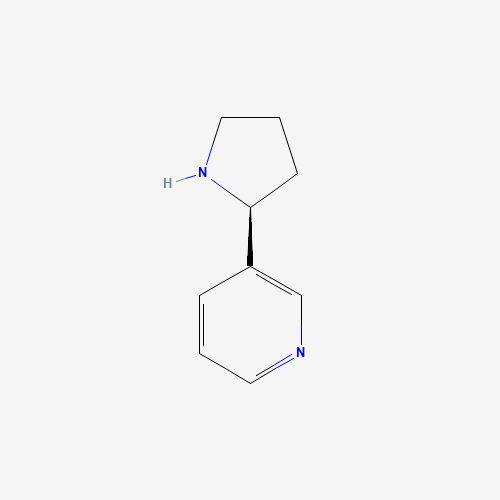
(S)-nornicotine is a pyridine alkaloid that is nicotine lacking the methyl group on the pyrrolidine nitrogen. It has a role as a phytogenic insecticide, a metabolite and a nicotinic acetylcholine receptor agonist. It is a pyridine alkaloid and a pyrrolidine alkaloid. It is a conjugate base of a (S)-nornicotine(1+). It is an enantiomer of a (+)-Nornicotine. It derives from a hydride of a nicotine.
科学粮草官-词典编辑部,修订于:2026-07-06
Toxicity
ToxicityEcotoxicity Values
LC50; Species: Eisenia fetida (Earthworm) mature, weight 370-450 mg; direct application (filter paper) 10-100 ug/sq cm for 48 hr
Fate Summary
ATMOSPHERIC FATE: According to a model of gas/particle partitioning of semivolatile organic compounds in the atmosphere(1), nornicotine, which has an estimated vapor pressure of 0.00923 mm Hg at 25 °C(SRC), determined from a fragment constant method(2), is expected to exist solely as a vapor in the ambient atmosphere. Vapor-phase nornicotine is degraded in the atmosphere by reaction with photochemically-produced hydroxyl radicals(SRC); the half-life for this reaction in air is estimated to be 4.4 hours(SRC), calculated from its rate constant of 8.67X10⁻¹¹ cu cm/molecule-sec at 25 °C(SRC) that was derived using a structure estimation method(2). Nornicotine does not contain chromophores that absorb at wavelengths >290 nm(3), and therefore is not expected to be susceptible to direct photol...
Soil Adsorption / Mobility
The Koc of nornicotine is estimated as 14(SRC), using a log Kow of 0.17(1) and a regression-derived equation(2). Using a structure estimation method based on molecular connectivity indices(2), the Koc can be estimated to be 500(SRC). According to a classification scheme(3), these estimated Koc value suggest that nornicotine may have very high to moderate mobility in soil. The estimated pKa of nornicotine is 5.25(4), indicating that this compound will partially exist in cation form in the environment and cations generally adsorb more strongly to soils containing organic carbon and clay than their neutral counterparts(5).
Environmental Bioconcentration
An estimated BCF of 3 was calculated in fish for nornicotine(SRC), using a log Kow of 0.17(1) and a regression-derived equation(2). According to a classification scheme(3), this BCF suggests the potential for bioconcentration in aquatic organisms is low(SRC).
Volatilization from Water / Soil
The Henry's Law constant for nornicotine is estimated as 1.37X10⁻⁹ atm-cu m/mole at 25 °C(SRC) using a fragment constant estimation method(1). This Henry's Law constant indicates that nornicotine is expected to be essentially nonvolatile water surfaces(2). Nornicotine's Henry's Law constant indicates that volatilization from moist soil surfaces is not expected to be an important fate process(SRC). Nornicotine is not expected to volatilize from dry soil surfaces(SRC) based upon an estimated vapor pressure of 0.00923 mm Hg at 25 °C(SRC), determined from a fragment constant method(1).
Environmental Abiotic Degradation
The rate constant for the vapor-phase reaction of nornicotine with photochemically-produced hydroxyl radicals has been estimated as 8.67X10⁻¹¹ cu cm/molecule-sec at 25 °C(SRC) using a structure estimation method(1). This corresponds to an atmospheric half-life of about 4.4 hours at an atmospheric concentration of 5X10+5 hydroxyl radicals per cu cm(1). Nornicotine is not expected to undergo hydrolysis in the environment due to the lack of functional groups that hydrolyze under environmental conditions(2). Nornicotine does not contain chromophores that absorb at wavelengths >290 nm(2) and it is reported to not darkened on exposure to light(3); therefore it is not expected to be susceptible to direct photolysis by sunlight(SRC).
Plant Concentrations
[Table#7982]: IkdlbnVzIHNwZWNpZXMiLCJDb21tb24gbmFtZShzKSIsIlBsYW50IHBhcnQiCiJEdWJvaXNpYSBteW9wb3JvaWRlcyIsIkNvcmt3b29kIFRyZWUiLCJMZWFmIgoiTmljb3RpYW5hIGdsYXVjYSIsIlRyZWUgVG9iYWNjbyIsIkxlYWYiCiJOaWNvdGlhbmEgcnVzdGljYSIsIkF6dGVjIFRvYmFjY28iLCJMZWFmIgoiTmljb3RpYW5hIHRhYmFjdW0iLCJUb2JhY2NvIiwiTGVhZiIK
Natural Pollution Sources
Nornicotine occurs in tobacco (Nicotiana Tabacum), other species of Nicotiana, and indigenous Australian plants such as Duboisia Hopwoodii and Duboisia Myoporoides(1-3); all these plants are members of the Solanacae family(2,3). Nornicotine has been identified as a chemical component in tobacco(4).
Artificial Pollution Sources
Nornicotine has been identified as a chemical component in tobacco smoke and in substituent tobacco smoke(1). Nornicotine's former production and use as an insecticide(2) may have resulted in its direct release to the environment through various waste streams(SRC).
Probable Routes of Human Exposure
Nornicotine's occurrence in tobacco and tobacco smoke will expose the general population to nornicotine through inhalation of tobacco smoke and through dermal contact with tobacco leaves and tobacco products. (SRC)
Other Environmental Concentrations
The concentration of nornicotine in environmental tobacco smoke has been reported as 1.0 umol/mol carbon monoxide(1).
Environmental Fate / Exposure Summary
Nornicotine has been identified as a chemical component in tobacco. In addition to tobacco, nornicotine occurs in other species of Nicotiana and in Duboisia hopwoodii and Solanacae. Nornicotine's former production and use as an insecticide would have resulted in its direct release to the environment through various waste streams. If released to air, an estimated vapor pressure of 0.00923 mm Hg at 25 °C indicates nornicotine will exist solely as a vapor in the atmosphere. Vapor-phase nornicotine will be degraded in the atmosphere by reaction with photochemically-produced hydroxyl radicals; the half-life for this reaction in air is estimated to be 4.4. Nornicotine does not contain chromophores that absorb at wavelengths >290 nm, and therefore is not expected to be susceptible to direct ph...
Interactions
... Nornicotine causes aberrant protein glycation and catalyzes the covalent modification of certain prescription drugs such as the commonly used steroid, prednisone. ...
Human Toxicity Excerpts
/CASE REPORTS/ Umbilical cord tissue was studied as a means of detecting prenatal exposure to nicotine. ... Between June and September 2009, 19 women with a tobacco exposure history (either first- or second-hand tobacco smoke exposure during pregnancy) were consented for the study. A questionnaire was completed to document nicotine exposure during each trimester of pregnancy. All infants were delivered at term (38 weeks or greater) and paired umbilical cord tissue (10-cm segment or greater) and meconium were obtained. ... Nornicotine was detected only in meconium, at very low concentrations. ... All analyte concentrations were lowest when the mother stated she quit smoking early in pregnancy or had only second-hand exposure, and detection was poor if exposure was limited to the first or...
Non-Human Toxicity Values
LD50 Rabbit intravenous 3 mg/kg
Non-Human Toxicity Excerpts
/OTHER TOXICITY INFORMATION/ ...Nornicotine (N-desmethyl-nicotine) appears to activate different nAChR subtypes, has a better pharmacokinetic profile, and produces less toxicity than nicotine. ... In the present study, the S(-)- and R(+)-enantiomers of nornicotine were characterized with regard to analgesia and side-effects profile. Efficacy was demonstrated in rat models of pain where central sensitization is involved: i.e. the chronic constriction nerve injury model of peripheral neuropathy and the formalin model of tonic inflammatory pain. The desirable (analgesic) properties resided predominantly in the S(-)- rather than the R(+)-enantiomer. In contrast, undesirable effects (motor in-coordination, reduced locomotor activity, ataxia) were more pronounced with the R(+)-enantiomer. Thi...









