

 一键配货
一键配货
化合物详情
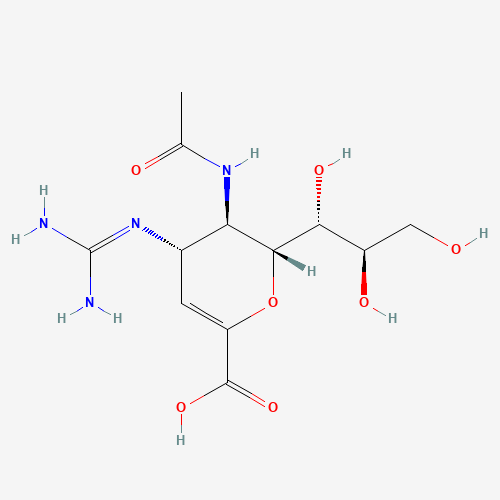
CAS139110-80-8
分子式C12H20N4O7
分子量332.31 g/mol g/mol
危化品
Zanamivir is a member of guanidines. It has a role as an antiviral agent and an EC 3.2.1.18 (exo-alpha-sialidase) inhibitor.
科学粮草官-词典编辑部,修订于:2026-07-06
Toxicity
ToxicityEnvironmental Water Concentrations
While data specific to zanamivir were not located(SRC, 2006), the literature suggests that some pharmaceutically active compounds originating from human and veterinary therapy are not eliminated completely in municipal sewage treatment plants and are therefore discharged into receiving waters(1). Wastewater treatment processes often were not designed to remove them from the effluent(2). Selected organic waste compounds may be degrading to new and more persistent compounds that may be released instead of or in addition to the parent compound(2). Studies have indicated that several polar pharmaceutically active compounds can leach through subsoils into aquifers(1).
Milk Concentrations
Zanamivir is distributed in the breast milk of rats. It is unknown if zanamivir is distributed in human breast milk.
Interactions
Zanamivir is not a substrate nor does it affect cytochrome P450 (CYP) isoenzymes (CYP1A1/2, 2A6, 2C9, 2C18, 2D6, 2E1, and 3A4) in human liver microsomes.
Hepatotoxicity
Likelihood score: E (unlikely cause of clinically apparent liver injury).
Human Toxicity Excerpts
/SIGNS AND SYMPTOMS/ Bronchospasm and decline in lung function have been reported in some patients receiving relenza. Many but not all of these patients had underlying airways disease such as asthma or chronic obstructive pulmonary disease. Because of the risk of serious adverse events and because efficacy has not been demonstrated in this population, /zanamivir/ is not generally recommend for treatment of patients with underlying airways disease. Some patients with serious adverse events during treatment with /zanamivir/ have had fatal outcomes, although causality was difficult to assess. /Zanamivir/ should be discontinued in any patient who develops bronchospasm or decline in respratory function; immediate treatment and hospitalization may be required. Some patients without prior pulm...
Drug Induced Liver Injury
References: DOI:10.1016/j.drudis.2019.09.022
Non-Human Toxicity Excerpts
/GENOTOXICITY/ Zanamivir was not mutagenic in in vitro and in vivo genotoxicity assays which included bacterial mutation assays in S. typhimurium and E. coli, mammalian mutation assays in mouse lymphoma, chromosomal aberration assays in human peripheral blood lymphocytes, and the in vivo mouse bone marrow micronucleus assay.
Populations at Special Risk
Bronchospasm and decline in lung function have been reported in some patients receiving relenza. Many but not all of these patients had underlying airways disease such as asthma or chronic obstructive pulmonary disease. Because of the risk of serious adverse events and because efficacy has not been demonstrated in this population, /zanamivir/ is not generally recommend for treatment of patients with underlying airways disease.
Antidote and Emergency Treatment
/SRP:/ Advanced treatment: Consider orotracheal or nasotracheal intubation for airway control in the patient who is unconscious, has severe pulmonary edema, or is in respiratory arrest. Positive pressure ventilation techniques with a bag valve mask device may be beneficial. Monitor cardiac rhythm and treat arrhythmias as necessary ... . Start an IV with D5W /SRP: "To keep open", minimal flow rate/. Use lactated Ringer's if signs of hypovolemia are present. Watch for signs of fluid overload. Consider drug therapy for pulmonary edema ... . For hypotension with signs of hypovolemia, administer fluid cautiously. Watch for signs of fluid overload ... . Treat seizures with diazepam (Valium) ... . Use proparacaine hydrochloride to assist eye irrigation ... . /Poison A and B/
Effects During Pregnancy and Lactation
◉ Effects on Lactation and Breastmilk