


 一键配货
一键配货
化合物详情
CAS77337-76-9
分子式5H11NO4S
分子量181.210 g/mol g/mol
非危品
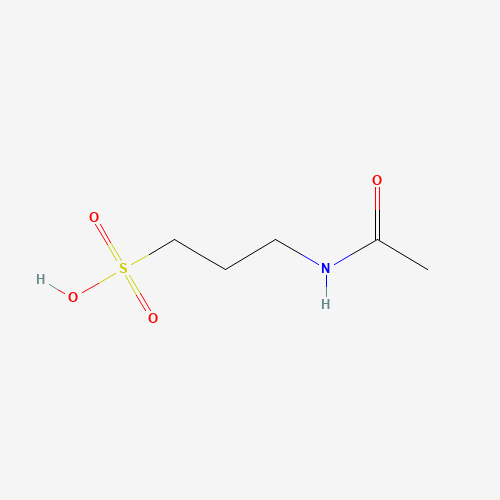
Acamprosate is an organosulfonic acid that is propane-1-sulfonic acid substituted by an acetylamino group at position 3. It has a role as a xenobiotic, a neurotransmitter agent and an environmental contaminant. It is a member of acetamides and an organosulfonic acid.
科学粮草官-词典编辑部,修订于:2026-07-06
Toxicity
ToxicityFate Summary
ATMOSPHERIC FATE: According to a model of gas/particle partitioning of semivolatile organic compounds in the atmosphere(1), acamprosate, which has an estimated vapor pressure of 1.8X10⁻⁸ mm Hg at 25 °C(SRC), determined from a fragment constant method(2), is expected to exist solely in the particulate phase in the ambient atmosphere. Particulate-phase acamprosate may be removed from the air by wet or dry deposition(SRC). Acamprosate does not contain chromophores that absorb at wavelengths >290 nm and therefore is not expected to be susceptible to direct photolysis by sunlight(SRC).
Soil Adsorption / Mobility
Using a structure estimation method based on molecular connectivity indices(1), the Koc of acamprosate can be estimated to be 10(SRC). According to a classification scheme(2), this estimated Koc value suggests that acamprosate is expected to have very high mobility in soil. The estimated pKa of acamprosate is 0.27 (sulfonic acid)(3), indicating that this compound will exist primarily as an anion in the environment and anions generally do not adsorb to soil as strongly as their neutral counterparts(4).
Environmental Bioconcentration
An estimated BCF of 3 was calculated for acamprosate(SRC), using an estimated log Kow of -2.9(1) and a regression-derived equation(2). According to a classification scheme(3), this BCF suggests the potential for bioconcentration in aquatic organisms is low(SRC).
Volatilization from Water / Soil
The estimated pKa of acamprosate is 0.27 (sulfonic acid)(1), indicating that this compound will exist primarily as an anion in the environment. Acamprosate is expected to be essentially nonvolatile from moist soil and water surfaces since anions do not volatilize. Acamprosate is not expected to volatilize from dry soil surfaces(SRC) based upon an estimated vapor pressure of 1.8X10⁻⁸ mm Hg(SRC), determined from a fragment constant method(2).
Environmental Abiotic Degradation
Acamprosate is not expected to undergo hydrolysis in the environment due to the lack of functional groups that hydrolyze under environmental conditions(1). Acamprosate does not contain chromophores that absorb at wavelengths >290 nm and therefore is not expected to be susceptible to direct photolysis by sunlight(SRC).
Environmental Water Concentrations
While data specific to acamprosate were not located(SRC, 2006), the literature suggests that some pharmaceutically active compounds originating from human and veterinary therapy are not eliminated completely in municipal sewage treatment plants and are therefore discharged into receiving waters(1). Wastewater treatment processes often were not designed to remove them from the effluent(2). Selected organic waste compounds may be degrading to new and more persistent compounds that may be released instead of or in addition to the parent compound(2).
Milk Concentrations
It is not known whether acamprosate is distributed into breast milk. However, acamprosate is distributed into the milk of lactating rats.
Artificial Pollution Sources
Acamprosate's production and use as a drug for maintaining abstinence from alcohol(1) may result in its release to the environment through various waste streams.
Probable Routes of Human Exposure
Occupational exposure to acamprosate may occur through inhalation and dermal contact with this compound at workplaces where acamprosate is produced or used. Exposure to acamprosate among the general population may be limited to those administered this substance as a drug. (SRC)
Environmental Fate / Exposure Summary
Acamprosate's production and use as a drug for maintaining abstinence from alcohol may result in its release to the environment through various waste streams. If released to air, an estimated vapor pressure of 1.8X10⁻⁸ mm Hg at 25 °C indicates acamprosate will exist solely in the particulate phase in the atmosphere. Particulate-phase acamprosate will be removed from the atmosphere by wet or dry deposition. Acamprosate does not contain chromophores that absorb at wavelengths >290 nm and therefore is not expected to be susceptible to direct photolysis by sunlight. If released to soil, acamprosate is expected to have very high mobility based upon an estimated Koc of 10. The pKa of acamprosate is 0.27 (sulfonic acid), indicating that this compound will exist primarily as an anion in the env...
Symptoms
In all reported cases of acute overdosage with acamprosate (total reported doses of up to 56 grams of acamprosate calcium), the only symptom that could be reasonably associated with acamprosate was diarrhea.
Treatment
Treatment consists of discontinuation of Acamprosate together with appropriate symptomatic therapy. The judicious use of a cardioselective beta-receptor blocker may beconsidered, bearing in mind that such medication can produce bronchospasm. (L1712)
Interactions
Acamprosate had no inducing potential on the cytochrome CYP1A2 and 3A4 systems, and in vitro inhibition studies suggest that acamprosate does not inhibit in vivo metabolism mediated by cytochrome CYP1A2, 2C9, 2C19, 2D6, 2E1, or 3A4. The pharmacokinetics of /acamprosate/ were unaffected when coadministered with alcohol, disulfiram or diazepam. Similarly, the pharmacokinetics of ethanol, diazepam and nordiazepam, imipramine and desipramine, naltrexone and 6-beta naltrexol were unaffected following co-administration with /acamprosate/.
Hepatotoxicity
Likelihood score: E (unlikely cause of clinically apparent liver injury).
Exposure Routes
The absolute bioavailability of acamprosate after oral administration is about 11%. The food effect on absorption is not clinically significant and no adjustment of dose is necessary.
Toxicity Summary
The mechanism of action of acamprosate in maintenance of alcohol abstinence is not completely understood. Chronic alcohol exposure is hypothesized to alter the normal balance between neuronal excitation and inhibition. <i>in vitro</i> and <i>in vivo</i> studies in animals have provided evidence to suggest acamprosate may interact with glutamate and GABA neurotransmitter systems centrally, and has led to the hypothesis that acamprosate restores this balance. It seems to inhibit NMDA receptors while activating GABA receptors.
Human Toxicity Excerpts
/HUMAN EXPOSURE STUDIES/ In all reported cases of acute overdosage with /acamprosate/ (total reported doses of up to 56 grams of acamprosate calcium), the only symptom that could be reasonably associated with /acamprosate/ was diarrhea. Hypercalcemia has not been reported in cases of acute overdose. A risk of hypercalcemia should be considered in chronic overdosage only. Treatment of overdose should be symptomatic and supportive.
Carcinogen Classification
No indication of carcinogenicity to humans (not listed by IARC).
Drug Induced Liver Injury
References: DOI:10.1016/j.drudis.2019.09.022
Non-Human Toxicity Excerpts
/LABORATORY ANIMALS: Developmental or Reproductive Toxicity/ In mice, acamprosate calcium administered orally for 60 days prior to mating and throughout gestation in females at doses up to 2400 mg/kg/day had no effect on fertility.
Populations at Special Risk
This drug is known to be substantially excreted by the kidney, and the risk of toxic reactions to this drug may be greater in patients with impaired renal function. Because elderly patients are more likely to have decreased renal function, care should be taken in dose selection, and it may be useful to monitor renal function.
Antidote and Emergency Treatment
/SRP:/ Advanced treatment: Consider orotracheal or nasotracheal intubation for airway control in the patient who is unconscious, has severe pulmonary edema, or is in respiratory arrest. Positive pressure ventilation techniques with a bag valve mask device may be beneficial. Monitor cardiac rhythm and treat arrhythmias as necessary ... . Start an IV with D5W /SRP: "To keep open", minimal flow rate/. Use lactated Ringer's if signs of hypovolemia are present. Watch for signs of fluid overload. Consider drug therapy for pulmonary edema ... . For hypotension with signs of hypovolemia, administer fluid cautiously. Watch for signs of fluid overload ... . Treat seizures with diazepam (Valium) ... . Use proparacaine hydrochloride to assist eye irrigation ... . /Poison A and B/
Effects During Pregnancy and Lactation
◉ Effects on Lactation and Breastmilk









