


 一键配货
一键配货
化合物详情
CAS196618-13-0
分子式C16H28N2O4
分子量312.4 g/mol g/mol
非危品
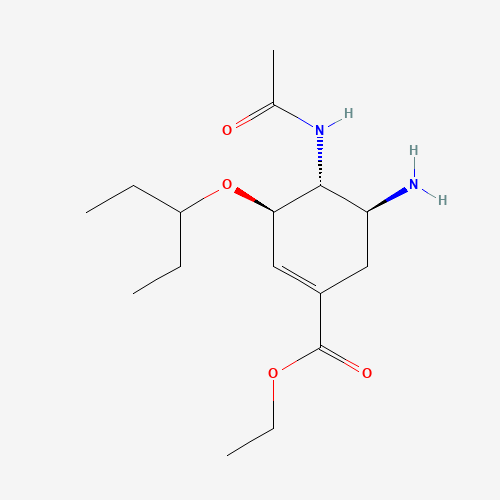
Oseltamivir is a cyclohexenecarboxylate ester that is the ethyl ester of oseltamivir acid. An antiviral prodrug (it is hydrolysed to the active free carboxylic acid in the liver), it is used to slow the spread of influenza. It has a role as a xenobiotic, an antiviral drug, a prodrug, an EC 3.2.1.18 (exo-alpha-sialidase) inhibitor and an environmental contaminant. It is a member of acetamides, a cyclohexenecarboxylate ester, an amino-acid ester and a primary amino compound.
科学粮草官-词典编辑部,修订于:2026-07-06
Toxicity
ToxicityFate Summary
ATMOSPHERIC FATE: According to a model of gas/particle partitioning of semivolatile organic compounds in the atmosphere(1), oseltamivir, which has an estimated vapor pressure of 1.3X10⁻⁸ mm Hg at 25 °C(SRC), determined from a fragment constant method(2), is expected to exist solely in the particulate phase in the ambient atmosphere. Particulate-phase oseltamivir may be removed from the air by wet or dry deposition(SRC). Oseltamivir does not contain chromophores that absorb at wavelengths >290 nm and therefore is not expected to be susceptible to direct photolysis by sunlight(SRC).
Soil Adsorption / Mobility
Using a structure estimation method based on molecular connectivity indices(1), the Koc of oseltamivir can be estimated to be 340(SRC). According to a classification scheme(2), this estimated Koc value suggests that oseltamivir is expected to have moderate mobility in soil. The pKa of oseltamivir is 7.7 (primary amine)(3), indicating that this compound will exist partially as a cation in the environment and cations generally adsorb to soil and sediment more strongly than their neutral counterparts(4).
Environmental Bioconcentration
An estimated BCF of 3 was calculated for oseltamivir(SRC), using an estimated log Kow of 0.95(1) and a regression-derived equation(2). According to a classification scheme(3), this BCF suggests the potential for bioconcentration in aquatic organisms is low(SRC).
Volatilization from Water / Soil
The Henry's Law constant for oseltamivir is estimated as 2.9X10⁻¹⁶ atm-cu m/mole(SRC) using a fragment constant estimation method(1). The pKa of oseltamivir is 7.7 (primary amine)(2), indicating that this compound will exist partially as a cation in the environment. Based on this Henry's Law constant and the fact that cations do not volatilize, oseltamivir is expected to be essentially nonvolatile from moist soil and water surfaces(3). Oseltamivir is not expected to volatilize from dry soil surfaces(SRC) based upon an estimated vapor pressure of 1.3X10⁻⁸ mm Hg(SRC), determined from a fragment constant method(4).
Environmental Abiotic Degradation
A base-catalyzed second-order hydrolysis rate constant of 2.0X10⁻³ L/mole-sec(SRC) was estimated using a structure estimation method(1); this corresponds to half-lives of 110 and 10 years at pH values of 7 and 8, respectively(1). Oseltamivir does not contain chromophores that absorb at wavelengths >290 nm and therefore is not expected to be susceptible to direct photolysis by sunlight(SRC).
Environmental Water Concentrations
While data specific to oseltamivir were not located(SRC, 2006), the literature suggests that some pharmaceutically active compounds originating from human and veterinary therapy are not eliminated completely in municipal sewage treatment plants and are therefore discharged into receiving waters(1). Wastewater treatment processes often were not designed to remove them from the effluent(2). Selected organic waste compounds may be degrading to new and more persistent compounds that may be released instead of or in addition to the parent compound(2).
Milk Concentrations
It is not known whether oseltamivir is distributed into human breast milk. Oseltamivir and oseltamivir carboxylate are distributed into the milk of lactating rats.
Artificial Pollution Sources
Oseltamivir's production and use as an antiviral drug for the treatment of individuals with influenza(1) may result in its release to the environment through various waste streams(SRC).
Probable Routes of Human Exposure
Occupational exposure to oseltamivir may occur through inhalation and dermal contact with this compound at workplaces where oseltamivir is produced or used. Exposure to oseltamivir among the general population may be limited to those administered this substance as a drug. (SRC)
Environmental Fate / Exposure Summary
Oseltamivir's production and use as an antiviral drug for the treatment of individuals with influenza may result in its release to the environment through various waste streams. If released to air, an estimated vapor pressure of 1.3X10⁻⁸ mm Hg at 25 °C indicates oseltamivir will exist solely in the particulate phase in the atmosphere. Particulate-phase oseltamivir will be removed from the atmosphere by wet or dry deposition. Oseltamivir does not contain chromophores that absorb at wavelengths >290 nm and therefore is not expected to be susceptible to direct photolysis by sunlight. If released to soil, oseltamivir is expected to have moderate mobility based upon an estimated Koc of 340. The pKa of oseltamivir is 7.7 (primary amine), indicating that this compound will exist partially as a...
Interactions
Coadministration with amoxicillin does not alter plasma levels of either compound, indicating that competition for the anionic secretion pathway is weak.
Hepatotoxicity
Likelihood score: D (possible rare cause of clinically apparent liver injury).
Adverse Effects
Influenza antiviral medications may decrease the efficacy of LAIV4 (live attenuated influenza vaccine) if administered within 48 hours to 14 days after LAIV4. Oseltamivir is an ester prodrug, and oseltamivir carboxylate contributes to the antiviral activity. Hydrolytic activation is mediated by human carboxylesterase (HCE) 1. In the presence of clopidogrel, the hydrolysis of oseltamivir is inhibited, leading to reduced antiviral efficacy.
Toxicity Summary
Oseltamivir is generally very well tolerated and has few drug interactions. Multiple animal toxicity studies, pre-marketing, and post-marketing of oseltamivir have indicated respiratory suppression resulting from central nervous system suppression, hypothermia, hypoactivity, and sudden death. This adverse event correlates with sudden-onset-type neuropsychiatric reactions in human patients (especially children from Japan), but no definitive link has been established. The oseltamivir-induced liver injury requires discontinuation of the drug and avoidance of reexposure. Most patients recover after discontinuation of oseltamivir without specific interventions.
Drug Induced Liver Injury
References: DOI:10.1016/j.drudis.2019.09.022
Non-Human Toxicity Excerpts
/GENOTOXICITY/ Oseltamivir was found to be non-mutagenic in the Ames test and the human lymphocyte chromosome assay with and without enzymatic activation and negative in the mouse micronucleus test. It was found to be positive in a Syrian Hamster Embryo (SHE) cell transformation test. Oseltamivir carboxylate was non-mutagenic in the Ames test and the L5178Y mouse lymphoma assay with and without enzymatic activation and negative in the SHE cell transformation test.
Antidote and Emergency Treatment
/SRP:/ Advanced treatment: Consider orotracheal or nasotracheal intubation for airway control in the patient who is unconscious, has severe pulmonary edema, or is in respiratory arrest. Positive pressure ventilation techniques with a bag valve mask device may be beneficial. Monitor cardiac rhythm and treat arrhythmias as necessary ... . Start an IV with D5W /SRP: "To keep open", minimal flow rate/. Use lactated Ringer's if signs of hypovolemia are present. Watch for signs of fluid overload. Consider drug therapy for pulmonary edema ... . For hypotension with signs of hypovolemia, administer fluid cautiously. Watch for signs of fluid overload ... . Treat seizures with diazepam (Valium) ... . Use proparacaine hydrochloride to assist eye irrigation ... . /Poison A and B/
Effects During Pregnancy and Lactation
◉ Effects on Lactation and Breastmilk
USGS Health-Based Screening Levels for Evaluating Water-Quality
Reference: Smith, C.D. and Nowell, L.H., 2024. Health-Based Screening Levels for evaluating water-quality data (3rd ed.). DOI:10.5066/F71C1TWP









