


 一键配货
一键配货
化合物详情
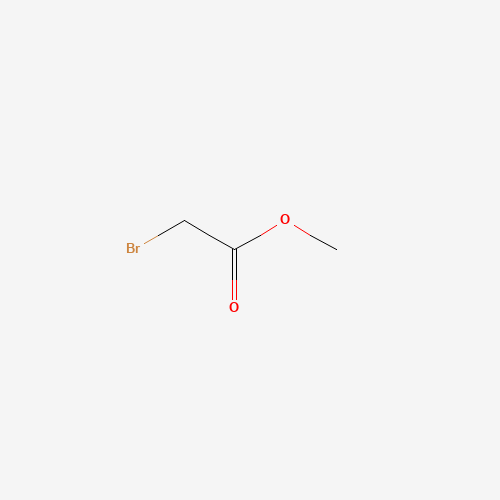
CAS96-32-2
分子式C3H5BrO2
分子量152.97 g/mol g/mol
危化品
Physical Description | Methyl bromoacetate appears as a colorless to straw-colored liquid with a sharp penetrating odor. Denser than water and soluble in water. Severly irritates skin and eyes. Toxic by ingestion and inhalation. Used to make vitamins and pharmaceuticals.
科学粮草官-词典编辑部,修订于:2026-07-06
Toxicity
ToxicityFate Summary
ATMOSPHERIC FATE: According to a model of gas/particle partitioning of semivolatile organic compounds in the atmosphere(1), methyl bromoacetate, which has an estimated vapor pressure of 6.1 mm Hg at 25 °C(SRC), determined from a fragment constant method(2), is expected to exist solely as a vapor in the ambient atmosphere. Vapor-phase methyl bromoacetate is degraded in the atmosphere by reaction with photochemically-produced hydroxyl radicals(SRC); the half-life for this reaction in air is estimated to be 74 days(SRC), calculated from its rate constant of 2.2X10⁻¹³ cu cm/molecule-sec at 25 °C(SRC) that was derived using a structure estimation method(2). Methyl bromoacetate does not contain chromophores that absorb at wavelengths >290 nm(3) and, therefore, is not expected to be susceptibl...
Soil Adsorption / Mobility
Using a structure estimation method based on molecular connectivity indices(1), the Koc of methyl bromoacetate can be estimated to be 6(SRC). According to a classification scheme(2), this estimated Koc value suggests that methyl bromoacetate is expected to have very high mobility in soil(SRC).
Environmental Bioconcentration
An estimated BCF of 3 was calculated in fish for methyl bromoacetate(SRC), using an estimated log Kow of 0.72(1) and a regression-derived equation(1). According to a classification scheme(2), this BCF suggests the potential for bioconcentration in aquatic organisms is low(SRC).
Volatilization from Water / Soil
The Henry's Law constant for methyl bromoacetate is estimated as 3.5X10⁻⁵ atm-cu m/mole(SRC) developed using a fragment constant estimation method(1). This Henry's Law constant indicates that methyl bromoacetate is expected to volatilize from water surfaces(2). Based on this Henry's Law constant, the volatilization half-life from a model river (1 m deep, flowing 1 m/sec, wind velocity of 3 m/sec)(2) is estimated as 1.4 days(SRC). The volatilization half-life from a model lake (1 m deep, flowing 0.05 m/sec, wind velocity of 0.5 m/sec)(2) is estimated as 14 days(SRC). Methyl bromoacetate's Henry's Law constant indicates that volatilization from moist soil surfaces may occur(SRC). Methyl bromoacetate is expected to volatilize from dry soil surfaces(SRC) based upon an estimated vapor pressu...
Environmental Abiotic Degradation
The rate constant for the vapor-phase reaction of methyl bromoacetate with photochemically-produced hydroxyl radicals has been estimated as 2.2X10⁻¹³ cu cm/molecule-sec at 25 °C(SRC) using a structure estimation method(1). This corresponds to an atmospheric half-life of about 74 days at an atmospheric concentration of 5X10+5 hydroxyl radicals per cu cm(1). A base-catalyzed second-order hydrolysis rate constant of 11 L/mole-sec(SRC) was estimated using a structure estimation method(1); this corresponds to half-lives of 7 days and 17 hours at pH values of 7 and 8, respectively(1). Methyl bromoacetate does not contain chromophores that absorb at wavelengths >290 nm(2) and, therefore, is not expected to be susceptible to direct photolysis by sunlight(SRC).
Artificial Pollution Sources
Methyl bromoacetate's production and use as a chemical intermediate for weed killers, dyes, vitamins and drugs(1) may result in its release to the environment through various waste streams(SRC). Its use as a lachrymator(1) will result in its direct release to the environment(SRC).
Other Environmental Concentrations
Occupational exposure to methyl bromoacetate may occur through inhalation and dermal contact with this compound at workplaces where methyl bromoacetate is produced or used. The general population is not likely to be exposed to methyl bromoacetate. (SRC)
Environmental Fate / Exposure Summary
Methyl bromoacetate's production and use as a chemical intermediate for weed killers, dyes, vitamins and drugs may result in its release to the environment through various waste streams. Its use as a lachrymator will result in its direct release to the environment. If released to air, an estimated vapor pressure of 6.1 mm Hg at 25 °C indicates methyl bromoacetate will exist solely as a vapor in the atmosphere. Vapor-phase methyl bromoacetate will be degraded in the atmosphere by reaction with photochemically-produced hydroxyl radicals; the half-life for this reaction in air is estimated to be 74 days. Methyl bromoacetate does not contain chromophores that absorb at wavelengths >290 nm and, therefore, is not expected to be susceptible to direct photolysis by sunlight. If released to soil...
Adverse Effects
Toxic Pneumonitis - Inflammation of the lungs induced by inhalation of metal fumes or toxic gases and vapors.
Toxicity Summary
IDENTIFICATION AND USE: Methyl bromoacetate is a colorless to straw-colored liquid. It is used as a chemical intermediate. HUMAN STUDIES: There are no data available. ANIMAL STUDIES: Fifty chemicals were experimentally screened for toxicity. Mice and rabbits were used in the tests. Chemicals were given iv, dermally, in the eye, or ip. Methyl bromoacetate was one of the most toxic of these chemicals.
Non-Human Toxicity Values
LD50 Rat oral 50 - 300 mg/kg bw
Non-Human Toxicity Excerpts
/OTHER TOXICITY INFORMATION/ Fifty chemical compounds were experimentally screened for toxicity, part of them being so determined as a routine procedure for estimating a chronic dose for the Sarcoma 180 assay. Mice and rabbits were used in the tests. Dosages were given intravenously, dermally, in the eye, or intraperitoneally. The more toxic substances included methyl-bromoacetate...
Antidote and Emergency Treatment
/SRP:/ Advanced treatment: Consider orotracheal or nasotracheal intubation for airway control in the patient who is unconscious. Positive pressure ventilation techniques with a bag valve mask device may be beneficial. Monitor cardiac rhythm and treat arrhythmias if necessary ... . Start an IV with D5W /SRP: "To keep open", minimal flow rate/. Use lactated Ringer's if signs of hypovolemia are present. Watch for signs of fluid overload. For hypotension with signs of hypovolemia, administer fluid cautiously. Consider vasopressors if patient is hypotensive with a normal fluid volume. Watch for signs of fluid overload ... . Consider drug therapy for pulmonary edema ... . Use proparacaine hydrochloride to assist eye irrigation ... . /Esters and related compounds/









