


 一键配货
一键配货
化合物详情
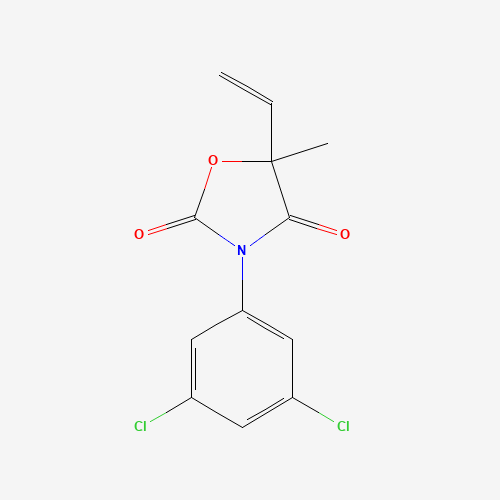
CAS50471-44-8
分子式C12H9Cl2NO3
分子量286.111 g/mol
非危品
Vinclozolin can cause cancer according to an independent committee of scientific and health experts. It can cause developmental toxicity according to The Environmental Protection Agency (EPA).
科学粮草官-词典编辑部,修订于:2026-07-06
Toxicity
ToxicityEPA Ecotoxicity
Pesticide Ecotoxicity Data from EPA: 31
Fate Summary
ATMOSPHERIC FATE: According to a model of gas/particle partitioning of semivolatile organic compounds in the atmosphere(1), vinclozolin, which has a vapor pressure of 2.6X10⁻⁶ mm Hg at 20 °C(2), will exist in both the vapor and particulate phases in the ambient atmosphere. Vapor-phase vinclozolin is degraded in the atmosphere by reaction with photochemically-produced hydroxyl radicals(SRC); the half-life for this reaction in air is estimated to be 4 hours(SRC), calculated from its rate constant of 3.3X10⁻¹¹ cu cm/molecule-sec at 25 °C(SRC), that was derived using a structure estimation method(3). Particulate-phase vinclozolin may be removed from the air by wet and dry deposition(SRC). Irradiation of vinclozolin for 8 hours under UV light (>290 nm) resulted in a 10% degradation of the ch...
Soil Adsorption / Mobility
Vinclozolin and its metabolic residues of hydrolysis, soil degradation and photolysis are likely more mobile in sandy soils with low carbon content(1). In one review, Koc values for vinclozolin are reported as 100 to 735(2). In a second review an average Koc of 500 is reported(3). In laboratory tests, vinclozolin migrated through Ottowa sand more deeply compared to aquatic hapludult soil, where all vinclozolin mass was retained in the upper 5 cm under high (6.7 mm) and low (3.1 mm) rain events(4). A Koc value of 1,570 was determined in a Chalmers silty clay loam(5). Using a structure estimation method based on molecular connectivity indices(1), the Koc of vinclozolin can be estimated to be 300(SRC). According to a classification scheme(2), these Koc data suggests that vinclozolin is exp...
Environmental Biodegradation
PURE CULTURE: Vinclozolin was biodegraded 52 to 65% in experiments with soil enrichment and pure cultures of Bacillus cereus, B. brevis and Pseudomonas fluorescnes. Metabolites indentified include: 3,5-dichloroaniline; 3,5-dichloroacetanilide; 2[(3,5-dichlorophenyl)carbamoyl]oxy]2-methyl]-3-butenoic acid; 3-butenamide, N-(3,5-dichlorophenyl)-2-hydroxy- 2-methyl; and N,N'-bis- 3,5-dichlorophenyl urea(1).
Environmental Bioconcentration
Estimated worst-case BCF values in fish for vinclozolin were reported as 60 and 1,260(1) on a wet weight basis with 5% lipid, and on a lipid basis predicted from the log Kow of 3.10(2), respectively, if no metabolism occurs or is negligible(1). Another study calculated a BCF range of 78 to 112(3). An estimated BCF of 52 was calculated in fish for vinclozolin(SRC), using a log Kow of 3.10(2) and a regression-derived equation(4). According to a classification scheme(5), these BCF data suggest the potential for bioconcentration in aquatic organisms is moderate to very high(SRC), provided the compound is not metabolized by the organism(SRC).
Volatilization from Water / Soil
The Henry's Law constant for vinclozolin is estimated as 1.7X10⁻⁸ atm-cu m/mole(SRC) derived from its vapor pressure, 2.6X10⁻⁶ mm Hg(1), and water solubility, 2.6 mg/L(2). This Henry's Law constant indicates that vinclozolin is expected to be essentially nonvolatile from water surfaces(3). Vinclozolin's estimated Henry's Law constant indicates that volatilization from moist soil surfaces is not expected(SRC). Vinclozolin is not expected to volatilize from dry soil surfaces(SRC) based upon its vapor pressure(1).
Environmental Abiotic Degradation
Five products were detected and identified, following 14 days irradiation of a methanolic solution of vinclozolin using a medium pressure mercury vapor lamp in a borosilicate glass system: 3,5-dichlorophenylisocyanate; 3,5-dichloroaniline; methyl 3,5-dichlorophenylcarbamate; 3-(3-chlorophenyl)-5-methyl-5-vinyl- oxazolidine-2, 4-dione; and methyl(3,5-dichlorophenyl)(2-hydroxy-2-methyl-1-oxo- buten-3-yl) carbamate; methyl(3,5-dichlorophenyl)(2-hydroxy-2-methyl-1-oxo- buten-3-yl) carbamate was also observed in a methanolic solution of vinclozolin after standing for several days in the dark(1). 65% vinclozolin remained in a benzene solution after 14 days irradiation using a medium pressure mercury vapor lamp and a borosilicate glass system(1). Vinclozolin in 2-propanol was completely degrad...
Environmental Water Concentrations
RAIN/SNOW: Vinclozolin was detected in rain water samples collected from Braunschweig, Rotenkamp, and Neuenkirchen, Germany from March 1990 to March 1992 at mean concentrations of 11, 11, and 16 ng/L, respectively(1). In 1997, vinclozolin was detected in rain water samples collected from two locations in the Province of South Holland, The Netherlands, at a maximum concentration of 28 ng/L(2).
Plant Concentrations
Vinclozolin was detected in vegetation (Salsola sp., Avena sp., Malva sp., and Heliotropium sp.) collected near Karak raw wastewater disposal site, Jordan, in October 1998, at concentrations ranging from 11.8 to 190.7 ppb, with an average of 46.9 ppb(1).
Effluent Concentrations
Vinclozolin was detected in wastewater samples taken from Karak raw wastewater disposal site, Jordan, in October 1998, at concentrations ranging from 12.1 to 110.5 ppb, with an average of 46.3 ppb(1). Vinclozolin was detected in the biodegradable fraction of household waste collected in 1995, its 5-month compost, anaerobic mesophilic digestates after 30 days and anaerobic thermophilic digestates after 19 days at average concentrations of 14, 5.1, 4.5 and 4.9 ng/g, respectively(2).
Artificial Pollution Sources
Vinclozolin's production may result in its release to the environment through various waste streams; its former use in the US as an agricultural fungicide(1) resulted in its direct release to the environment(SRC).
Sediment/Soil Concentrations
SOIL: Vinclozolin was detected in soil from one of the five locations sampled from Hamrat Al-Sahn site in Jordan, with a mean value of five replicates being 0.28 ppm(1). Vinclozolin was detected in soil samples taken from Karak, Jordan, in October 1998, at concentrations ranging from 7.3 to 116.0 ppb, with an average of 36.7 ppb(2).
Probable Routes of Human Exposure
Occupational exposure to vinclozolin may occur through inhalation of dust and dermal contact with this compound at workplaces where vinclozolin is produced(SRC). The average amount of vinclozolin found on clothes worn by harvesters after 8 hours work in a greenhouse was 25 mg; most of the fungicide was found on the gloves(1). Monitoring data indicate that the general population may be exposed to vinclozolin via ingestion of food(SRC).
Environmental Fate / Exposure Summary
Vinclozolin's production may result in its release to the environment through various waste streams; its former use in the US as an agricultural fungicide resulted in its direct release to the environment. If released to air, a vapor pressure of 2.6X10⁻⁶ mm Hg at 20 °C indicates vinclozolin will exist in both the vapor and particulate phases in the atmosphere. Vapor-phase vinclozolin will be degraded in the atmosphere by reaction with photochemically-produced hydroxyl radicals; the half-life for this reaction in air is estimated to be 4 hours. Particulate-phase vinclozolin will be removed from the atmosphere by wet and dry deposition. Vinclozolin contains chromophores that absorb at wavelengths >290 nm and, therefore, is expected to be susceptible to direct photolysis by sunlight. If re...
Target Organs
Urinary
Toxicity Data
LC50 (rat) > 29,100 mg/m3/4h
Adverse Effects
Skin Sensitizer - An agent that can induce an allergic reaction in the skin.
Toxicity Summary
Vinclozolin and some of its metabolites have antiandrogenic activity. Vinclozolin's main toxic effects are related to its antiandrogenic activity. They compete with androgens for the androgen receptor, inhibit androgen receptor-DNA binding, and alter androgen-dependent gene expression.
RAIS Toxicity Values
Oral Chronic Reference Dose Reference: OPP
Human Toxicity Excerpts
/OTHER TOXICITY INFORMATION/ ... The concept of Genes X Environment (G X E) and its modern variants was viewed as an improvement on nature-nurture but has proven that, except in rare instances, it is not possible to fractionate phenotypes into these constituent elements. The entanglement inherent in terms such as nature-nurture or G X E is a Gordian knot that cannot be dissected or even split. Given that the world today is not what it was less than a century ago, yet the arbitrator (differential survival and reproduction) has stayed constant, de novo principles and practices are needed to better predict what the future holds. Put simply, the transformation that is now occurring within and between individuals as a product of global endocrine disruption is quite independent of what has be...
Carcinogen Classification
No indication of carcinogenicity to humans (not listed by IARC).
1 or Cancer Risk Level 1E-06
Fraction of Contaminant Absorbed Dermally from Soil: 0.1
Evidence for Carcinogenicity
Cancer Classification: Group C Possible Human Carcinogen
Antidote and Emergency Treatment
Advanced treatment: Consider orotracheal or nasotracheal intubation for airway control in the patient who is unconscious, has severe pulmonary edema, or is in severe respiratory distress. Positive-pressure ventilation techniques with a bag valve mask device may be beneficial. Consider drug therapy for pulmonary edema ... . Consider administering a beta agonist such as albuterol for severe bronchospasm ... . Monitor cardiac rhythm and treat arrhythmias as necessary ... . Start IV administration of D5W /SRP: "To keep open", minimal flow rate/. Use 0.9% saline (NS) or lactated Ringer's if signs of hypovolemia are present. For hypotension with signs of hypovolemia, administer fluid cautiously. Watch for signs of fluid overload ... . Treat seizures with diazepam or lorazepam ... . Use propar...
Hazard Quotient Level 3 or Cancer Risk Level 1E-04
Fraction of Contaminant Absorbed Dermally from Soil: 0.1









