

 一键配货
一键配货
化合物详情
CAS77094-11-2
分子式C12H12N4
分子量212.25 g/mol g/mol
非危品
MeIQ (2-Amino-3,4-dimethylimidazo[4,5-f]quinoline) can cause cancer according to The World Health Organization's International Agency for Research on Cancer (IARC).
科学粮草官-词典编辑部,修订于:2026-07-06
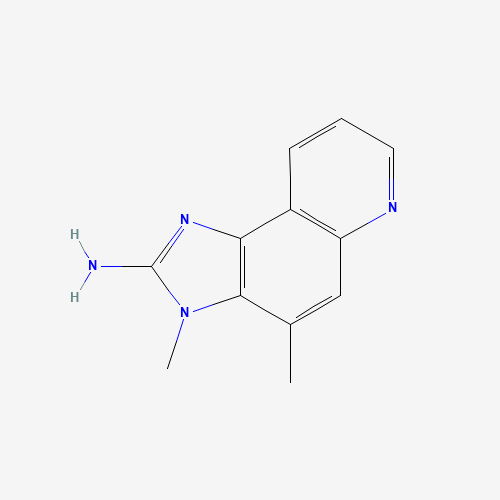
Toxicity
ToxicityFate Summary
ATMOSPHERIC FATE: According to a model of gas/particle partitioning of semivolatile organic compounds in the atmosphere(1), 2-amino-3,4-dimethylimidazo[4,5-f]quinoline, which has an estimated vapor pressure of 9.9X10⁻¹⁰ mm Hg at 25 °C(SRC), determined from a fragment constant method(2), will exist solely the particulate phase in the ambient atmosphere. Particulate-phase 2-amino-3,4-dimethylimidazo[4,5-f]quinoline may be removed from the air by wet or dry deposition(SRC). 2-Amino-3,4-dimethylimidazo[4,5-f]quinoline contains chromophores that absorb at wavelengths >290 nm(3) and therefore may be susceptible to direct photolysis by sunlight(SRC).
Soil Adsorption / Mobility
Using a structure estimation method based on molecular connectivity indices(1), the Koc of 2-amino-3,4-dimethylimidazo[4,5-f]quinoline can be estimated to be 10,000(SRC). According to a classification scheme(2), this estimated Koc value suggests that 2-amino-3,4-dimethylimidazo[4,5-f]quinolne is expected to be immobile in soil. The pKa values of 2-amino-3,4-dimethylimidazo[4,5-f]quinoline are estimated as pKa1 of 3.7 and pKa2 of 7.3(3), indicating that this compound will exist partially as a cation in the environment and cations generally absorb to soil containing organic carbon and clay more strongly than their neutral counterparts(4).
Environmental Bioconcentration
An estimated BCF of 9 was calculated in fish for 2-amino-3,4-dimethylimidazo[4,5-f]quinoline(SRC), using an estimated log Kow of 1.98(1) and a regression-derived equation(2). According to a classification scheme(3), this BCF suggests the potential for bioconcentration in aquatic organisms is low(SRC).
Volatilization from Water / Soil
The Henry's Law constant for 2-amino-3,4-dimethylimidazo[4,5-f]quinoxaline is estimated as 3.9X10⁻¹³ atm-cu m/mole(SRC) using a fragment constant estimation method(1). This Henry's Law constant indicates that 2-amino-3,4-dimethylimidazo[4,5-f]quinoxaline is expected to be essentially nonvolatile from water surfaces(2). 2-Amino-3,4-dimethylimidazo[4,5-f]quinoxaline is not expected to volatilize from dry soil surfaces(SRC) based upon an estimated vapor pressure of 9.9X10⁻¹⁰ mm Hg(SRC), determined from a fragment constant method(3).
Environmental Abiotic Degradation
2-Amino-3,4-dimethylimidazo[4,5-f]quinoline is not expected to undergo hydrolysis in the environment due to the lack of functional groups that hydrolyze under environmental conditions(1). 2-Amino-3,4-dimethylimidazo[4,5-f]quinoline contains chromophores that absorb at wavelengths >290 nm(1) and therefore may be susceptible to direct photolysis by sunlight(SRC).
Food Survey Values
2-Amino-3,4-dimethylimidazo[4,5-f]quinoline was detected in meat and chicken purchased from local Okayama, Japan markets, following cooking and analysis on the same day; concentrations in chicken, pork, well done beef and medium beef were 142, 86, 94 and 125 pg/g, respectively(1).
Ecotoxicity Excerpts
/AQUATIC SPECIES/ Marine sponges do not appear to suffer from neoplastic diseases, in spite of possible high exposures resulting from their nature as sessile bottom filter feeders which pump large volumes of sea water. The assessment of several parameters related to the biotransformation of mutagens/carcinogens showed that the metabolic machinery of sponge medulla cells is mainly oriented towards detoxification, with some differences depending on species (Geodia cydonium or Tethya aurantium) ... The metabolism of mutagens was investigated by using the Salmonella typhimurium his- strains TA100, TA98 and YG1024. Sponge S12 fractions failed to activate ... the two heterocyclic amines 3-amino-1-methyl-5H-pyrido[4,3-b]indole and 2-amino-3,4-dimethyl-imidazo[4,5-f]quinoline ...
Fish/Seafood Concentrations
2-Amino-3,4-dimethylimidazo[4,5-f]quinoline was detected in fish purchased from local Okayama, Japan markets, following cooking and analysis on the same day: in the skin and flesh of pacific saury 424 pg/g and not detected; in the skin and flesh of sardine at 317 pg/g and not detected; not detected in the skin and flesh of horse mackerel; in the skin and flesh of mackerel at 375 and 67 pg/g; in the skin and flesh of salmon at not detected and 180 pg/g; in the skin and flesh of salted atka mackerel at 435 and 98 pg/g; in seasoned eel skin and flesh at not detected and 318 pg/g; in semi-dried horse mackerel skin and flesh at 262 and 70 pg/g(1).
Probable Routes of Human Exposure
Limited occupational exposure to 2-amino-3,4-dimethylimidazo[4,5-f]quinoline may occur through inhalation and dermal contact with this compound at workplaces where 2-amino-3,4-dimethylimidazo[4,5-f]quinoline is produced or used. Monitoring data indicate that the general population may be exposed to 2-amino-3,4-dimethylimidazo[4,5-f]quinoline via ingestion of cooked food. (SRC)
Environmental Fate / Exposure Summary
2-Amino-3,4-dimethylimidazo[4,5-f]quinoline is formed and released in the cooking of fish, meat and chicken, resulting in its direct release to the environment. Its limited production and use for research purposes may result in its release to the environment through various waste streams. If released to air, an estimated vapor pressure of 9.9X10⁻¹⁰ mm Hg at 25 °C indicates 2-amino-3,4-dimethylimidazo[4,5-f]quinoline will exist solely in the particulate phase in the atmosphere. Particulate-phase 2-amino-3,4-dimethylimidazo[4,5-f]quinoline will be removed from the atmosphere by wet or dry deposition. 2-Amino-3,4-dimethylimidazo[4,5-f]quinoline contains chromophores that absorb at wavelengths >290 nm and therefore may be susceptible to direct photolysis by sunlight. If released to soil, 2-...
Interactions
Curcumin (C) and its natural analogues demethoxycurcumin (dmC) and bisdemethoxycurcumin (bdmC), known for their potent anti-inflammatory, antioxidant, antimutagenic, and anticarcinogenic effects, were tested for their possible inhibitory effects against seven cooked food mutagens (heterocyclic amines): 2-amino-3-methylimidazo[4,5-f]quinoline (IQ), 2-amino-3,4-dimethylimidazo[4,5-f]quinoline (MeIQ), 2-amino-3,8-dimethylimidazo[4,5-f]quinoxaline (MeIQx), 3-amino-1,4-dimethyl-5H-pyrido[4,3-b]indole (Trp-P-1), 3-amino-1-methyl-5H-pyrido[4,3-b]indole (Trp-P-2), 2-amino-1-methyl-6-phenylimidazo[4,5-b]pyridine (PhIP), and 2-amino-6-methyldipyrido[1,2-a:3',2'-d]imidazole (Glu-P-1), in both TA98 and TA100 strains of Salmonella typhimurium using Ames Salmonella/reversion assay in the presence of...
Adverse Effects
NTP Carcinogen - Reasonably anticipated to be a human carcinogen.
Human Toxicity Excerpts
/ALTERNATIVE and IN VITRO TESTS/ When incubated in suspension with the heterocyclic aromatic amine food mutagens 2-amino-3-methylimidazo [4,5-f]-quinoline (IQ) and 2-amino-3,4-dimethylimidazo[4,5-f]quinoline (MeIQ), human mammary epithelial cell aggregates were found, by (32P)-postlabelling analysis, to yield DNA that contained adducts. Analysis by HPLC of the (32P)-labelled digests of mammary cell DNA indicated that in each case a major adduct peak corresponded to that produced in DNA in vitro by activated derivatives of the two compounds. The patterns of adducts obtained when DNA digests were separated by TLC on polyethyleneimine-cellulose plates were found to resemble those previously shown to be present in DNA of tissues of mice fed IQ or MeIQ. These results demonstrate the ability...
Carcinogen Classification
IARC Monographs: Volume 56: (1993) Some Naturally Occurring Substances: Food Items and Constituents, Heterocyclic Aromatic Amines and Mycotoxins
Non-Human Toxicity Excerpts
/LABORATORY ANIMALS: Chronic Exposure or Carcinogenicity/ 2-Amino-3,4-dimethylimidazo[4,5-f]quinoline (MeIQ) induces cancers in the forestomach and liver, but not in the colon, of CDF1 male and female mice, which are thought to be resistant to induction of colon cancer by 1,2-dimethylhydrazine. In this study, we examined the carcinogenicity of MeIQ in C57BL/6N female mice, which are susceptible to 1,2-dimethylhydrazine. This strain of mice developed carcinomas of the cecum, colon, and liver, but not the forestomach, when given a diet containing 300 ppm of MeIQ. This fact indicates that the target organs of a chemical carcinogen change depending on the strain of a given animal species.
Evidence for Carcinogenicity
There is inadequate evidence in humans for the carcinogenicity of MeIQ. There is suffcient evidence in experimental animaIs for the carcinogenicity of MeIQ. Overall evaluation: MeIQ (2-Amino-3,4-dimethylimidazo(4,5-f)quinoline) is possibly carcinogenic to humans (Group 2B).
Antidote and Emergency Treatment
/SRP:/ Advanced treatment: Consider orotracheal or nasotracheal intubation for airway control in the patient who is unconscious, has severe pulmonary edema, or is in severe respiratory distress. Consider drug therapy for pulmonary edema ... . Positive-pressure ventilation techniques with a bag valve mask device may be beneficial. Consider drug therapy for pulmonary edema ... . Consider administering a beta agonist such as albuterol for severe bronchospasm ... . Monitor cardiac rhythm and treat arrhythmias if necessary ... Start IV administration of D5W /SRP: "To keep open", minimal flow rate/. Use 0.9% saline (NS) or lactated Ringer's (LR) if signs of hypovolemia are present. For hypotension with signs of hypovolemia, administer fluid cautiously. Watch for signs of fluid overload ... .T...