

 一键配货
一键配货
化合物详情
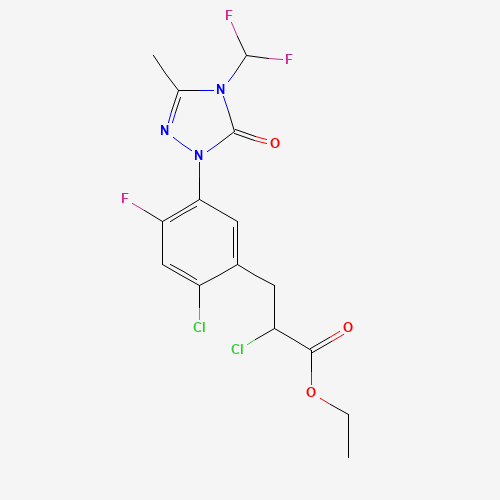
CAS128639-02-1
分子式C15H14Cl2F3N3O3
分子量412.191 g/mol
非危品
Ethyl 2-chloro-3-{2-chloro-5-[4-(difluoromethyl)-3-methyl-5-oxo-4,5-dihydro-1H-1,2,4-triazol-1-yl]-4-fluorophenyl}propanoate is an ethyl ester resulting from the formal condensation of the carboxy group of 2-chloro-3-{2-chloro-5-[4-(difluoromethyl)-3-methyl-5-oxo-4,5-dihydro-1H-1,2,4-triazol-1-yl]-4-fluorophenyl}propanoic acid with ethanol. It has a role as a proherbicide.
科学粮草官-词典编辑部,修订于:2026-07-06
Toxicity
ToxicityEPA Ecotoxicity
Pesticide Ecotoxicity Data from EPA: 88
Ecotoxicity Values
LD50; Species: /Apis mellifera/ (Bee) contact >200 ug/bee
Fate Summary
[Table#6856]: IkRheXMgYWZ0ZXIgYXBwbGljYXRpb24iLCIlQ0YtRSAocGhlbnlsLTE0QykiLCIlQ0YtQ0lQQWMgKHBoZW55bCAtMTRDKSIsIiVDRi1FICh0cmlhem9sZS0xNEMpIiwiJUNGLUNJUEFjICh0cmlhem9sZS0xNEMpIgoiU2lsdCBDbGF5IExvYW0gU2VkaW1lbnQiLCIiLCIiLCIiLCIiCiIwLjAiLCI2OC42IiwiOS4yIiwiODEuMiIsIjguNCIKIjAuMiIsIjI5LjAiLCI1MC4yIiwiMzguOCIsIjUxLjciCiIxIiwiNS42IiwiNzMuMiIsIjMuOCIsIjc5LjQiCiIzIiwiMS4yIiwiNzIuMSIsIjEuMyIsIjc4LjkiCiI3IiwiMC40IiwiNzcuNyIsIjAuOSIsIjc5LjYiCiIxNCIsIjAuNiIsIjYzLjciLCIwLjAiLCI0MC45IgoiMjEiLCIwLjAiLCI2NC4wIiwiMC4wIiwiNDUuMSIKIjMwIiwiMC4wIiwiNTIuOCIsIjAuMCIsIjQwLjIiCiJDbGF5IExvYW0gU2VkaW1lbnQiLCIiLCIiLCIiLCIiCiIwLjAiLCIzOC42IiwiNDYuMiIsIjczLjkiLCI3LjYiCiIwLjIiLCIxNC40IiwiNzIuNyIsIjQzLjMiLCIzNy44IgoiMSIsIjUuOSIsIjc5LjgiLCIxNy4yIiwiNjMuMyIKIjMiLCJuL2E7Iiwibi9hOyIsIjIuMCIsIjczLjkiCiI3IiwiMC44IiwiNzUuOCI...
Soil Adsorption / Mobility
A Koc value of 750 (pH not specified) and 15-35 at pH 5.5 have been reported(1). According to a classification scheme(2), these Koc values suggest that carfentrazone-ethyl is expected to have very high mobility in acid soil and low mobility in neutral or basic soils(SRC).
Environmental Biodegradation
ANAEROBIC: The half-life for the anaerobic metabolism of carfentrazone-ethyl in water has been reported as 0.3-0.8 days(1). Additional details were not provided.
Environmental Bioconcentration
An estimated BCF of 77 was calculated in fish for carfentrazone-ethyl(SRC), using a log Kow of 3.36(1) and a regression-derived equation(2). According to a classification scheme(3), this BCF suggests the potential for bioconcentration in aquatic organisms is moderate(SRC).
Volatilization from Water / Soil
The Henry's Law constant for carfentrazone-ethyl is estimated as 3.0X10⁻⁹ atm-cu m/mole(SRC) derived from its vapor pressure, 1.2X10⁻⁷ mm Hg(1), and water solubility, 22 mg/L(1). This Henry's Law constant indicates that carfentrazone-ethyl is expected to be essentially nonvolatile from moist soil or water surfaces(2). Carfentrazone-ethyl is not expected to volatilize from dry soil surfaces(SRC) based upon its vapor pressure(1).
Environmental Abiotic Degradation
The rate constant for the vapor-phase reaction of carfentrazone-ethyl with photochemically-produced hydroxyl radicals has been estimated as 5.0X10⁻¹² cu cm/molecule-sec at 25 °C(SRC) using a structure estimation method(1). This corresponds to an atmospheric half-life of about 3 days at an atmospheric concentration of 5X10+5 hydroxyl radicals per cu cm(1). Hydrolysis half-lives of 131 and 3.4 hours were measured for carfentrazone-ethyl at respective pHs of 7.09 and 9.09(2). Only 43% of the substance was hydrolyzed after 830 hours at pH 5.17(2). The primary hydrolysis degradation pathway for carfentrazone-ethyl is to carfentrazone-chloropropionic acid which is then further degraded to a series of acidic products(2). Carfentrazone-ethyl was considered largely stable to direct UV photosynth...
Food Survey Values
Carfentrazone-ethyl was not detected (detection limit 0.050 ppm) in commercially grown hops(1).
Plant Concentrations
Carfentrazone-ethyl was not detected (detection limit 0.002 mg/kg) in wheat grains 72 hours after field application of 60 or 120 g/100 sq m (g/hm2) of the pesticide(1).
Artificial Pollution Sources
Carfentrazone-ethyl's production may result in its release to the environment through various waste streams; its use as a herbicide(1) will result in its direct release to the environment(SRC).
Probable Routes of Human Exposure
Occupational exposure to carfentrazone-ethyl may occur through inhalation and dermal contact with this compound at workplaces where carfentrazone-ethyl is produced or used. (SRC)
Environmental Fate / Exposure Summary
Carfentrazone-ethyl's production may result in its release to the environment through various waste streams; its use as a herbicide will result in its direct release to the environment. If released to air, a vapor pressure of 1.2X10⁻⁷ mm Hg at 25 °C indicates carfentrazone-ethyl will exist in both the vapor and particulate phases in the atmosphere. Vapor-phase carfentrazone-ethyl will be degraded in the atmosphere by reaction with photochemically-produced hydroxyl radicals; the half-life for this reaction in air is estimated to be 3 days. Particulate-phase carfentrazone-ethyl will be removed from the atmosphere by wet and dry deposition. Carfentrazone-ethyl contains chromophores that absorb at wavelengths >290 nm and, therefore, may be susceptible to direct photolysis by sunlight. If re...
Treatment
Remove contaminated clothing and wash skin with soap and water. For eye exposure, copious irrigation with water or saline is used. The treatment is usually symptomatic and supportive.
Effect Level
collection=toxvaldb&kind=^EL$
Lethal Dose
collection=toxvaldb&kind=^LD$
Toxicity Data
LD50 (rat, oral) >5000 mg/kg LD50 (rat, dermal) >4000 mg/kg LC50 (rat, inhalation) >5.09 mg/L
Health Effects
Carfentrazone-ethyl is not considered to cause significant toxicity in helathy humans. But in patient with very large acute exposures or long-term chronic exposures, carfentrazone-ethyl may cause variegate porphyria or transient porphyria cutanea tarda-like syndrome. (L2125)
Adverse Effects
ACGIH Carcinogen - Not Classifiable.
Toxicity Summary
IDENTIFICATION AND USE: Carfentrazone-ethyl is a viscous yellow-orange liquid with a faint petroleum odor. It is registered for pesticide use in the U.S. but approved pesticide uses may change periodically and so federal, state and local authorities must be consulted for currently approved uses. It is used as a postemergent, contact herbicide for controlling broadleaf weeds; as a defoliant in cotton; and it provided a good control of hazelnut shoots. It is also used for turf and ornamentals. HUMAN EXPOSURE AND TOXICITY: There is no published data available on the toxicity in humans. ANIMAL STUDIES: Ninety-day subchronic feeding studies resulted in decreases in body weight, reductions in food consumption and histopathological lesions in rats; liver pathology in mice; and decrease in the...
Effect Concentration
collection=toxvaldb&kind=^EC$
RAIS Toxicity Values
Oral Chronic Reference Dose Reference: OPP
Other Toxicity Values
collection=toxvaldb&kind=^Other$
Carcinogen Classification
No indication of carcinogenicity to humans (not listed by IARC).
Non-Human Toxicity Values
LC50 Rat inhalation 5.09 mg/L/4 hr
Reference and Risk Values
collection=toxvaldb&kind=^RRV$
Non-Human Toxicity Excerpts
/LABORATORY ANIMALS: Subchronic or Prechronic Exposure/ A 90-day subchronic feeding study was conducted in rats at intake levels of 0, 58, 226, 470, 831 and 1197 mg/kg/day for males and 0, 72, 284, 578, 1008 and 1427 mg/kg/day in females, respectively. The NOEL was 226 mg/kg/day in males and 284 mg/kg/day in females. The LOEL was 470 mg/kg/day in males and 578 mg/kg/day in females based on decreases in body weight, reductions in food consumption and histopathological lesions.
Evidence for Carcinogenicity
Cancer Classification: Not Likely to be Carcinogenic to Humans
Antidote and Emergency Treatment
/SRP:/ Advanced treatment: Consider orotracheal or nasotracheal intubation for airway control in the patient who is unconscious, has severe pulmonary edema, or is in severe respiratory distress. Positive-pressure ventilation techniques with a bag-valve-mask device may be beneficial. Consider drug therapy for pulmonary edema ... . Monitor cardiac rhythm and treat arrhythmias if necessary ... . Start IV administration of D5W /SRP: "To keep open", minimal flow rate/. Use 0.9% saline (NS) or lactated Ringer's (LR) if signs of hypovolemia are present. For hypotension with signs of hypovolemia, administer fluid cautiously. Consider vasopressors if patient is hypotensive with a normal fluid volume. Watch for signs of fluid overload ... . Use proparacaine hydrochloride to assist eye irrigation...