


 一键配货
一键配货
化合物详情
CAS63041-90-7
分子式C20H11NO2
分子量297.3068 g/mol
非危品
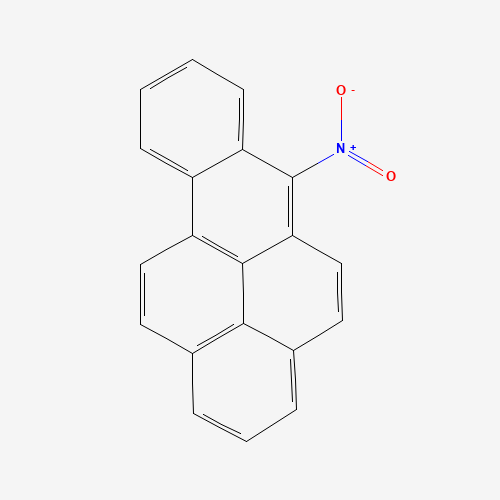
6-Nitrobenzo[a]pyrene is an ortho- and peri-fused polycyclic arene.
科学粮草官-词典编辑部,修订于:2026-07-06
Toxicity
ToxicityFate Summary
ATMOSPHERIC FATE: According to a model of gas/particle partitioning of semivolatile organic compounds in the atmosphere(1), 6-nitrobenzo[a]pyrene, which has an estimated vapor pressure of 1.0X10⁻¹⁰ mm Hg at 25 °C(SRC), determined from a fragment constant method(2), is expected to exist solely in the particulate phase in the ambient atmosphere. Two atmospheric monitoring studies that looked for 6-nitrobenzo[a]pyrene in both the gas and particulate phases detected it only in the particulate phase(3,4). 6-Nitrobenzo[a]pyrene is susceptible to direct photolysis in sunlight(5-7). When adsorbed onto various substrates (such as alumina, silica, cellulose, diesel soots), 6-nitrobenzo[a]pyrene can photodegrade rapidly when exposed to solar irradiation(5,7). In chamber studies, 6-nitrobenzo[a]pyr...
Soil Adsorption / Mobility
Using a structure estimation method based on molecular connectivity indices(1), the Koc of 6-nitrobenzo[a]pyrene can be estimated to be 9.5X10+5(SRC). According to a classification scheme(2), this estimated Koc value suggests that 6-nitrobenzo[a]pyrene is expected to be immobile in soil.
Environmental Biodegradation
PURE CULTURE: Incubation of 6-nitrobenzo[a]pyrene with the fungus Cunninghamella elegans for periods ranging from 1 to 7 days resulted in degradation of the 6-nitrobenzo[a]pyrene to metabolites identified as glucoside and sulfate conjugates of 1- and 3-hydroxy 6-nitrobenzo[a]pyrene(1); 62% of initial 6-nitrobenzo[a]pyrene was metabolized within 168 hours(1). Nitro-substituted PAHs are only slowly degraded by indigenous microorganisms and may persist in soils and sediments(2); the recalcitrance of high molecular weight nitro-PAHs is due in part to the strong adsorption to soil organic matter, low solubility, large molecular size and the polar character of the nitro group(2).
Environmental Bioconcentration
An estimated BCF of 1800 was calculated in fish for 6-nitrobenzo[a]pyrene(SRC), using a log Kow of 5.44(1) and a regression-derived equation(2). According to a classification scheme(3), this BCF suggests the potential for bioconcentration in aquatic organisms is very high(SRC), provided the compound is not metabolized by the organism(SRC).
Volatilization from Water / Soil
The Henry's Law constant for 6-nitrobenzo[a]pyrene is estimated as 3.2X10⁻⁹ atm-cu m/mole(SRC) using a fragment constant estimation method(1). This Henry's Law constant indicates that 6-nitrobenzo[a]pyrene is expected to be essentially nonvolatile from water surfaces(2). 6-Nitrobenzo[a]pyrene's Henry's Law constant indicates that volatilization from moist soil surfaces is not expected to occur(SRC). 6-Nitrobenzo[a]pyrene is not expected to volatilize from dry soil surfaces(SRC) based upon an estimated vapor pressure of 1.0X10⁻¹⁰ mm Hg(SRC), determined from a fragment constant method(1).
Environmental Abiotic Degradation
The rate constant for the vapor-phase reaction of 6-nitrobenzo[a]pyrene with photochemically-produced hydroxyl radicals has been estimated as 6.2X10⁻¹² cu cm/molecule-sec at 25 °C(SRC) using a structure estimation method(1). This corresponds to an atmospheric half-life of about 2.6 days at an atmospheric concentration of 5X10+5 hydroxyl radicals per cu cm(1). 6-Nitrobenzo[a]pyrene contains chromophores, such as benzo[a]pyrene, that absorb strongly at wavelengths >290 nm(2) and, therefore, is susceptible to direct photolysis by sunlight(SRC). In dimethyl sulfoxide solution, 6-nitrobenzo[a]pyrene degraded by approximately 5% when irradiated with UV-light at 312 nm for 6 hours(3). Smog chamber experiments demonstrated that 6-nitrobenzo[a]pyrene degraded much more rapidly when irradiated wi...
Effluent Concentrations
6-Nitrobenzo[a]pyrene was emitted in the exhaust from a modern day EURO IV heavy duty diesel engine as a result of formation of 6-nitrobenzo[a]pyrene by nitration of pre-existing PAH(1). 6-Nitrobenzo[a]pyrene was detected in the particulate material emitted from the exhaust of 1978 Volkswagen Rabit diesel engine(2). 6-Nitrobenzo[a]pyrene has been detected in diesel soot (14 mg/kg), diesel-powered car exhaust particulates (50 mg/kg) and gasoline-powered car emissions (0.21-32.8 mg/kg)(3). The rates of emission of 6-Nitrobenzo[a]pyrene in automobile exhaust have been reported to be 1.46 ug/mile for a gasoline-powered car with a precatalyst engine running on leaded fuel, 0.45 ug/mile for an engine with the catalyst removed running on unleaded fuel and 0.012 ug/mile for a gasoline-powered e...
Atmospheric Concentrations
RURAL/REMOTE: Gaseous and pariculate samples collected in late autumn of 2010 from Wanqingsha, a rural site in the Pearl River Delta region, China, contained an average 6-nitrobenzo[a]pyrene concentration of 63 pg/cu m in the particule samples and 0 pg/cu m in the gaseous samples(1). 6-Nitrobenzo[a]pyrene was detected in air samples collected in two French alpine valleys(2).
Artificial Pollution Sources
6-Nitrobenzo[a]pyrene's limited production and use in laboratory applications(1) may result in its release to the environment through various waste streams. 6-Nitrobenzo[a]pyrene and other nitrated-polycyclic aromatic hydrocarbons (nitro-PAHs) may be present in the atmosphere due to direct emission from sources such as diesel and gasoline exhaust and through atmospheric reaction of parent PAHs with nitrogen oxides and nitrate radicals(2). Nitro-PAHs are formed through incomplete combustion of fossil fuels like coal and oil and through pyrolysis of organic materials and may be emitted from cars, factories and oil and coal stoves(3). 6-Nitrobenzo[a]pyrene is emitted in the exhaust of modern day EURO IV heavy duty diesel engines via formation of 6-nitrobenzo[a]pyrene by nitration of pre-ex...
Sediment/Soil Concentrations
SEDIMENT: Coastal sediments collected offshore from Barcelona, Spain, contained 6-nitrobenzo[a]pyrene concentrations of 0.34 g/kg dry weight in sediment from urban littoral stations(1).
Probable Routes of Human Exposure
Occupational exposure to 6-nitrobenzo[a]pyrene may occur through inhalation of particulates and dermal contact with this compound at workplaces where exposure to exhaust from diesel engines, industrial stack emissions or emissions from other combustion sources occur(SRC). Monitoring data indicate that the general population may be exposed to 6-nitrobenzo[a]pyrene via inhalation of ambient air. (SRC)
Other Environmental Concentrations
Toners for photocopy machines prior to 1980 contained total nitropyrene levels (which include 6-nitrobenzo[a]pyrene) of 5-100 mg/kg to below 0.3 mg/k(1); due to changes in production techniques after 1980, toners had no detectable levels(1).
Environmental Fate / Exposure Summary
6-Nitrobenzo[a]pyrene's limited production and use in laboratory applications may result in its release to the environment through various waste streams. 6-Nitrobenzo[a]pyrene and other nitrated-polycyclic aromatic hydrocarbons (nitro-PAHs) may be present in the atmosphere due to direct emission from sources such as diesel and gasoline exhaust and through atmospheric reaction of parent PAHs with nitrogen oxides and nitrate radicals. Nitro-PAHs are formed through incomplete combustion of fossil fuels like coal and oil and through pyrolysis of organic materials and may be emitted from cars, factories and oil and coal stoves. If released to air, an estimated vapor pressure of 1.0X10⁻¹⁰ mm Hg at 25 °C indicates 6-nitrobenzo[a]pyrene will exist solely in the particulate phase in the atmosphe...
Human Toxicity Excerpts
/OTHER TOXICITY INFORMATION/ Questionable carcinogen.
Carcinogen Classification
IARC Monographs: Volume 46: (1989) Diesel and Gasoline Engine Exhausts and Some Nitroarenes
Non-Human Toxicity Excerpts
/GENOTOXICITY/ The mononitro-substituted isomers of benzo[a]pyrene (B[a]P), 1-, 3- and 6-nitrobenzo[a]pyrene (NB[a]P), are environmental pollutants and are metabolized to mutagens in Salmonella by rat-liver homogenate postmitochondrial supernatant (S9) fractions. In this study, activation of these compounds to mutagens was investigated using the hepatocyte-mediated Salmonella mutagenicity assay. Hepatocytes from rats treated with Aroclor 1254 activated both 3-NB[a]P and 1-NB[a]P to mutagens, while 6-NB[a]P was not mutagenic. The positive mutagenicity responses were functions of both the chemical dose and the hepatocyte concentration. By using a nitroreductase-deficient strain (TA98NR) and a transesterificase-deficient strain (TA98/1,8-DNP6), it was verified that the direct-acting mutage...
Evidence for Carcinogenicity
Evaluation: There is limited evidence for the carcinogenicity in experimental animals of 6-nitrobenzo(a)pyrene. No data were available from studies in humans on the carcinogenicity of 6-nitrobenzo(a)pyrene. Overall evaluation: 6-Nitrobenzo(a)pyrene is not classifiable as to its carcinogenicity to humans (Group 3).
Antidote and Emergency Treatment
/SRP:/ Advanced treatment: Consider orotracheal or nasotracheal intubation for airway control in the patient who is unconscious, has severe pulmonary edema, or is in severe respiratory distress. Positive-pressure ventilation techniques with a bag valve mask device may be beneficial. Consider drug therapy for pulmonary edema ... . Consider administering a beta agonist such as albuterol for severe bronchospasm ... . Monitor cardiac rhythm and treat arrhythmias as necessary ... . Start IV administration of D5W /SRP: "To keep open", minimal flow rate/. Use 0.9% saline (NS) or lactated Ringer's if signs of hypovolemia are present. For hypotension with signs of hypovolemia, administer fluid cautiously. Watch for signs of fluid overload ... . Treat seizures with diazepam or lorazepam ... . Use...









