


 一键配货
一键配货
化合物详情
CAS107-46-0
分子式C6H18Si2O
分子量162.38 g/mol g/mol
危化品
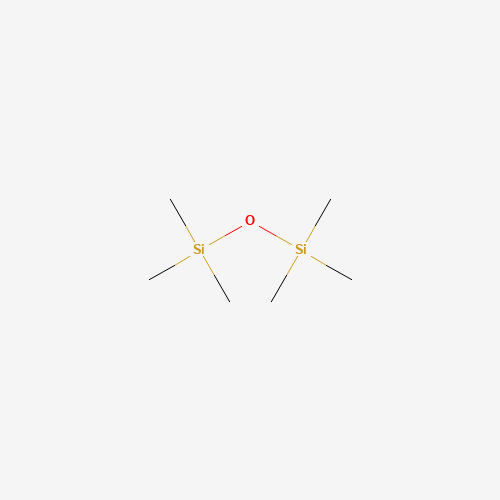
Hexamethyldisiloxane is an organosiloxane consisting of two trimethylsilyl groups covalently bound to a central oxygen.
科学粮草官-词典编辑部,修订于:2026-07-06
Toxicity
ToxicityEcotoxicity Values
LC50 Oncorhynchus mykiss (rainbow trout) ca 3.02 mg/L/96 hr, flow-through bioassay
Fate Summary
ATMOSPHERIC FATE: According to a model of gas/particle partitioning of semivolatile organic compounds in the atmosphere(1), hexamethyldisiloxane, which has a vapor pressure of 42.1 mm Hg at 25 °C(2), is expected to exist solely as a vapor in the ambient atmosphere. Vapor-phase hexamethyldisiloxane is degraded in the atmosphere by reaction with photochemically-produced hydroxyl radicals(SRC); the half-life for this reaction in air is estimated to be 18 days(SRC), calculated from its rate constant of 1.4x10⁻¹² cu cm/molecule-sec at 25 °C(3). Methyl siloxanes are transparent to UV radiation >290 nm(4) and therefore hexamethyldisiloxane is not expected to undergo direct photolytic degradation(SRC).
Soil Adsorption / Mobility
The Koc of hexamethyldisiloxane is estimated as 4,600(SRC), using a log Kow of 4.2(1) and a regression-derived equation(2). According to a classification scheme(3), this estimated Koc value suggests that hexamethyldisiloxane is expected to have slight mobility in soil.
Environmental Biodegradation
AEROBIC: No biodegradation data regarding hexamethyldisiloxane were found(SRC, 2006); however dimethyl siloxanes in general are highly resistant to biodegradation(1). As a member of this class biodegradation is not expected to be an important fate process.
Environmental Bioconcentration
An estimated BCF of 340 was calculated for hexamethyldisiloxane(SRC), using a log Kow of 4.2(1) and a regression-derived equation(2). According to a classification scheme(3), this BCF suggests the potential for bioconcentration in aquatic organisms is high(SRC), provided the compound is not metabolized by the organism(SRC).
Volatilization from Water / Soil
The Henry's Law constant for hexamethyldisiloxane is 0.0453 atm-cu m/mole(1). This Henry's Law constant indicates that hexamethyldisiloxane is expected to volatilize rapidly from water surfaces(2). Based on this Henry's Law constant, the volatilization half-life from a model river (1 m deep, flowing 1 m/sec, wind velocity of 3 m/sec)(2) is estimated as 1.3 hours(SRC). The volatilization half-life from a model lake (1 m deep, flowing 0.05 m/sec, wind velocity of 0.5 m/sec)(2) is estimated as 5 days(SRC). However, volatilization from water surfaces is expected to be attenuated by adsorption to suspended solids and sediment in the water column. The estimated volatilization half-life from a model pond is 30 days if adsorption is considered(3). Hexamethyldisiloxane's Henry's Law constant ind...
Environmental Abiotic Degradation
The rate constant for the vapor-phase reaction of hexamethyldisiloxane with photochemically-produced hydroxyl radicals has been reported as 1.4X10⁻¹² cu cm/molecule-sec at 25 °C(1). This corresponds to an atmospheric half-life of about 18 days at an atmospheric concentration of 5X10+5 hydroxyl radicals per cu cm(1). Polydimethylsiloxane fluids undergo siloxane bond rearrangement to form low molecular weight linear and cyclic oligomers that are water soluble(2), indicating that hydrolysis of hexamethyldisiloxane may be an important environmental fate process leading to products that will predominantly partition into the atmosphere. Methyl siloxanes are transparent to UV radiation >290 nm(3) and therefore hexamethyldisiloxane is not expected to undergo direct photolytic degradation(SRC).
Effluent Concentrations
Hexamethyldisiloxane was detected in two separate domestic waste sites in Munich Germany at concentrations of 0.01 and 0.31-0.45 mg/cu m(1). Hexamethyldisiloxane was also detected in the respective sewage treatment plants at concentrations of 0.14-0.17 and 0.18-0.20 mg/cu m, respectively(1).
Atmospheric Concentrations
SOURCE DOMINATED: Hexamethyldisiloxane was detected but not quantified in volatile chemical emissions from sponge rubber, bonded urethane and prime urethane carpet cushions(1).
Artificial Pollution Sources
Hexamethyldisiloxane's production and use as a chemical intermediate in the synthesis of silicone fluids, elastomers and fluorosilicone oils as well as in photolithography(1), personal care products and cosmetics(2) may result in its release to the environment through various waste streams(SRC).
Probable Routes of Human Exposure
NIOSH (NOES Survey 1981-1983) has statistically estimated that 14,234 workers may be exposed to hexamethyldisiloxane in the US(1). Occupational exposure to hexamethyldisiloxane may occur through inhalation and dermal contact with this compound at workplaces where hexamethyldisiloxane is produced or used(SRC). The most likely pathway by which the general public is exposed to hexamethyldisiloxane is by inhalation and dermal contact when personal care products and cosmetics containing this substance are used(SRC).
Other Environmental Concentrations
Hexamethyldisiloxane was detected but not quantified in volatile chemical emissions from sponge rubber, bonded urethane and prime urethane carpet cushions(1). Hexamethyldisiloxane was detected but not quantified in emissions from new carpet vapors(2).
Environmental Fate / Exposure Summary
Hexamethyldisiloxane's production and use as a chemical intermediate in the synthesis of silicone fluids, elastomers and fluorosilicone oils as well as in photolithography, personal care products and cosmetics may result in its release to the environment through various waste streams. If released to air, a vapor pressure of 42.1 mm Hg at 25 °C indicates hexamethyldisiloxane will exist solely as a vapor in the atmosphere. Vapor-phase hexamethyldisiloxane will be degraded in the atmosphere by reaction with photochemically-produced hydroxyl radicals; the half-life for this reaction in air is estimated to be 18 days. Methyl siloxanes are transparent to UV radiation >290 nm, and therefore hexamethyldisiloxane is not expected to undergo direct photolytic degradation. If released to soil, hexa...
Interactions
... Hexamethyldisiloxane (HMDS) coadministered with ethinyl estradiol (EE) did produce a small, but statistically significant reduction in uterine weight compared to EE alone.
Toxicity Data
LC50 (rat) = 15,956 ppm/4h
Adverse Effects
Occupational hepatotoxin - Secondary hepatotoxins: the potential for toxic effect in the occupational setting is based on cases of poisoning by human ingestion or animal experimentation.
Human Toxicity Excerpts
/OTHER TOXICITY INFORMATION/ Vapors have a very low toxicity for ... humans. ... /it/ irritates conjunctiva but does not attack the cornea.
Non-Human Toxicity Values
LD50 Mouse ip 4500 mg/kg
Antidote and Emergency Treatment
Advanced treatment: Consider orotracheal or nasotracheal intubation for airway control in the patient who is unconscious, has severe pulmonary edema, or is in severe respiratory distress. Early intubation at the first sign of upper airway obstruction may be necessary. Positive-pressure ventilation techniques with a bag valve mask device may be beneficial. Consider drug therapy for pulmonary edema ... . Monitor cardiac rhythm and treat arrhythmias if necessary ... . Start IV administration of D5W /SRP: "To keep open", minimal flow rate/. Use 0.9% saline (NS) or lactated Ringer's if signs of hypovolemia are present. For hypotension with signs of hypovolemia, administer fluid cautiously. Watch for signs of fluid overload ... .Treat seizures with diazepam or lorazepam ... Use proparacaine h...









