


 一键配货
一键配货
化合物详情
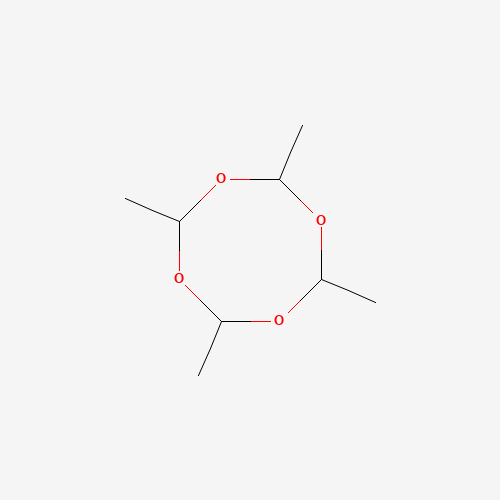
CAS108-62-3
分子式C8H16O4
分子量176.21 g/mol g/mol
危化品
Physical Description | Metaldehyde is a white-colored crystalline solid. It is insoluble in water. It is highly flammable and when ignited will give off irritating fumes. It may be toxic by ingestion and is very irritating to skin and eyes. It is used to make other chemicals.
科学粮草官-词典编辑部,修订于:2026-07-06
Toxicity
ToxicityEPA Ecotoxicity
Pesticide Ecotoxicity Data from EPA: 52
Ecotoxicity Values
LD50; Species: /Coturnix japonica/ (Japanese quail) single oral dose 181 mg/kg
Fate Summary
ATMOSPHERIC FATE: According to a model of gas/particle partitioning of semivolatile organic compounds in the atmosphere(1), metaldehyde, which has a vapor pressure of 5.0X10⁻² mm Hg at 25 °C(2), is expected to exist solely as a vapor in the ambient atmosphere. Vapor-phase metaldehyde is degraded in the atmosphere by reaction with photochemically-produced hydroxyl radicals(SRC); the half-life for this reaction in air is estimated to be 13 hours(SRC), calculated from its rate constant of 2.9X10⁻¹¹ cu cm/molecule-sec at 25 °C(SRC) that was derived using a structure estimation method(3). Metaldehyde does not contain chromophores that absorb at wavelengths >290 nm(4) and therefore is not expected to be susceptible to direct photolysis by sunlight(SRC).
Soil Adsorption / Mobility
The Koc of metaldehye is measured as 240(1). According to a classification scheme(2), this Koc value suggests that metaldehyde is expected to have moderate mobility in soil.
Environmental Biodegradation
ANAEROBIC: Under anaerobic conditions, the half-life of metaldehyde has been reported as greater than 200 days(1).
Environmental Bioconcentration
An estimated BCF of 3.2 was calculated for metaldehyde(SRC), using a log Kow of 0.12(1) and a regression-derived equation(2). According to a classification scheme(3), this BCF suggests the potential for bioconcentration in aquatic organisms is low(SRC).
Volatilization from Water / Soil
The Henry's Law constant for metaldehyde is estimated as 5.2X10⁻⁵ atm-cu m/mole(SRC) derived from its vapor pressure, 5.0X10⁻² mm Hg(1), and water solubility, 2.22X10+2 mg/L(1). This Henry's Law constant indicates that metaldehyde is expected to volatilize from water surfaces(2). Based on this Henry's Law constant, the volatilization half-life from a model river (1 m deep, flowing 1 m/sec, wind velocity of 3 m/sec)(2) is estimated as 26 hours(SRC). The volatilization half-life from a model lake (1 m deep, flowing 0.05 m/sec, wind velocity of 0.5 m/sec)(2) is estimated as 12 days(SRC). Metaldehyde's estimated Henry's Law constant indicates that volatilization from moist soil surfaces may occur(SRC). Metaldehyde is not expected to volatilize from dry soil surfaces(SRC) based upon its vapo...
Environmental Abiotic Degradation
The rate constant for the vapor-phase reaction of metaldehyde with photochemically-produced hydroxyl radicals has been estimated as 2.9X10⁻¹¹ cu cm/molecule-sec at 25 °C(SRC) using a structure estimation method(1). This corresponds to an atmospheric half-life of about 13 hours at an atmospheric concentration of 5X10+5 hydroxyl radicals per cu cm(1). Metaldehyde is expected to undergo hydrolysis in the environment since this compound contains functional groups that hydrolyze under environmental conditions(2). Metaldehyde does not contain chromophores that absorb at wavelengths >290 nm(2) and therefore is not expected to be susceptible to direct photolysis by sunlight(SRC).
Ecotoxicity Excerpts
/FIELD STUDIES/ Over two years, six consecutive field experiments were done in which the chemical molluscicide metaldehyde and the nematode biocontrol agent Phasmarhabditis hermaphrodita (Schneider) were applied at the standard field rates to replicated mini-plots successively planted with lettuce, Brussels sprouts, leaf beet, and cabbage, to compare the effectiveness of different treatments in reducing slug damage to the crops. Soil samples from each plot were taken prior to the start of the experiments, and then monthly, to assess the populations of slugs, snails, earthworms, nematodes, acarids and collembolans. The experiments were done on the same site and each plot received the same treatment in the six experiments. The six treatments were: (1) untreated controls, (2) metaldehyde p...
Artificial Pollution Sources
Metaldehyde's production may result in its release to the environment through various waste streams; its use as a molluscicide(1) will result in its direct release to the environment(SRC).
Probable Routes of Human Exposure
...EMITTED VAPORS /FROM METALDEHYDE USED AS A FUEL/ ARE ALSO SOURCE OF POISONING IN SITUATIONS WHERE POOR VENTILATION EXISTS.
Environmental Fate / Exposure Summary
Metaldehyde's production may result in its release to the environment through various waste streams; its use as a molluscicide will result in its direct release to the environment. If released to air, a vapor pressure of 5.0X10⁻² mm Hg at 25 °C indicates metaldehyde will exist solely as a vapor in the atmosphere. Vapor-phase metaldehyde will be degraded in the atmosphere by reaction with photochemically-produced hydroxyl radicals; the half-life for this reaction in air is estimated to be 13 hours. Metaldehyde does not contain chromophores that absorb at wavelengths >290 nm and therefore is not expected to be susceptible to direct photolysis by sunlight. If released to soil, metaldehyde is expected to have moderate mobility based upon a measured Koc of 240. Volatilization from moist soil...
Symptoms
Ingestion is the most common route of metaldehyde poisoning. One to three hours after ingestion the following can occur: severe abdominal pain, nausea, salivation, vomiting, facial flushing, gastroenteritis, diarrhoea, metabolic acidosis, a marked rise in body temperature, drowsiness, convulsions, muscular rigidity, spasms, rhabdomyolysis and coma. Pulse and respiratory rate become progressively slower. Liver and kidney injury occurs at a later stage. Metaldehyde fumes may cause somnolence, uncoordinated movements, nausea, dizziness, CNS-depression, convulsions, and coma. Metaldehyde is also irritant to eyes and skin. (L1787)
Treatment
Measures to eliminate the substance from the gastrointestinal tract should be especially emphasized because metaldehyde is slowly absorbed and eliminated in the gastrointestinal tract. There is no specific antidote. (L1787)
Interactions
In mice intraperitoneal administration of 10 mg/kg bw diazepam or 0.5 mg/kg clonidine hydrochloride decreased the toxicity of an oral dose of 100 mg metaldehyde/kg bw administered 20 min previously. A dose of 0.5 mg diazepam/kg bw was without protective effect.
Toxicity Data
LD50: 630 mg/kg (Oral, Rat) (L1782) LD50: 600 mg/kg (Oral, Dog) (L1782)
Health Effects
Metaldehyde intoxicatin leads to central nervous system depression, and liver and kidney injury. Death from respiratory failure can occur within a few hours of exposure. (L1787)
Adverse Effects
Occupational hepatotoxin - Secondary hepatotoxins: the potential for toxic effect in the occupational setting is based on cases of poisoning by human ingestion or animal experimentation.
Exposure Routes
Oral (L1782); inhalation (L1782); dermal (L1782)
Toxicity Summary
The toxicologically active substance in metaldehyde intoxication is mainly the degradation product acetaldehyde; other toxic products are probably also formed. Acetaldehyde acts as a releasing factor for 5-hydroxytryptamine (5-HT) and noradrenaline (NA). It also competitively inhibits biogenic amine oxidation which, in turn, decreases 5-hydroxyindoleacetic acid (5-HIAA), a metabolite of 5-HT by competitively inhibiting 5-HT-oxidation. Acetaldehyde also increases monoamine oxidase activity and decreases central serotonin levels. (L1782)
RAIS Toxicity Values
Oral Chronic Reference Dose Reference: OPP
Human Toxicity Values
The relation between the dose ingested and the clinical consequences is: trace (few): salivation, facial flushing, fever, abdominal cramps, nausea, vomiting; up to 50 mg/kg: drowsiness, tachycardia, spasms, irritability, salivation, abdominal cramps, facial flushing, nausea; 50 to 100 mg/kg: ataxia, increased muscle tone; 100 to 150 mg/kg: convulsions, tremor, hyperreflexia; 150 to 200 mg/kg: muscle twitching; 400 mg/kg: coma, death.
Human Toxicity Excerpts
/SIGNS AND SYMPTOMS/ Several incidents of metaldehyde exposure are reported in literature. Ingestion of slug-bait pellets by children accounts for the majority of the incidents reported in the United States of America between 1966-1980. In Europe, human poisonings are also associated with voluntary ingestion of tablets intended for use as fuel. Appearance of symptoms might be delayed a few hours after ingestion. Survivors of severe poisoning showed loss of memory which lasted for up to a year. Laboratory findings included acid urine despite alkali therapy and elevated serum transaminase activities. At autopsy, the main findings were fatty degeneration with zonal necrosis of the liver and swelling and desquamation of the renal tubular epithelium.
Carcinogen Classification
No indication of carcinogenicity to humans (not listed by IARC).
Non-Human Toxicity Values
LD50 Rat dermal > 5000 mg/kg
Non-Human Toxicity Excerpts
/LABORATORY ANIMALS: Chronic Exposure or Carcinogenicity/ Dogs fed metaldehyde exhibited emesis, depression, incoordination, hypernea, tachycardia, prostration, and cyanosis. Autopsy findings included congestion of the kidneys and liver. The lung tissue showed interstitial hemorrhaging, and the ganglion cells of the brain demonstrated degeneration processes. Similar signs of toxicity are seen in cats but nystagmus is also seen.
Populations at Special Risk
Occupationally exposed populations: gardeners
Antidote and Emergency Treatment
/VET/ Treatment is most effective if initiated early. Further toxicant absorption should be prevented by induced emesis, gastric lavage, and oral dosing with activated charcoal. Hyperesthesia and muscle activity may be controlled with diazepam at 2-5 mg, lV, or light barbiturate anesthesia and muscle relaxants as needed. IV fluid therapy with lactated Ringer's solution or 5% glucose should be aggressive to promote toxin excretion and to combat dehydration and the acidosis induced by the excessive muscle activity. Continuous supportive care is important. Prognosis is heavily determined by the exposure dose, but if death does not occur earlier, animals poisoned by metaldehyde may show clinical improvement 24-36 hr after initial onset of signs.









