


 一键配货
一键配货
化合物详情
CAS105-16-8
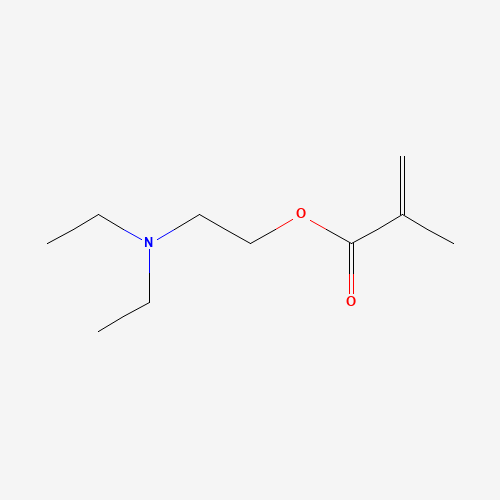
分子式H2C=C(CH3)CO2CH2CH2N(C2H5)2
分子量185.26 g/mol g/mol
危化品
Physical Description | Diethylaminoethylmethacrylate, [liquid] appears as a clear light colored liquid. Insoluble in water and slightly denser than water. May be toxic by ingestion. Contact may severely irritate skin.
科学粮草官-词典编辑部,修订于:2026-07-06
Toxicity
ToxicityFate Summary
ATMOSPHERIC FATE: According to a model of gas/particle partitioning of semivolatile organic compounds in the atmosphere(1), 2-(N,N-diethylamino)ethyl methacrylate, which has an estimated vapor pressure of 0.11 mm Hg at 25 °C(SRC), determined from a fragment constant method(2), is expected to exist solely as a vapor in the ambient atmosphere. Vapor-phase 2-(N,N-diethylamino)ethyl methacrylate is degraded in the atmosphere by reaction with photochemically-produced hydroxyl radicals(SRC); the half-life for this reaction in air is estimated to be 3.4 hours(SRC), calculated from its rate constant of 1.1X10⁻¹⁰ cu cm/molecule-sec at 25 °C(SRC) that was derived using a structure estimation method(2). Vapor-phase 2-(N,N-diethylamino)ethyl methacrylate is also degraded in the atmosphere by reacti...
Soil Adsorption / Mobility
Using a structure estimation method based on molecular connectivity indices(1), the Koc of 2-(N,N-diethylamino)ethyl methacrylate can be estimated to be 71(SRC). According to a classification scheme(2), this estimated Koc value suggests that 2-(N,N-diethylamino)ethyl methacrylate is expected to have high mobility in soil. The estimated pKa of 2-(N,N-diethylamino)ethyl methacrylate is 8.96(3), indicating that this compound will exist mostly in the cation form in the environment and cations generally adsorb more strongly to soils containing organic carbon and clay than their neutral counterparts(4).
Environmental Biodegradation
AEROBIC: -(N,N-Diethylamino)ethyl methacrylate, present at 100 mg/L, reached 70% of its theoretical BOD in 4 weeks using an activated sludge inoculum at 30 mg/L in the Japanese MITI test which classified the compound as readily biodegradable(1); it was also reported that the 2-(N,N-diethylamino)ethyl methacrylate hydrolyzed in water to form methacrylic acid and 2-diethylaminoethanol(1).
Environmental Bioconcentration
An estimated BCF of 9 was calculated in fish for 2-(N,N-diethylamino)ethyl methacrylate(SRC), using an estimated log Kow of 1.95(1) and a regression-derived equation(1). According to a classification scheme(2), this BCF suggests the potential for bioconcentration in aquatic organisms is low(SRC).
Volatilization from Water / Soil
The Henry's Law constant for 2-(N,N-diethylamino)ethyl methacrylate is estimated as 2.1X10⁻⁷ atm-cu m/mole(SRC) using a fragment constant estimation method(1). This Henry's Law constant indicates that 2-(N,N-diethylamino)ethyl methacrylate is expected to be essentially nonvolatile from water surfaces(2). 2-(N,N-Diethylamino)ethyl methacrylate's Henry's Law constant indicates that volatilization from moist soil surfaces is not expected to occur(SRC). 2-(N,N-Diethylamino)ethyl methacrylate may volatilize from dry soil surfaces(SRC) based upon an estimated vapor pressure of 0.11 mm Hg(SRC), determined from a fragment constant method(1).
Environmental Abiotic Degradation
The rate constant for the vapor-phase reaction of 2-(N,N-diethylamino)ethyl methacrylate with photochemically-produced hydroxyl radicals has been estimated as 1.1X10⁻¹⁰ cu cm/molecule-sec at 25 °C(SRC) using a structure estimation method(1). This corresponds to an atmospheric half-life of about 3.4 hours at an atmospheric concentration of 5X10+5 hydroxyl radicals per cu cm(1). The rate constant for the vapor-phase reaction of 2-(N,N-diethylamino)ethyl methacrylate with ozone has been estimated as 1.1X10⁻¹⁷ cu cm/molecule-sec at 25 °C(SRC) that was derived using a structure estimation method(1). This corresponds to an atmospheric half-life of about 24 hours at an atmospheric concentration of 7X10+11 ozone molecules per cu cm(1). Based on analogy to a measured nitrate radical rate constan...
Artificial Pollution Sources
2-(N,N-Diethylamino)ethyl methacrylate's production and use as an intermediate for chemical synthesis and as a monomer in the production of a variety of copolymers and homopolymers(1) may result in its release to the environment through various waste streams(SRC).
Probable Routes of Human Exposure
Occupational exposure to 2-(N,N-diethylamino)ethyl methacrylate may occur through inhalation and dermal contact with this compound at workplaces where 2-(N,N-diethylamino)ethyl methacrylate is produced or used(SRC). Based on analogy to the very similar 2-(N,N-dimethylamino)ethyl methacrylate(1), the general population may be exposed to 2-(N,N-diethylamino)ethyl methacrylate via dermal contact with consumer products containing polymers made with the compound and resulting migration of residual monomer from the polymer matrix(SRC).
Environmental Fate / Exposure Summary
2-(N,N-Diethylamino)ethyl methacrylate's production and use as an intermediate for chemical synthesis and as a monomer in the production of a variety of copolymers and homopolymers may result in its release to the environment through various waste streams. If released to air, an estimated vapor pressure of 0.11 mm Hg at 25 °C indicates 2-(N,N-diethylamino)ethyl methacrylate will exist solely as a vapor in the atmosphere. Vapor-phase 2-(N,N-diethylamino)ethyl methacrylate will be degraded in the atmosphere by reaction with photochemically-produced hydroxyl radicals; the half-life for this reaction in air is estimated to be 3.4 hours. Vapor-phase 2-(N,N-diethylamino)ethyl methacrylate will also be degraded in the atmosphere by reaction with ozone and nitrate radicals; the half-lives for t...
Toxicity Data
LC50 (rat) = 11,000 mg/m3/4h
Adverse Effects
Skin Sensitizer - An agent that can induce an allergic reaction in the skin.
Toxicity Summary
IDENTIFICATION AND USE: 2-(N,N-Diethylamino)ethyl methacrylate is a clear, colorless liquid. It is used as a pH-responsive component in the formation of nanocarriers. HUMAN EXPOSURE AND TOXICITY: No human studies available. ANIMAL STUDIES: 2-(N,N-diethylamino)ethyl methacrylate, in acute studies with rabbits, initially suppressed brain electrical activity and then induced clonic-tonic spasms. It was strongly irritating to skin of guinea pigs and conjunctiva of rabbits. Animal studies using rats revealed that some acrylates and methacrylates are embryotoxic. The doses of monomers used in the animal studies, however, were much higher than concentrations likely encountered by workers. This chemical did not induce gene mutations in S. typhimurium and E. coli strains. Toxicity was observed a...
Non-Human Toxicity Values
LD50 Rat oral 4696 mg/kg
Non-Human Toxicity Excerpts
/LABORATORY ANIMALS: Subchronic or Prechronic Exposure/ In a 50 day repeat dose toxicity test, male and female Crj:CD(SD) rats (12 each) were given 0(vehicle), 50, 150, and 500 mg/kg/day 2-(diethylamino)ethyl methacrylate (99.8% pure) in olive oil by gavage. In males of the 500 mg/kg group, low values for hemoglobin, mean corpuscular volume, mean corpuscular hemoglobin and mean corpuscular hemoglobin concentration and high values for unsaturated iron-binding capacity and total iron-binding capacity were seen, as well as low alpha2u-globulin and high alpha2u-globulin fraction ratios, which were thought to be reflections of the aforementioned changes. In addition, high values for BUN and absolute and relative weights of kidneys were observed. There were no effects of the test substance on...
Antidote and Emergency Treatment
/SRP:/ Advanced treatment: Consider orotracheal or nasotracheal intubation for airway control in the patient who is unconscious, has severe pulmonary edema, or is in severe respiratory distress. Positive-pressure ventilation techniques with a bag-valve-mask device may be beneficial. Consider drug therapy for pulmonary edema ... . Monitor cardiac rhythm and treat arrhythmias if necessary ... . Start IV administration of D5W /SRP: "To keep open", minimal flow rate/. Use 0.9% saline (NS) or lactated Ringer's (LR) if signs of hypovolemia are present. For hypotension with signs of hypovolemia, administer fluid cautiously. Consider vasopressors if patient is hypotensive with a normal fluid volume. Watch for signs of fluid overload ... . Use proparacaine hydrochloride to assist eye irrigation...









