


 一键配货
一键配货
化合物详情
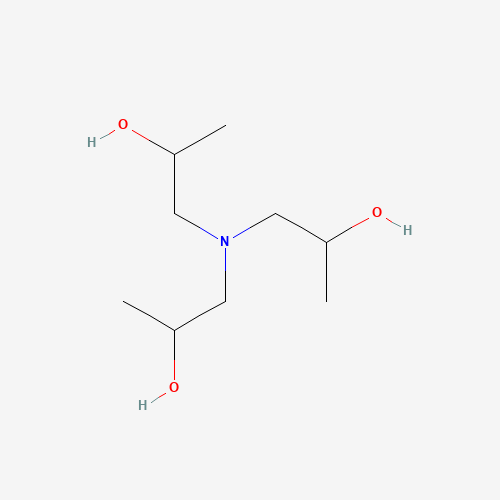
CAS122-20-3
分子式[CH3CH(OH)CH2]3N
分子量191.27 g/mol g/mol
危化品
Physical Description | Triisopropanolamine is a white solid with slight odor of ammonia. Denser than water.
科学粮草官-词典编辑部,修订于:2026-07-06
Toxicity
ToxicityFate Summary
ATMOSPHERIC FATE: According to a model of gas/particle partitioning of semivolatile organic compounds in the atmosphere(1), triisopropanolamine, which has a vapor pressure of 9.75X10⁻⁶ mm Hg at 25 °C(2), is expected to exist in both the vapor and particulate phases in the ambient atmosphere. Vapor-phase triisopropanolamine is degraded in the atmosphere by reaction with photochemically-produced hydroxyl radicals(SRC); the half-life for this reaction in air is estimated to be about 3 hours(SRC), calculated from its rate constant of 1.2X10⁻¹⁰ cu cm/molecule-sec at 25 °C(SRC) that was derived using a structure estimation method(3). Particulate-phase triisopropanolamine may be removed from the air by wet or dry deposition(SRC). Triisopropanolamine absorbs light at wavelengths >290 nm(2) and...
Soil Adsorption / Mobility
Using a structure estimation method based on molecular connectivity indices(1), the Koc of triisopropanolamine can be estimated to be 10(SRC). According to a classification scheme(2), this estimated Koc value suggests that triisopropanolamine is expected to have very high mobility in soil. The pKa of triisopropanolamine is 8.06(3), indicating that this compound will partially exist in cation form in the environment and cations generally adsorb more strongly to soils containing organic carbon and clay than their neutral counterparts(4).
Environmental Biodegradation
AEROBIC: Triisopropanolamine, present at 100 mg/L, reached 0% of its theoretical BOD in 2 weeks using an activated sludge inoculum at 30 mg/L(1). In a biodegradation test, triisopropanolamine reached 0%, 46%, and >46% of its theoretical BOD in 5, 10, and 20 days, respectively, using surface water or sewage treatment inoculum(2). Triisopropanolamine, present at 30 mg/L, reached 3.4% of its theoretical BOD in 4 weeks using an activated sludge inoculum at 100 mg/L in the Japanese MITI test(3). In inherent biodegradability BOD tests (system pre-acclimated to test compound), triisopropanolamine had 51%, 75% and >75% degradation after a 5-day, 10-day and 20-day incubation periods respectively(2). In a soil batch system using an initial triisopropanolamine concentration of 3.3 ppm, triisopropa...
Environmental Bioconcentration
During a 6 week period using carp fish (Cyprinus carpio), BCF values of <0.06 and <0.57 were measured for triisopropanolamine at respective concentrations of 2.5 and 0.25 mg/L(1). According to a classification scheme(2), these BCF values suggest the potential for bioconcentration in aquatic organisms is low(SRC).
Volatilization from Water / Soil
The Henry's Law constant for triisopropanolamine is estimated as 9.8X10⁻¹² atm-cu m/mole(SRC) using a fragment constant estimation method(1). This Henry's Law constant indicates that triisopropanolamine is expected to be essentially nonvolatile from water surfaces(2). Triisopropanolamine's Henry's Law constant indicates that volatilization from moist soil surfaces is not expected to occur(SRC). Triisopropanolamine acid is not expected to volatilize from dry soil surfaces(SRC) based upon a vapor pressure of 9.75X10⁻⁶ mm Hg at 25 °C(3).
Environmental Abiotic Degradation
The rate constant for the vapor-phase reaction of triisopropanolamine with photochemically-produced hydroxyl radicals has been estimated as 1.2X10⁻¹⁰ cu cm/molecule-sec at 25 °C(SRC) using a structure estimation method(1). This corresponds to an atmospheric half-life of about 3 hours at an atmospheric concentration of 5X10+5 hydroxyl radicals per cu cm(1). Triisopropanolamine is expected to be stable to aqueous hydrolysis in the environment(2). Triisopropanolamine absorbs light at wavelengths >290 nm(3) and may be susceptible to direct photolysis by sunlight(SRC).
ICSC Environmental Data
The substance is harmful to aquatic organisms.
Artificial Pollution Sources
Triisopropanolamine's production and use as a crosslinking agent for coatings, emulsifiers and surfactants, and use as a chemical intermediate(1) may result in its release to the environment through various waste streams(SRC).
Probable Routes of Human Exposure
NIOSH (NOES Survey 1981-1983) has statistically estimated that 64,304 workers (8,631 of these are female) are potentially exposed to triisopropanolamine in the US(1). The most likely route of occupational exposure to triisopropanolamine is the dermal route, but inhalation exposure to aerosols is also possible(2). Because triisopropanolamine, or triisopropanolamine-derived fatty acid soaps and salts may be used in a wide variety of personal care products, the most likely route of consumer exposure to triisopropanolamine in these products would be via the dermal route(2).
Environmental Fate / Exposure Summary
Triisopropanolamine's production and use as a crosslinking agent for coatings, emulsifiers and surfactants, and use as a chemical intermediate may result in its release to the environment through various waste streams. If released to air, a vapor pressure of 9.75X10⁻⁶ mm Hg at 25 °C indicates triisopropanolamine will exist in both the vapor and particulate phases in the atmosphere. Vapor-phase triisopropanolamine will be degraded in the atmosphere by reaction with photochemically-produced hydroxyl radicals; the half-life for this reaction in air is estimated to be about 3 hours. Particulate-phase triisopropanolamine will be removed from the atmosphere by wet or dry deposition. Triisopropanolamine absorbs light at wavelengths >290 nm and may be susceptible to direct photolysis by sunligh...
Symptoms
Ingestion Exposure: Sore throat. Burning sensation.
Toxicity Summary
Cosmetic Ingredient Review Finding(s): Safe for use in cosmetics, with qualifications
Non-Human Toxicity Values
LD50 Rabbit oral 11,000 mg/kg
Non-Human Toxicity Excerpts
/OTHER TOXICITY INFORMATION/ Diisopropanolamine, triisopropanolamine, isopropanolamine, & mixed isopropanolamine are used as water-soluble emulsifiers & neutralizers in cosmetic products at concns up to 1%. In animal studies these ingredients were slightly toxic to practically nontoxic to rats & guinea pigs via acute oral admin. Triisopropanolamine was relatively nontoxic to rats in the two subchronic oral studies. These ingredients were moderate skin irritants for rabbits. All four ingredients, when tested at 100% concns, were severe ocular irritants in rabbits. Products containing small amounts (1%) of diisopropanolamine or triisopropanolamine, isopropanolamine were not ocular irritants in rabbits. The triisopropanolamine salt was not mutagenic in Aspergillus nidulans. ... Clinical st...
Antidote and Emergency Treatment
/SRP:/ Advanced treatment: Consider orotracheal or nasotracheal intubation for airway control in the patient who is unconscious, has severe pulmonary edema, or is in severe respiratory distress. Positive-pressure ventilation techniques with a bag valve mask device may be beneficial. Consider drug therapy for pulmonary edema ... . Consider administering a beta agonist such as albuterol for severe bronchospasm ... . Monitor cardiac rhythm and treat arrhythmias as necessary ... . Start IV administration of D5W /SRP: "To keep open", minimal flow rate/. Use 0.9% saline (NS) or lactated Ringer's if signs of hypovolemia are present. For hypotension with signs of hypovolemia, administer fluid cautiously. Watch for signs of fluid overload ... . Treat seizures with diazepam or lorazepam ... . Use...









