


 一键配货
一键配货
化合物详情
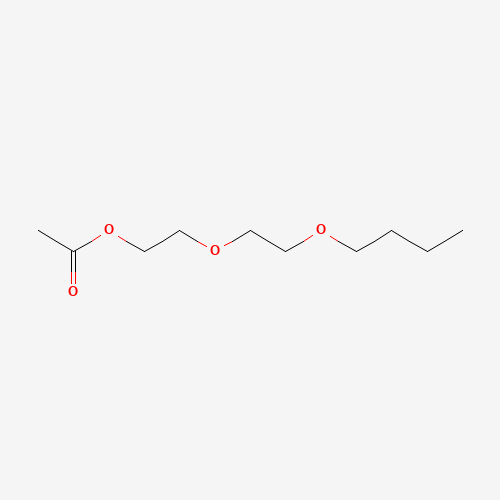
CAS124-17-4
分子式C10H20O4
分子量204.26 g/mol g/mol
危化品
Physical Description | Diethylene glycol monobutyl ether acetate is a colorless liquid with a mild odor. Floats and mixes slowly with water. (USCG, 1999)
科学粮草官-词典编辑部,修订于:2026-07-06
Toxicity
ToxicityEcotoxicity Values
LC50 Pimephales promelas (Fathead minnow) 77 mg/L/96 hr /Conditions of bioassay not specified in source examined/
Fate Summary
ATMOSPHERIC FATE: According to a model of gas/particle partitioning of semivolatile organic compounds in the atmosphere(1), diethyleneglycol monobutyl ether acetate, which has a vapor pressure of 0.04 mm Hg at 20 °C(2), is expected to exist solely as a vapor in the ambient atmosphere. Vapor-phase diethyleneglycol monobutyl ether acetate is degraded in the atmosphere by reaction with photochemically-produced hydroxyl radicals(SRC); the half-life for this reaction in air is estimated to be 11 hours(SRC), calculated from its rate constant of 3.5X10⁻¹¹ cu cm/molecule-sec at 25 °C(SRC) that was derived using a structure estimation method(3).
Soil Adsorption / Mobility
Using a structure estimation method based on molecular connectivity indices(1), the Koc of diethyleneglycol monobutyl ether acetate can be estimated to be 10(SRC). According to a classification scheme(2), this estimated Koc value suggests that diethyleneglycol monobutyl ether acetate is expected to have very high mobility in soil(SRC).
Environmental Biodegradation
AEROBIC: Diethyleneglycol monobutyl ether acetate, present at 100 mg/L, reached 100% of its theoretical BOD in four weeks using an activated sludge inoculum at 30 mg/L and the Japanese MITI test(1). A 20-day biodegradation study using 2.5 ppm diethyleneglycol monobutyl ether acetate in BOD bottle mineralization dilution water and settled sewage seed at 20 °C gave a theoretical BOD of 67.6%(2). The normal BOD curve for diethyleneglycol monobutyl ether acetate seeded with microorganisms from domestic sewage shows slow development that usually requires more than five days for the BOD value to reach 20 percent of the theoretical oxygen demand (40% at 14 days)(3). Acclimated microorganisms from the Kanawana River biodegrade diethyleneglycol monobutyl ether acetate much faster with theoretica...
Environmental Bioconcentration
An estimated BCF of 2 was calculated in fish for diethyleneglycol monobutyl ether acetate(SRC), using an estimated log Kow of 1.30(1) and a regression-derived equation(2). According to a classification scheme(3), this BCF suggests the potential for bioconcentration in aquatic organisms is low(SRC).
Volatilization from Water / Soil
The Henry's Law constant for diethyleneglycol monobutyl ether acetate is estimated as 3.5X10⁻⁷ atm-cu m/mole(SRC), derived from its vapor pressure, 0.04 mm Hg(1), and water solubility, 31,000 mg/L(2). This Henry's Law constant indicates that diethyleneglycol monobutyl ether acetate is expected to be essentially nonvolatile from water surfaces(3). Diethyleneglycol monobutyl ether acetate is not expected to volatilize from dry soil surfaces(SRC) based upon its vapor pressure(1).
Environmental Abiotic Degradation
The rate constant for the vapor-phase reaction of diethyleneglycol monobutyl ether acetate with photochemically-produced hydroxyl radicals has been estimated as 3.5X10⁻¹¹ cu cm/molecule-sec at 25 °C(SRC) using a structure estimation method(1). This corresponds to an atmospheric half-life of about 11 hours at an atmospheric concentration of 5X10+5 hydroxyl radicals per cu cm(1). A base-catalyzed second-order hydrolysis rate constant of 0.26 L/mole-sec(SRC) was estimated using a structure estimation method(2); this corresponds to half-lives of 30 and 305 days at pH values of 8 and 7, respectively(2).
Environmental Water Concentrations
SURFACE WATER: Diethyleneglycol monobutyl ether acetate has been identified in the Rhine Delta at Maasslius at a concentration of 0.031 ug/L(1).
ICSC Environmental Data
The substance is harmful to aquatic organisms.
Artificial Pollution Sources
Diethyleneglycol monobutyl ether acetate's production and use as a solvent in printing inks and high-bake enamels, as a coalescing aid in latex paints, in silk screen inks, a component in polystyrene coatings for decals, a selective solvent in the separation of alcohols and ketones by distillation(1), and as a solvent for cellulose acetate, ester gum and polyvinyl acetate(2) may result in its release to the environment through various waste streams(SRC).
Probable Routes of Human Exposure
NIOSH (NOES Survey 1981-1983) has statistically estimated that 45,220 workers (10,562 of these are female) are potentially exposed to diethyleneglycol monobutyl ether acetate in the US(1). Occupational exposure to diethyleneglycol monobutyl ether acetate may occur through inhalation and dermal contact with this compound at workplaces where diethyleneglycol monobutyl ether acetate is produced or used(SRC). Monitoring and use data indicate that the general population may be exposed to diethyleneglycol monobutyl ether acetate via inhalation of ambient air, ingestion of contaminated drinking water, and dermal contact with products containing diethyleneglycol monobutyl ether acetate(SRC).
Other Environmental Concentrations
Diethyleneglycol monobutyl ether acetate has been qualitatively identified in printer's inks(1). Diethyleneglycol monobutyl ether acetate was detected but not quantified in 4 of 44 emission samples from furniture(2).
Environmental Fate / Exposure Summary
Diethyleneglycol monobutyl ether acetate's production and use as a solvent in a variety of commercial applications may result in its release to the environment through various waste streams. If released to air, a vapor pressure of 0.04 mm Hg at 20 °C indicates diethyleneglycol monobutyl ether acetate will exist solely as a vapor in the atmosphere. Vapor-phase diethyleneglycol monobutyl ether acetate will be degraded in the atmosphere by reaction with photochemically-produced hydroxyl radicals; the half-life for this reaction in air is estimated to be 11 hours. If released to soil, diethyleneglycol monobutyl ether acetate is expected to have very high mobility based upon an estimated Koc of 10. Volatilization from moist soil surfaces is not expected to be an important fate process based...
Symptoms
Eye Exposure: Redness.
Toxicity Data
LC50 (rat) = 72,500 mg/m3/4h
Adverse Effects
Hemolytic anemia - Decreased hemoglobin or number of red blood cells.
Human Toxicity Excerpts
/CASE REPORTS/ ... 3 YR OLD CHILD ... WAS STATED ... TO HAVE DEVELOPED NEPHROSIS FROM /USE AS INSECT REPELLENT/ ... MATERIAL USED WAS KNOWN AS STA-WAY (WHICH CONTAINED 50% OF BUTYL CARBITOL ACETATE & 15% OF CARBITOL).









