


 一键配货
一键配货
化合物详情
CAS124-26-5
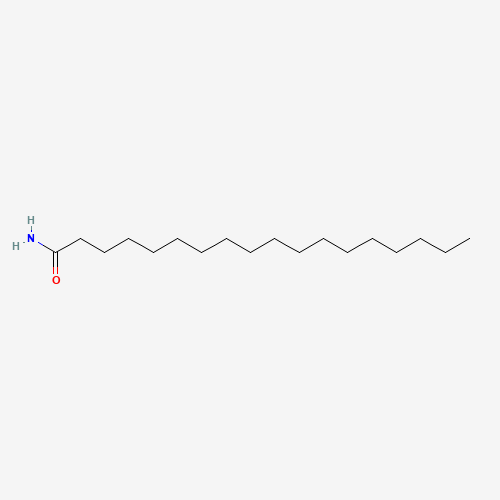
分子式C18H37NO
分子量283.5 g/mol g/mol
危化品
Octadecanamide is a fatty amide of stearic acid. It has a role as a metabolite. It is functionally related to an octadecanoic acid.
科学粮草官-词典编辑部,修订于:2026-07-06
Toxicity
ToxicityFate Summary
ATMOSPHERIC FATE: According to a model of gas/particle partitioning of semivolatile organic compounds in the atmosphere(1), stearic acid amide, which has an estimated vapor pressure of 6.7X10⁻⁷ mm Hg at 25 °C(SRC), determined from a fragment constant method(2), will exist in both the vapor and particulate phases in the ambient atmosphere. Vapor-phase stearic acid amide is degraded in the atmosphere by reaction with photochemically-produced hydroxyl radicals(SRC); the half-life for this reaction in air is estimated to be 14 hours(SRC), calculated from its rate constant of 2.7X10⁻¹¹ cu cm/molecule-sec at 25 °C(SRC) that was derived using a structure estimation method(3). Particulate-phase stearic acid amide may be removed from the air by wet and dry deposition(SRC). Stearic acid amide doe...
Soil Adsorption / Mobility
Using a structure estimation method based on molecular connectivity indices(1), the Koc of stearic acid amide can be estimated to be 4.6X10+4(SRC). According to a classification scheme(2), this estimated Koc value suggests that stearic acid amide is expected to be immobile in soil.
Environmental Biodegradation
AEROBIC: Stearic acid amide reached 62% degradation based on CO2 evolution in 28 days using an activated sludge inoculum in the OECD Guideline 301 B(1). Using the Warburg respirometer screening test and activated sludge from 3 sewage treatment plants stearic acid amide reached approximately 3% of theoretical BOD after 24 hours(2). Additional biodegradation studies with analogous substances indicate that stearic acid amide is likely to be biodegradable under certain environmental conditions and have low environmental persistence(3).
Environmental Bioconcentration
An estimated BCF of 510 was calculated in fish for stearic acid amide(SRC), using an estimated log Kow of 6.70(1) and a regression-derived equation(1). According to a classification scheme(2), this BCF suggests the potential for bioconcentration in aquatic organisms is high(SRC), provided the compound is not metabolized by the organism(SRC).
Volatilization from Water / Soil
The Henry's Law constant for stearic acid amide is estimated as 1.0X10⁻⁶ atm-cu m/mole(SRC) using a fragment constant estimation method(1). This Henry's Law constant indicates that stearic acid amide is not expected to volatilize from water surfaces and moist soil surfaces(2). Additionally, volatilization from water surfaces and moist soil surfaces is expected to be attenuated by adsorption to suspended solids and sediment in the water column(SRC). Stearic acid amide is not expected to volatilize from dry soil surfaces(SRC) based upon an estimated vapor pressure of 6.7X10⁻⁷ mm Hg(SRC), determined from a fragment constant method(1).
Environmental Abiotic Degradation
The rate constant for the vapor-phase reaction of stearic acid amide with photochemically-produced hydroxyl radicals has been estimated as 2.7X10⁻¹¹ cu cm/molecule-sec at 25 °C(SRC) using a structure estimation method(1). This corresponds to an atmospheric half-life of about 14 hours at an atmospheric concentration of 5X10+5 hydroxyl radicals per cu cm(1). Stearic acid amide does not contain chromophores that absorb at wavelengths >290 nm(2) and, therefore, is not expected to be susceptible to direct photolysis by sunlight(SRC).
Environmental Water Concentrations
GROUNDWATER: Stearic acid amide was detected but not quantified in water samples collected from Qutariz thermal springs in the city of Ourense in northwest Spain, sampling dates not reported; these waters are used for bathing and drinking(1).
Effluent Concentrations
Stearic acid amide has been detected in the emissions of cooked meat(1,2) at concentrations of 0.6, 8.4 and 17.2 mg/kg from frying hamburger, char-broiling extra-lean and regular hamburger, respectively (1). Average concentrations of stearic acid amide emitted during Chinese cooking practices were reported as 129, 48, 53, and 43 ng/mg, for Cantonese style, Sichuan style, Dongbei style, and Hunan style cooking, respectively(3).
Artificial Pollution Sources
Stearic acid amide's production and use in industry in anti-adhesive agents, lubricants and lubricant additives, plating agents and surface treating agents, processing aids, and viscosity adjustors and use in consumer applications such as in building and construction materials, food packaging, fuels and related products, and plastic and rubber products(1) may result in its release to the environment through various waste streams(SRC).
Sediment/Soil Concentrations
SOIL: In 2002, stearic acid amide was detected, but not quantified, in sand samples collected from a sand dune 50 miles north of Saudi Arabia(1).
Probable Routes of Human Exposure
NIOSH (NOES Survey 1981-1983) has statistically estimated that 23,611 workers (11,289 of these are female) were potentially exposed to stearic acid amide in the US(1). Occupational exposure to stearic acid amide may occur through inhalation and dermal contact with this compound at workplaces where stearic acid amide is produced or used. The general population is not likely be exposed to stearic acid amide(SRC).
Environmental Fate / Exposure Summary
Stearic acid amide's production and use in industry in anti-adhesive agents, lubricants and lubricant additives, plating agents and surface treating agents, processing aids, and viscosity adjustors and use in consumer applications such as in building and construction materials, food packaging, fuels and related products, and plastic and rubber products may result in its release to the environment through various waste streams. If released to air, an estimated vapor pressure of 6.7X10⁻⁷ mm Hg at 25 °C indicates stearic acid amide will exist in both the vapor and particulate phases in the atmosphere. Vapor-phase stearic acid amide will be degraded in the atmosphere by reaction with photochemically-produced hydroxyl radicals; the half-life for this reaction in air is estimated to be 14 hou...
Toxicity Summary
IDENTIFICATION AND USE: Stearic acid amide (Stearamide) is a solid. It is used as a corrosion inhibitor in oil wells. It is also used in food packaging, plastic and rubber products. HUMAN STUDIES: There are no data available. ANIMAL STUDIES: Rats (5/sex/dose) were administered stearamide in corn oil via gavage at a dose of 10,000 mg/kg and then observed for 14 days. No mortality was observed. Salmonella typhimurium strains TA98, TA100, TA1535, TA1537 and TA1538 were exposed to stearamide at concentrations of 50, 150, 500, 1500 or 5000 ug/plate in the presence and absence of metabolic activation. Stearamide was not mutagenic in this assay.
Non-Human Toxicity Values
LD50 Rat oral > 10,000 mg/kg
Non-Human Toxicity Excerpts
/GENOTOXICITY/ Salmonella typhimurium strains TA98, TA100, TA1535, TA1537 and TA1538 were exposed to /stearamide/ at concentrations of 50, 150, 500, 1500 or 5000 ug/plate in the presence and absence of metabolic activation. Positive and negative controls were tested concurrently and responded appropriately. A precipitate was observed at concentrations >/= 500 ug/plate, but no indications of toxicity were observed. Stearamide was not mutagenic in this assay.
Antidote and Emergency Treatment
/SRP:/ Advanced treatment: Consider orotracheal or nasotracheal intubation for airway control in the patient who is unconscious, has severe pulmonary edema, or is in severe respiratory distress. Positive-pressure ventilation techniques with a bag valve mask device may be beneficial. Consider drug therapy for pulmonary edema ... . Consider administering a beta agonist such as albuterol for severe bronchospasm ... . Monitor cardiac rhythm and treat arrhythmias as necessary ... . Start IV administration of D5W TKO /SRP: "To keep open", minimal flow rate/. Use 0.9% saline (NS) or lactated Ringer's (LR) if signs of hypovolemia are present. For hypotension with signs of hypovolemia, administer fluid cautiously. Watch for signs of fluid overload ... . Treat seizures with diazepam or lorazepam...









