


 一键配货
一键配货
化合物详情
CAS124-73-2
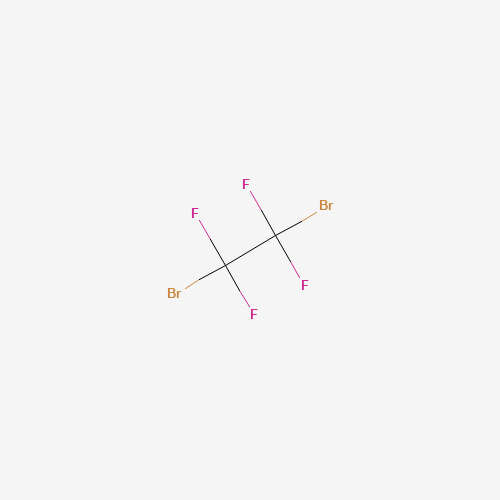
分子式C2Br2F4
分子量259.82 g/mol
非危品
proposed fire extinguishing agent; causes hepatotoxicity; structure
科学粮草官-词典编辑部,修订于:2026-07-06
Toxicity
ToxicityFate Summary
ATMOSPHERIC FATE: According to a model of gas/particle partitioning of semivolatile organic compounds in the atmosphere(1), 1,2-dibromotetrafluoroethane, which has a vapor pressure of 325 mm Hg at 25 °C(2), is expected to exist solely as a vapor in the ambient atmosphere. Vapor-phase 1,2-dibromotetrafluoroethane is not expected to be degraded in the atmosphere by reaction with photochemically-produced hydroxyl radicals(SRC) based on an estimated half-life of over 300 years for this reaction in air(SRC), calculated from its rate constant of 1.30X10⁻¹⁶ cu cm/molecule-sec at 25 °C(3). 1,2-Dibromotetrafluoroethane does not contain chromophores that absorb at wavelengths >290 nm and therefore is not expected to be susceptible to direct photolysis by sunlight in the troposphere(SRC). However,...
Soil Adsorption / Mobility
Using a structure estimation method based on molecular connectivity indices(1), the Koc of 1,2-dibromotetrafluoroethane can be estimated to be 220(SRC). According to a classification scheme(2), this estimated Koc value suggests that 1,2-dibromotetrafluoroethane is expected to have moderate mobility in soil.
Environmental Bioconcentration
An estimated BCF of 340 was calculated for 1,2-dibromotetrafluoroethane(SRC), using a water solubility of 3.00 mg/L(1) and a regression-derived equation(2). According to a classification scheme(3), this BCF suggests the potential for bioconcentration in aquatic organisms is high(SRC), provided the compound is not metabolized by the organism(SRC).
Volatilization from Water / Soil
The Henry's Law constant for 1,2-dibromotetrafluoroethane is estimated as 37 atm-cu m/mole(SRC) derived from its vapor pressure, 325 mm Hg(1), and water solubility, 3.00 mg/L(2). This Henry's Law constant indicates that 1,2-dibromotetrafluoroethane is expected to volatilize rapidly from water surfaces(3). Based on this Henry's Law constant, the volatilization half-life from a model river (1 m deep, flowing 1 m/sec, wind velocity of 3 m/sec)(3) is estimated as 1.5 hours(SRC). The volatilization half-life from a model lake (1 m deep, flowing 0.05 m/sec, wind velocity of 0.5 m/sec)(3) is estimated as 6.4 days(SRC). 1,2-Dibromotetrafluoroethane's estimated Henry's Law constant indicates that volatilization from moist soil surfaces may occur(SRC). The potential for volatilization of 1,2-dibr...
Environmental Abiotic Degradation
The rate constant for the vapor-phase reaction of 1,2-dibromotetrafluoroethane with photochemically-produced hydroxyl radicals is 1.30X10⁻¹⁶ cu cm/molecule-sec at 25 °C(1). This corresponds to an atmospheric half-life of greater than 300 years at an atmospheric concentration of 5X10+5 hydroxyl radicals per cu cm(2). 1,2-Dibromotetrafluoroethane does not contain chromophores that absorb at wavelengths >290 nm and therefore is not expected to be susceptible to direct photolysis by sunlight in the troposphere(SRC). However, as this substance rises into the stratosphere, it is expected to be broken down by shorter wavelength UV radiation(3). As a result, bromide radicals will be released into the stratosphere where they can contribute to the destruction of atmospheric ozone(3-5). 1,2-Dibrom...
Artificial Pollution Sources
1,2-Dibromotetrafluoroethane's production and use as a refrigerant and control fluid(1) may result in its release to the environment through various waste streams(SRC). Its use as a fire-extinguishing agent(1) may result in its direct release to the environment(SRC). However, in accordance with the the Montreal Protocol of 1987, production and consumption of this substance was to be phased out in developed nations in 1994, and is scheduled to be phased out in non-developed nations by 2010(2,3).
Probable Routes of Human Exposure
... IN THE MANUFACTURE, USE, SERVICING, & DISPOSAL OF REFRIGERATION UNITS, FOOD PROCESSING, SOLVENT APPLICATIONS, PLASTIC FOAM BLOWING, & FIRE EXTINGUISHING. /FLUOROCARBONS/
Environmental Fate / Exposure Summary
1,2-Dibromotetrafluoroethane's production and use as a refrigerant and control fluid may result in its release to the environment through various waste streams. Its use as a fire-extinguishing agent may result in its direct release to the environment. However, in accordance with the the Montreal Protocol of 1987, production and consumption of this substance was to be phased out in developed nations in 1994, and is scheduled to be phased out in non-developed nations by 2010. If released to air, a vapor pressure of 325 mm Hg at 25 °C indicates 1,2-dibromotetrafluoroethane will exist solely as a vapor in the atmosphere. Vapor-phase 1,2-dibromotetrafluoroethane is not expected to be degraded in the atmosphere by reaction with photochemically-produced hydroxyl radicals based on a measured ha...
Interactions
The combination of cyanide, hydrobromic acid and freon-114B2 in air due to pyrolytic degradation of freon used in fire extinguishers may have a toxic effect on humans exposed to fumes. The combination of freon-114B2 (inhaled) and cyanide, administered ip as sodium cyanide, had an additive toxic effect on mice. Freon-114B2, a narcotic, inhibited tissue respiration at the flavoprotein and cytochrome stage; the cyanide affected the oxidoreductase and, in part, the cytochrome/oxidase systems. A combination of sodium cyanide and hydrobromic acid administered ip to rats had an antagonistic effect. Hydrobromic acid, a nonspecific irritant, acted as a stress factor and induced body resistance to the combined effect. LD84 (LD for 84% of subjects), LD50 and LD16 (LD for 16% of subjects) values fo...
Toxicity Data
LC50 (rat) = 584,000 mg/m3/4h
Adverse Effects
Neurotoxin - Acute solvent syndrome
Non-Human Toxicity Values
LC50 Mouse inhalation 300 g/cu m/2 hr
Populations at Special Risk
It is possible that pt with cardiac or resp disorders may prove esp susceptible. /fluorocarbons/
Antidote and Emergency Treatment
...If inhalation occurs, epinephrine or other sympathomimetic amines and adrenergic activators should not be administered since they will further sensitize heart to development of arrhythmias. /Fluorocarbons/









