Natural Pollution Sources
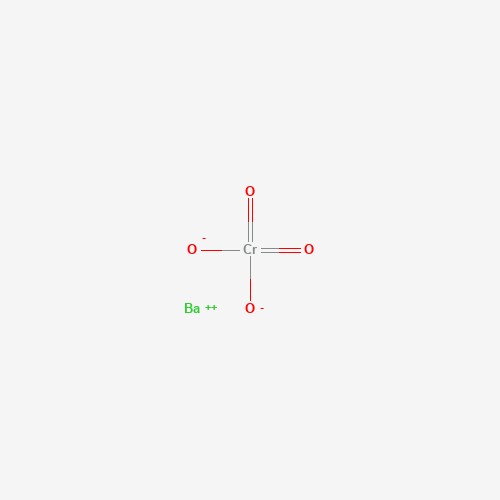
Barium chromate was found to exist in hashemite crystals in host rocks found in the country of Jordan. The hashemite crystals are not composed of pure barium chromate but instead contain some small sulfur content as well(1).
Probable Routes of Human Exposure
NIOSH (NOES Survey 1981-1983) has statistically estimated that 3,546 workers (1,984 of these are female) were potentially exposed to barium chromate in the US(1). Occupational exposure to barium chromate may occur through inhalation of dust and particulates and dermal contact with this compound at workplaces where barium chromate is produced or used(2).
Symptoms
Ingesting excess barium may cause vomiting, abdominal cramps, diarrhea, difficulties in breathing, increased or decreased blood pressure, numbness around the face, and muscle weakness. High levels may result in changes in heart rhythm or paralysis and possibly death. Breathing hexavalent chromium can cause irritation to the lining of the nose, nose ulcers, runny nose, and breathing problems, such as asthma, cough, shortness of breath, or wheezing. Ingestion of hexavalent chromium causes irritation and ulcers in the stomach and small intestine, as well as anemia. Skin contact can cause skin ulcers. (L16, L214)
Treatment
Intravenous infusion of potassium often relieves many of the symptoms of barium toxicity. There is no know antidote for chromium poisoning. Exposure is usually handled with symptomatic treatment. (L16, L214)
Health Effects
The health effects of the different barium compounds depend on how well the compound dissolves in water or the stomach contents. At low doses, barium acts as a muscle stimulant, while higher doses affect the nervous system, causing cardiac irregularities, tremors, weakness, anxiety, dyspnea, paralysisand possibly death. Barium may also cause gastrointestinal disturbances, damage the kidneys and cause decreases in body weight. Hexavalent chromium is a known carcinogen. Chronic inhalation especially has been linked to lung cancer. Hexavalent chromium has also been know to cause reproductive and developmental defects. (A12, L214)
Adverse Effects
ACGIH Carcinogen - Confirmed Human.
Exposure Routes
Inhalation (L16); oral (L16); dermal (L16)
Toxicity Summary
Barium is a competitive potassium channel antagonist that blocks the passive efflux of intracellular potassium, resulting in a shift of potassium from extracellular to intracellular compartments. The intracellular translocation of potassium results in a decreased resting membrane potential, making the muscle fibers electrically unexcitable and causing paralysis. Some of these barium's effects may also be due to barium induced neuromuscular blockade and membrane depolarization. Hexavalent chromium's carcinogenic effects are caused by its metabolites, pentavalent and trivalent chromium. The DNA damage may be caused by hydroxyl radicals produced during reoxidation of pentavalent chromium by hydrogen peroxide molecules present in the cell. Trivalent chromium may also form complexes with pep...
Minimum Risk Level
Intermediate Oral: 0.2 mg/kg/day (Barium salts) (L134) Chronic Oral: 0.2 mg/kg/day (Barium salts) (L134) Intermediate Oral: 0.005 mg/kg/day (Chromium) (L134) Chronic Oral: 0.001 mg/kg/day (Chromium) (L134)
RAIS Toxicity Values
Oral Slope Factor Reference: CALEPA
Human Toxicity Excerpts
/GENOTOXICITY/ Hexavalent chromium (Cr(VI)) compounds are well-established human lung carcinogens. Solubility plays an important role in their carcinogenicity with the particulate Cr(VI) compounds being the most carcinogenic. Epidemiology and animal studies suggest that zinc chromate is the most potent particulate Cr(VI) compound; however, there are few comparative data to support these observations. The purpose of this study was to compare the genotoxicity of zinc chromate with two other particulate Cr(VI) compounds, barium chromate and lead chromate, and one soluble Cr(VI) compound, sodium chromate /in human bronchial cells/. The clastogenic effects of barium chromate and zinc chromate were similar, but lead chromate induced significantly less damage. The levels of DNA damage measured...
Carcinogen Classification
1, carcinogenic to humans. (L135)
Non-Human Toxicity Excerpts
/IMMUNOTOXICITY/ Soluble and insoluble hexavalent chromium (Cr6+) agents are concomitantly released with ozone (O3) during welding. Although pulmonary/immunologic implications from exposure to each agent individually have been investigated, the effects from simultaneous exposure, as occurs under actual working conditions, are unclear. To investigate immunomodulatory effects of inhaled Cr6+, F-344 rats were exposed for 5 hr/day, 5 days/week for 2 or 4 weeks to atmospheres containing soluble potassium chromate (K2CrO4) or insoluble barium chromate (BaCrO4), each alone at 360 micrograms Cr/cu m or in combination with 0.3 ppm O3. One day after the final exposure, rats were euthanized, their lungs were lavaged, and pulmonary macrophages (PAM) were recovered for assessment of basal and induci...
Evidence for Carcinogenicity
A1; Confirmed human carcinogen. /Insoluble Cr(VI) inorganic compounds/
Antidote and Emergency Treatment
Advanced treatment: Consider orotracheal or nasotracheal intubation for airway control in the patient who is unconscious, has severe pulmonary edema, or is in severe respiratory distress. Positive-pressure ventilation techniques with a bag-valve-mask device may be beneficial. Consider drug therapy for pulmonary edema ... . Consider administering a beta agonist such as albuterol for severe bronchospasm ... . Monitor cardiac rhythm and treat arrhythmias as necessary ... . Start IV administration of D5W TKO. Use 0.9% saline (NS) or lactated Ringer's (LR) if signs of hypovolemia are present. For hypotension with signs of hypovolemia, administer fluid cautiously. Watch for signs of fluid overload ... . Treat seizures with diazepam (Valium) or lorazepam (Ativan) ... . Use proparacaine hydroch...



 一键配货
一键配货