


 一键配货
一键配货
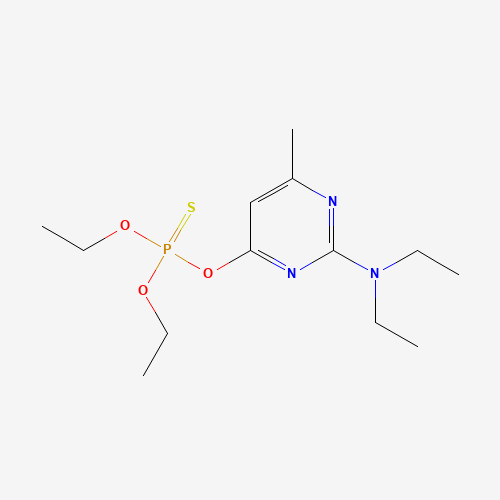
化合物详情
CAS23505-41-1
分子式C13H24N3O3PS
分子量333.39 g/mol
非危品
Physical Description | Straw colored liquid. Used as a pesticide. (EPA, 1998)
科学粮草官-词典编辑部,修订于:2026-07-06
Toxicity
ToxicityEcotoxicity Values
USDA APHIS Chemical Effects: collection=usda_chemeffect&query_type=synonym&query='^23505-41-1$'
Fate Summary
ATMOSPHERIC FATE: According to a model of gas/particle partitioning of semivolatile organic compounds in the atmosphere(1), pirimiphos-ethyl, which has a vapor pressure of 2.9X10⁻⁴ mm Hg at 25 °C(2), will exist in both the vapor and particulate phases in the ambient atmosphere. Vapor-phase pirimiphos-ethyl is degraded in the atmosphere by reaction with photochemically-produced hydroxyl radicals(SRC); the half-life for this reaction in air is estimated to be 2 hours(SRC), calculated from its rate constant of 1.9X10⁻¹⁰ cu cm/molecule-sec at 25 °C(SRC) that was derived using a structure estimation method(3). Particulate-phase pirimofos-ethyl may be removed from the air by wet or dry deposition(SRC). Pirimiphos-ethyl contains chromophores that absorb at wavelengths >290 nm(4) and, therefore...
Soil Adsorption / Mobility
Using a structure estimation method based on molecular connectivity indices(1), the Koc of pirimiphos-ethyl can be estimated to be 1240(SRC). Other calculated Koc values reported are 300, 25,893 and 64,925(2). According to a classification scheme(3), this Koc value range suggests that pirimiphos-ethyl is expected to have moderate to no mobility in soil.
Environmental Biodegradation
AEROBIC: Pirimiphos-ethyl has reported aerobic half-lives in soil of 21-70 days at pH 6.0-7.5 with organic matter of 1.8-6.3%(1).
Environmental Bioconcentration
An estimated BCF of 925 was calculated in fish for pirimiphos-ethyl(SRC), using a log Kow of 5.0(1) and a regression-derived equation(2). According to a classification scheme(3), this BCF suggests the potential for bioconcentration in aquatic organisms is high(SRC), provided the compound is not metabolized by the organism(SRC).
Volatilization from Water / Soil
The Henry's Law constant for pirimiphos-ethyl is estimated as 5.5X10⁻⁵ atm-cu m/mole(SRC) derived from its vapor pressure, 2.9X10⁻⁴ mm Hg(1), and water solubility, 2.3 mg/L(1). This Henry's Law constant indicates that pirimiphos-ethyl is expected to volatilize from water surfaces(2). Based on this Henry's Law constant, the volatilization half-life from a model river (1 m deep, flowing 1 m/sec, wind velocity of 3 m/sec)(2) is estimated as 1.4 days(SRC). The volatilization half-life from a model lake (1 m deep, flowing 0.05 m/sec, wind velocity of 0.5 m/sec)(2) is estimated as 16 days(SRC). Pirimiphos-ethyl's estimated Henry's Law constant indicates that volatilization from moist soil surfaces may occur(SRC). However, volatilization from water surfaces is expected to be attenuated by adso...
Environmental Abiotic Degradation
The rate constant for the vapor-phase reaction of pirimiphos-ethyl with photochemically-produced hydroxyl radicals has been estimated as 1.9X10⁻¹⁰ cu cm/molecule-sec at 25 °C(SRC) using a structure estimation method(1). This corresponds to an atmospheric half-life of about 2 hours at an atmospheric concentration of 5X10+5 hydroxyl radicals per cu cm(1). Pirimiphos-ethyl is hydrolyzed by acid and base giving a degradation half-life of 52-1200 days at 25 °C and pH range of 5.5-8.5(2). Pirimiphos-ethyl is most stable at pH 7-8(2). Pirimiphos-ethyl contains chromophores that absorb at wavelengths >290 nm(3) and, therefore, may be susceptible to direct photolysis by sunlight(SRC).
Environmental Water Concentrations
SURFACE WATER: Surface water samples taken from the Hogeveense Polder during 1989-1990 contained pirimifos-ethyl at concentrations of 0.1-0.3 ug/L(1).
Food Survey Values
Pirimiphos-ethyl was detected in pesticide residue studies by the FDA in foods for the years 1983-1986 (unreported concentrations)(1). In a 1995 monitoring program in Egypt pirimiphos-ethyl was not detected in cauliflower, carrot, courgette, cucumber, eggplant, green beans, green peas, lettuce, onion, pepper, tomato, apple, cantaloupe, grape, guava, mango, peach or strawberry samples(2). Pirimiphos-ethyl was detected in 1 of 5 cabbage samples at 0.32 mg/kg in the same 1995 monitoring program(2). In a 1996 monitoring program in Egypt pirimiphos-ethyl was not detected in any of the samples (cabbage, grape leaf, lettuce, melokhia, spinach, watercress, artichoke, broad bean, cauliflower, cantaloupe, cucumber, eggplant, green beans, green peas, okra, onion, pepper, squash, tomato, carrot, sw...
Animal Concentrations
Pirimiphos-ethyl was detected in 33% of honeybee samples at concentrations of 0.001 to 0.030 mg/kg, dead bee samples were collected in bags suspended under beehives (only worker bees were analyzed) in the district of Bologna, Italy(1).
Artificial Pollution Sources
UNREVIEWED | Pirimiphos-ethyl's production may result in its release to the environment through various waste streams; its use as an insecticide(1) will result in its direct release to the environment(SRC).
Probable Routes of Human Exposure
Occupational exposure to pirimiphos-ethyl may occur through inhalation and dermal contact with this compound at workplaces where pirimiphos-ethyl is produced or used. Monitoring data indicate that the general population may be exposed to pirimiphos-ethyl via ingestion of fruits and vegetables containing pirimiphos-ethyl residues. (SRC)
Environmental Fate / Exposure Summary
Pirimiphos-ethyl's production may result in its release to the environment through various waste streams; its use as an insecticide will result in its direct release to the environment. If released to air, a vapor pressure of 2.9X10⁻⁴ mm Hg at 25 °C indicates pirimiphos-ethyl will exist in both the vapor and particulate phases in the atmosphere. Vapor-phase pirimiphos-ethyl will be degraded in the atmosphere by reaction with photochemically-produced hydroxyl radicals; the half-life for this reaction in air is estimated to be 2 hours. Particulate-phase pirimiphos-ethyl will be removed from the atmosphere by wet or dry deposition. Pirimiphos-ethyl contains chromophores that absorb at wavelengths >290 nm and, therefore, may be susceptible to direct photolysis by sunlight. If released to so...
Adverse Effects
Other Poison - Organophosphate
Human Toxicity Excerpts
/GENOTOXICITY/ Lymphocytes obtained from 5 healthy donors were incubated with a mixture of 15 pesticides commonly found in foods of central Italy (dithiocarbamates (20.7%), benomyl (19.6%), thiabendazole (14.9%), diphenylamine (14.4%), chlorothalonil (13.1%), procymidone (8.0%), methidathion (2.3%), chlorpyrifos-ethyl (2%), fenarimol (1.9%), parathion-methyl (1%), chlorpropham, parathion, vinchlozolin, chlorfenvinphos and pirimiphos-ethyl (< 1%)). The percent of each pesticide in the mixture was proportional to its average concentration in foods. Incubated with the lymphocytes at a concentration of 1-20 mug/ml the pesticide mixture did not induce significant variations in the number of hypodiploid, hyperdiploid and polyploid cells or in the number of chromosome and chromatid aberrations...









