


 一键配货
一键配货
化合物详情
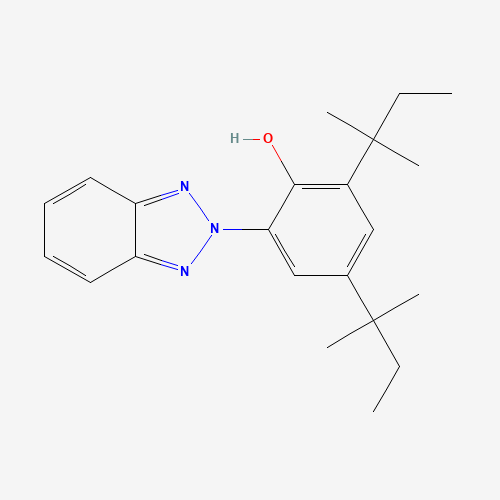
CAS25973-55-1
分子式C22H29N3O
分子量351.49 g/mol
非危品
ultraviolet light (UV) absorber
科学粮草官-词典编辑部,修订于:2026-07-06
Toxicity
ToxicityFate Summary
ATMOSPHERIC FATE: According to a model of gas/particle partitioning of semivolatile organic compounds in the atmosphere(1), UV-328, which has an estimated vapor pressure of 1.9X10⁻¹⁰ mm Hg at 25 °C(SRC), determined from a fragment constant method(2), is expected to exist solely in the particulate phase in the ambient atmosphere. Particulate-phase UV-328 may be removed from the air by wet or dry deposition(SRC). UV-328 absorbs light at wavelengths >290 nm(3) but is resistant to deterioration by sunlight(4).
Soil Adsorption / Mobility
Using a structure estimation method based on molecular connectivity indices(1), the Koc of UV-328 can be estimated to be 450,000(SRC). According to a classification scheme(2), this estimated Koc value suggests that UV-328 is expected to be immobile in soil(SRC).
Environmental Bioconcentration
An estimated BCF of 6000 was calculated in fish for UV-328(SRC), using an estimated log Kow of 7.25(1) and a regression-derived equation(1). According to a classification scheme(2), this BCF suggests the potential for bioconcentration in aquatic organisms is very high, provided the compound is not metabolized by the organism(SRC).
Volatilization from Water / Soil
The Henry's Law constant for UV-328 is estimated as 6.5X10⁻¹³ atm-cu m/mole(SRC) using a fragment constant estimation method(1). This Henry's Law constant indicates that UV-328 is expected to be essentially nonvolatile from water and moist soil surfaces(2). UV-328 is not expected to volatilize from dry soil surfaces(SRC) based upon an estimated vapor pressure of 1.9X10⁻¹⁰ mm Hg(SRC), determined from a fragment constant method(1).
Environmental Abiotic Degradation
UV-328 is not expected to undergo hydrolysis in the environment due to the lack of functional groups that hydrolyze under environmental conditions(1). UV-328 absorbs light at wavelengths >290 nm(2) but is resistant to deterioration by sunlight(3).
Environmental Water Concentrations
SURFACE WATER: UV-328 was detected at 0.5-2, 8-9 and 10-40 ppb in the Providence River, Pawtuxet Cove and Pawtuxet River, respectively, samples were collected Sep 1977 to Sep 1978(1).
Ecotoxicity Excerpts
/AQUATIC SPECIES/ Benzotriazole ultra violet stabilizers (BZT-UVs) are compounds used in many applications and products to prevent photochemical degradation. Despite their widespread presence in aquatic ecosystems and persistence in the environment, there are very limited data on their effects and toxicity, and their modes of action remain largely unknown. The objectives of the present study were to evaluate the chronic effects of 2 BZT-UVs, 2-(2H-benzotriazol-2-yl)-4,6-bis(1-methyl-1-phenylethyl)phenol (UV-234) and 2-(2H-benzotriazol-2-yl)-4,6-di-tert-pentylphenol (UV-328), on the freshwater green algae Chlamydomonas reinhardtii and the freshwater crustacean Daphnia magna. Organisms were exposed to 0.01 and 10 ug/L of UV-234, UV-328, as well as a mixture of the 2 compounds. Life-histor...
Animal Concentrations
UV-328 concentrations were <0.15 ng/g wet weight in spot-billed (Anas poecilorhyncha) and mallard ducks (Anas platyrhynchos) collected 2004 to 2007 from the Ariake Sea, Japan(1).
Effluent Concentrations
UV-328 was reported at not detected to approximately 1000 ppm in Pawtuxet River, NJ sediment core samples collected Sep 1977 to Jun 1978(1). In sediment samples collected in 1989 from the Pawtuxet River and in 1997 from Narragansett Bay, UV-328 was detected at a trace to 2 ug/g and a trace to approximately 25 ug/g, respectively(2). UV-328 was detected at 2.6-320 ng/g dry weight in sediment samples collected 2006 to 2007 from the Ariake Sea, Japan(3). In sediment samples collected in 2009 from six locations on the Songhua River, China, UV-328 was detected at 2.06-7.12 ng/g dry weight(4). Six sediment samples collected 2002 and 1998 from the Saginaw and Detroit Rivers, US, respectively, contained 0.72-224 ng/g dry weight of UV-328(4). The concentration of UV-328 in suspended solids from t...
Artificial Pollution Sources
UV-328's production and use as a UV stabilizer in plastics and films(1) may result in its release to the environment through various waste streams(SRC).
Probable Routes of Human Exposure
Occupational exposure to UV-328 may occur through inhalation and dermal contact with this compound at workplaces where UV-328 is produced or used. Monitoring data indicate that the general population may be exposed to UV-328 via inhalation of dust, and dermal contact with consumer products containing UV-328. (SRC)
Other Environmental Concentrations
UV-328 was found in 82 and 85% of dust samples collected Aug 2008 from 20 homes in Malate and 17 home in Payatas, Phillippines at not detected to 304 and not detected to 48 ng/g dust, respectively(1). UV-328 is listed as an ingredient in two varnish products for in home use(2). UV-328 was detected at 6.01 ug/g in one of 27 commercial food packaging samples(3) and at 2.01 and 13.88 mg/g in 2 of 17 commercial beverage packages(4).
Environmental Fate / Exposure Summary
UV-328's production and use as a UV stabilizer in plastics and films may result in its release to the environment through various waste streams. If released to air, an estimated vapor pressure of 1.9X10⁻¹⁰ mm Hg at 25 °C indicates UV-328 will exist solely in the particulate phase in the atmosphere. Particulate-phase UV-328 will be removed from the atmosphere by wet or dry deposition. UV-328 absorbs light at wavelengths >290 nm but is resistant to deterioration by sunlight. If released to soil, UV-328 is expected to have no mobility based upon an estimated Koc of 450,000. Volatilization from moist soil surfaces is not expected to be an important fate process based upon an estimated Henry's Law constant of 6.5X10⁻¹³ atm-cu m/mole. UV-328 is not expected to volatilize from dry soil surface...
Adverse Effects
Nephrotoxin - The chemical is potentially toxic to the kidneys in the occupational setting.
Toxicity Summary
IDENTIFICATION AND USE: 2-(2H-Benzotriazol-2-yl)-4,6-di-tert-pentylphenol is used as a UV absorber in plastics applications. It is particularly recommended for polyolefins, polyurethanes, PVC, polyacrylate, epoxy, and elastomers. It offers strong intensity and broad UV absorption with a fairly sharp wavelength cutoff close to the visible region. HUMAN STUDIES: In vitro studies demonstrated antiandrogenic activity of human CYP3A4 enzyme-mediated hydroxylated metabolites. ANIMAL STUDIES: Rats were administered 2-(2H-benzotriazol-2-yl)-4,6-di-tert-pentylphenol via oral gavage at doses of 1392, 1800, 2325 mg/kg test-substance-basis for 14 days. Within 2 hours after treatment the rats in all dosage groups showed sedation, dyspnea, curved position and ruffled fur. The animals recovered within...
Average Daily Intake
Based on house dust concentrations measured in Malate and Payatas, Phillippines, the mean and high average daily intake of UV-328 from dust was reported as 0.15-0.34 and 0.37-0.85 ng/day for adults, and 0.5-1.2 and 2.0-4.6 ng/day for toddlers(1).
Human Toxicity Excerpts
/ENDOCRINE MODULATION/ Benzotriazole ultraviolet stabilizers (BUVSs) are prominent chemicals widely used in industrial and consumer products to protect against ultraviolet radiation. They are becoming contaminants of emerging concern since their residues are frequently detected in multiple environmental matrices and their toxicological implications are increasingly reported. We herein investigated the antiandrogenic activities of eight BUVSs prior to and after human CYP3A4-mediated metabolic activation/deactivation by the two-hybrid recombinant human androgen receptor yeast bioassay and the in vitro metabolism assay. More potent antiandrogenic activity was observed for the metabolized UV-328 in comparison with UV-328 at 0.25 uM ((40.73 +/- 4.90)% vs. (17.12 +/- 3.00)%), showing a signif...
Non-Human Toxicity Values
LD50 Rat oral >2,325 mg/kg
Non-Human Toxicity Excerpts
/GENOTOXICITY/ The chemical was tested for mutagenic effects on histidine-auxotrophic mutants of Salmonella typhimurium: TA 98, TA 100, TA 1535 and TA 1537. The investigations were performed with the following concentrations of the test substance with and without microsomal activation: 25, 75, 225, 675 and 2025 ug/0.1 mL. In the experiments performed with and without microsomal activation, comparison of the number of back-mutant colonies in the controls and the cultures treated with the various concentrations of the test chemical revealed no marked deviations. No evidence of point mutations was detected.
Antidote and Emergency Treatment
/SRP:/ Advanced treatment: Consider orotracheal or nasotracheal intubation for airway control in the patient who is unconscious, has severe pulmonary edema, or is in severe respiratory distress. Positive-pressure ventilation techniques with a bag valve mask device may be beneficial. Consider drug therapy for pulmonary edema ... . Consider administering a beta agonist such as albuterol for severe bronchospasm ... . Monitor cardiac rhythm and treat arrhythmias as necessary ... . Start IV administration of D5W TKO /SRP: "To keep open", minimal flow rate/. Use 0.9% saline (NS) or lactated Ringer's (LR) if signs of hypovolemia are present. For hypotension with signs of hypovolemia, administer fluid cautiously. Watch for signs of fluid overload ... . Treat seizures with diazepam (Valium) or l...









