

 一键配货
一键配货
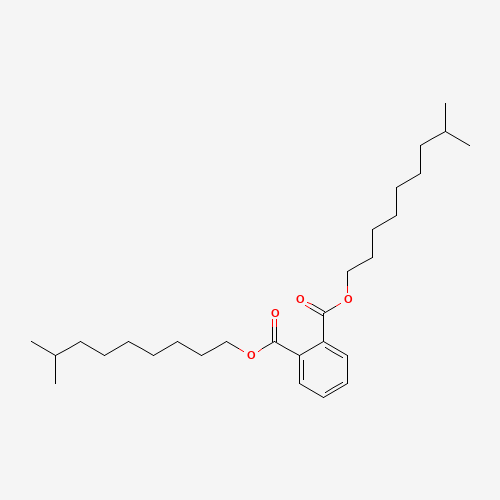
化合物详情
CAS26761-40-0
分子式C28H46O4
分子量446.66 g/mol g/mol
危化品
科学粮草官-词典编辑部,修订于:2026-07-06
Toxicity
ToxicityBody Burden
The diisodecyl phthalate metabolite, monocarboxyl isononyl phthalate, was detected in 89.9% of 2548 urine samples at 0.6-672.6 ug/L; samples were collected by the United States National Health and Nutrition Examination Survey (2005-2006)(1). Diisodecyl phthalate metabolites, mono carboxyl isononyl phthalate, mono hydroxyl isodecyl phthalate and mono oxo isodecyl phthalate were detected in urine of 129 US adults with no documented exposure to diisodecyl phthalate at a rate of 98, 96 and 85%, respectively(2). Mono isodecyl phthalate was not detected in any of the samples. Samples were collected in 2005 from a diverse demographic population(2). A survey of chemical substances in the environment of Ibaraki Prefecture, Japan showed that diisodecyl phthalate along with other phthalate esters...
Fate Summary
ATMOSPHERIC FATE: According to a model of gas/particle partitioning of semivolatile organic compounds in the atmosphere(1), diisodecyl phthalate, which has a vapor pressure of 5.28X10⁻⁷ mm Hg at 25 °C(2), will exist in both the vapor and particulate phases in the ambient atmosphere. Vapor-phase diisodecyl phthalate is degraded in the atmosphere by reaction with photochemically-produced hydroxyl radicals(SRC); the half-life for this reaction in air is estimated to be 15 hours(SRC), calculated from its rate constant of 2.6X10⁻¹¹ cu cm/molecule-sec at 25 °C(SRC) that was derived using a structure estimation method(3). Particulate-phase diisodecyl phthalate may be removed from the air by wet and dry deposition(SRC). Diisodecyl phthalate contains chromophores that absorb at wavelengths >290...
Soil Adsorption / Mobility
Using a structure estimation method based on molecular connectivity indices(1), the log Koc of diisodecyl phthalate can be estimated to be 6.04(SRC). Other estimated log Koc values reported were 5.46 and 5.78(2). According to a classification scheme(3), these estimated log Koc values suggest that diisodecyl phthalate is expected to be immobile in soil. The average Koc of (14)C-diisodecyl phthalate using three standard USEPA sediments (supplied and characterized by the EPA) was measured at 2.86X10+5(4).
Environmental Biodegradation
AEROBIC: In a semi-continuous activated sludge test (Soap and Detergent Association biodegradation test method), the mean degradation for diisodecyl phthalate was 68% in 24 hr(1). In a die-away phase of the testing, it took 9 days to achieve 90% degradation(1). Diisodecyl phthalate is confirmed to be degradable in the screening procedure of the Japanese Ministry of Trade and Industry (MITI) which uses a mixed inoculum derived from soil, fresh water and sewage(2). In an acclimated shake flask CO2 evolution test, loss of parent compound (primary degradation) as well as CO2 evolution (ultimate degradation) was measured using an inoculum prepared from soil and sewage, >99% of diisodecyl phthalate was lost and 56% of theoretical CO2 was evolved after 28 days(3). The biodegradation half-life...
Environmental Bioconcentration
BCFs of <3.6 and <14.4 were measured for diisodecyl phthalate at chemical concentrations of 1 and 0.1 mg/L, respectively, using carp (Cyprinus carpio) which were exposed over an 8-week period(1). According to a classification scheme(2), these BCFs suggest that bioconcentration in aquatic organisms is low(SRC). The mean log BCF of diisodecyl phthalate in Daphnia magna as determined in a 21 day test using ring-labeled chemical was 2.06(3), corresponding to a BCF of 115(SRC). The mean log BCF in mussels (Mytilus edulis) was 3.54 between 14 and 28 days also using ring-labeled ester(4), corresponding to a BCF of 3467(SRC). However depuration was rapid in mussels, the half-life being 3.5 days(4).
Volatilization from Water / Soil
The Henry's Law constant for diisodecyl phthalate is estimated as 1.1X10⁻⁶ atm-cu m/mole(SRC) derived from its vapor pressure, 5.28X10⁻⁷ mm Hg(1), and water solubility, 0.28 mg/L(2). This Henry's Law constant indicates that diisodecyl phthalate is expected to volatilize from water surfaces(3). Based on this Henry's Law constant, the volatilization half-life from a model river (1 m deep, flowing 1 m/sec, wind velocity of 3 m/sec)(3) is estimated as 70 days(SRC). The volatilization half-life from a model lake (1 m deep, flowing 0.05 m/sec, wind velocity of 0.5 m/sec)(3) is estimated as 1.4 years(SRC). However, volatilization from water surfaces is expected to be attenuated by adsorption to suspended solids and sediment in the water column. The estimated volatilization half-life from a mod...
Environmental Abiotic Degradation
The rate constant for the vapor-phase reaction of diisodecyl phthalate with photochemically-produced hydroxyl radicals has been estimated as 2.6X10⁻¹¹ cu cm/molecule-sec at 25 °C(SRC) using a structure estimation method(1). This corresponds to an atmospheric half-life of about 15 hours at an atmospheric concentration of 5X10+5 hydroxyl radicals per cu cm(1). A base-catalyzed second-order hydrolysis rate constant of 0.064 L/mole-sec(SRC) was estimated using a structure estimation method(1); this corresponds to half-lives of 3.4 years and 130 days at pH values of 7 and 8, respectively(1). Diisodecyl phthalate contains chromophores that absorb at wavelengths >290 nm(2) and, therefore, may be susceptible to direct photolysis by sunlight(SRC).
Environmental Water Concentrations
SURFACE WATER: A survey of chemical substances in the environment of Ibaraki Prefecture, Japan showed that diisodecyl phthalate along with other phthalate esters of higher alcohols were found in the waters of the Tone and Kido Rivers and Kasumiga Ura Lake(1). Diisodecyl phthalate was found in 55% of 375 water samples at an average concentration of 0.94 ppb, samples were collected 1974 to 1976, along the Pacific coast of Japan including Tokyo Bay, Ise Bay, Osaka Bay, Seto Inland Sea and 2 or 3 industrial zones along the coast(2).
Food Survey Values
Diisodecyl phthalate was not detected (detection limit 0.01 mg/kg) in 74 samples of composite fatty foods (meat, meat products, offal, poultry, eggs, fish, fats and oils, milk and milk products) from the UK(1). Diisodecyl phthalate was not detected in 59 samples of 15 different brands of infant formula analyzed at a typical detection limit of 0.01 mg/kg wet weight. In a follow-up survey, diisodecyl phthalate was not detected in 39 infant formula samples from the UK(1).
Milk Concentrations
ENVIRONMENTAL: Diisodecyl phthalate was not detected (detection limit 0.01 mg/kg) in milk and milk products from the UK(1). Diisodecyl phthalate was not detected in 59 samples of 15 different brands of infant formula analyzed at a typical detection limit of 0.01 mg/kg wet weight. In a follow-up survey, diisodecyl phthalate was not detected in 39 infant formula samples from the UK(1).
Plant Concentrations
Diisodecyl phthalate was found in aquatic organisms June to Sept 1999 from False Harbor, Vancouver, British Columbia. Concentrations in green algae (Enteromorpha intestinalis) were 3.44 ng/g lipid and in brown algae (Nereocysitis luetkeana, Fucus gardneri), 2.46 ng/g lipid(1).
Animal Concentrations
Diisodecyl phthalate concentrations in surf scoters (Melanitta perspicillata) sampled from June to Sept 1999 in False Harbor, Vancouver, British Columbia was 3.15 ng/g lipid(1). Concentrations in plankton (composite of phytoplankton, zooplankton and other pelagic invertebrates) sampled was 3.87 ng/g lipid(1).
Effluent Concentrations
An effluent sample from a New Jersey publicly owned treatment work contained diisodecyl phthalate at an estimated concentration of 3 ppb(1). Diisodecyl phthalate was detected at a maximum of 17 ug/L in urban run-off samples from Sweden(2).
Artificial Pollution Sources
Diisodecyl phthalate's production and use as a plasticizer(1) may result in its release to the environment through various waste streams(SRC). Congress has banned (on an interim basis) three types of phthalates, which includes diisodecyl phthalate, in any amount greater than 0.1 percent in a children's toy that can be placed in a child's mouth, and in child care articles(2).
Sediment/Soil Concentrations
SEDIMENT: A survey of chemical substances in the environment of Ibaraki Prefecture, Japan showed that diisodecyl phthalate along with other phthalate esters of higher alcohols were found in the environment(1). Coastal sediments were high in phthalate esters, probably as a result of inland discharge and rainwater from populated areas(1). Diisodecyl phthalate was found in 44% of 370 sediment samples at an average concentration of 0.08 ppm, 1974-1976, along the Pacific coast of Japan including Tokyo Bay, Ise Bay, Osaka Bay, Seto Inland Sea and 2 or 3 industrial zones along the coast(2). Diisodecyl phthalate was detected at a maximum of 66 ug/g dry weight in sediment from 3 urban run-off catchment basins in Sweden(3).
Probable Routes of Human Exposure
NIOSH (NOES Survey 1981-1983) has statistically estimated that 80,441 workers (31,734 of these are female) were potentially exposed to diisodecyl phthalate in the US(1). Occupational exposure to diisodecyl phthalate may occur through inhalation and dermal contact with this compound at workplaces where diisodecyl phthalate is produced or used(SRC). Workers were exposed to phthalic acid esters mainly di(ethylhexyl), diisodecyl, and butylbenzyl phthalate in air in a polyvinyl chloride processing industry whose mean ranged from 0.02 to 2.0 mg/cu m in 6 different job categories(2). Monitoring and use data indicate that the general population may be exposed to diisodecyl phthalate via inhalation and dermal contact with consumer products containing diisodecyl phthalate(SRC).
Other Environmental Concentrations
Diisodecyl phthalate was detected in dust samples collected from homes in Canada(1). Diisodecyl phthalate was detected in 3 of 14 gasket seals used in the food industry at 37-41%(2). Food packaging items were acquired from Brazilian retail markets; diisodecyl phthalate was detected at 10-11% wet weight in films and closure seals(3). In a Dutch survey of teething rings and toy animals, diisodecyl phthalate levels were 1.4-15%(4). Surveys conducted by the UK government found diisodecyl phthalate in 6 of 18 toys in 1990, 4 of 27 toys in 1991, 0 of 16 toys in 1992 and 0 of 29 toys in 1996(4). Diisodecyl phthalate was detected in 3 of 4 teethers and 1 of 3 dolls tested at 0.7 to 10.1%(4). The Consumer Product Safety Commission (US) did not detect diisodecyl phthalate in 35 toys that containe...
Environmental Fate / Exposure Summary
Diisodecyl phthalate's production and use as a plasticizer may result in its release to the environment through various waste streams. Congress has banned (on an interim basis) three types of phthalates, which includes diisodecyl phthalate, in any amount greater than 0.1 percent in a children's toy that can be placed in a child's mouth, and in child care articles. If released to air, a vapor pressure of 5.28X10⁻⁷ mm Hg at 25 °C indicates diisodecyl phthalate will exist in both the vapor and particulate phases in the atmosphere. Vapor-phase diisodecyl phthalate will be degraded in the atmosphere by reaction with photochemically-produced hydroxyl radicals; the half-life for this reaction in air is estimated to be 15 hours. Particulate-phase diisodecyl phthalate will be removed from the at...
Symptoms
Phthalate esters are endocrine disruptors and can cause a number of developmental malformations termed 'phthalate syndrome'. (A2883)
Interactions
The ability of phthalic acid, phthalic acid anhydride, and various phthalate esters to enhance the mutagenicity of many amino acid pyrolysates was observed with the Ames test (Salmonella typhimurium TA 98), but not the SOS Chromotest. Phthalate enhancement of the mutagenicity of 4-nitroquinoline-1-oxide, 2-nitrofluorene, and benzo[a]pyrene was not observed with either test. The mutagenicity-enhancing ability may be related to the induction of enzymes such as P450IIB, that metabolize amino acid pyrolysates. By quantitative structure activity relationship (QSAR) analysis, a good correlation was observed between the mutagenicity-enhancing activity of phthalates and their octanol-water partition coefficients.
Toxicity Data
LD50: >3160 mg/kg (Dermal, Rabbit) (T13) LD50: 64 000 mg/kg (Oral, Rat) (T13)
Health Effects
Phthalate esters are endocrine disruptors. Animal studies have shown that they disrupt reproductive development and can cause a number of malformations in affected young, such as reduced anogenital distance (AGD), cryptorchidism, hypospadias, and reduced fertility. The combination of effects associated with phthalates is called 'phthalate syndrome’. (A2883)
Adverse Effects
Occupational hepatotoxin - Secondary hepatotoxins: the potential for toxic effect in the occupational setting is based on cases of poisoning by human ingestion or animal experimentation.
Exposure Routes
Oral (L1903); inhalation (L1903); dermal (L1903)
Toxicity Summary
Phthalate esters are endocrine disruptors. They decrease foetal testis testosterone production and reduce the expression of steroidogenic genes by decreasing mRNA expression. Some phthalates have also been shown to reduce the expression of insulin-like peptide 3 (insl3), an important hormone secreted by the Leydig cell necessary for development of the gubernacular ligament. Animal studies have shown that these effects disrupt reproductive development and can cause a number of malformations in affected young. (A2883)
Average Daily Intake
The average daily intake of diisodecyl phthalate was estimated as 30-40 ng/kg body weight/day in studies of foods and beverages purchased from Norwegian grocery stores(1). In infants, toddlers and children 55-82, 40 and 16% of the average daily intake of diisodecyl phthalate is due to mouthing plastic, ingestion of dust and inhalation of indoor air, respectively(2). In teenagers and adults 55-70, >10, 9-13, 5-7 and 5-7% is due to ingestion of food, ingestion of dust, inhalation of indoor air, gloves and spray paint fumes, respectively(2). An analysis of indirect exposure models and urinary biomonitoring data of various population segments indicate an average daily intake of <1 ug/kg/day of diisodecyl phthalate(3).
Carcinogen Classification
No indication of carcinogenicity to humans (not listed by IARC).
Antidote and Emergency Treatment
/SRP:/ Advanced treatment: Consider orotracheal or nasotracheal intubation for airway control in the patient who is unconscious, has severe pulmonary edema, or is in severe respiratory distress. Positive-pressure ventilation techniques with a bag-valve-mask device may be beneficial. Consider drug therapy for pulmonary edema ... . Monitor cardiac rhythm and treat arrhythmias if necessary ... . Start IV administration of D5W /SRP: "To keep open", minimal flow rate/. Use 0.9% saline (NS) or lactated Ringer's (LR) if signs of hypovolemia are present. For hypotension with signs of hypovolemia, administer fluid cautiously. Consider vasopressors if patient is hypotensive with a normal fluid volume. Watch for signs of fluid overload ... . Use proparacaine hydrochloride to assist eye irrigation...