


 一键配货
一键配货
化合物详情
CAS37517-28-5
分子式C22H43N5O13
分子量585.6 g/mol
非危品
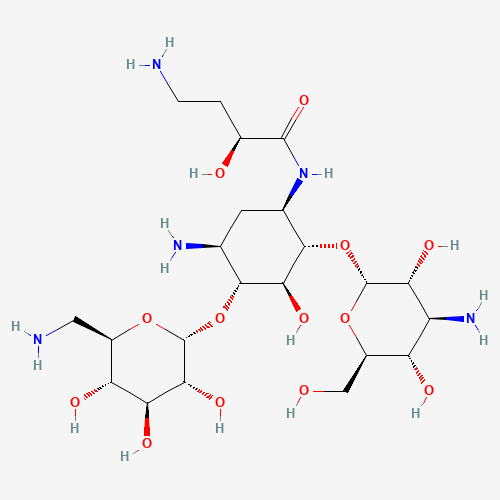
Amikacin is an amino cyclitol glycoside that is kanamycin A acylated at the N-1 position by a 4-amino-2-hydroxybutyryl group. It has a role as an antimicrobial agent, an antibacterial drug and a nephrotoxic agent. It is an alpha-D-glucoside, an amino cyclitol glycoside, a carboxamide and an aminoglycoside. It is functionally related to a kanamycin A. It is a conjugate base of an amikacin(4+).
科学粮草官-词典编辑部,修订于:2026-07-06
Toxicity
ToxicityFate Summary
ATMOSPHERIC FATE: According to a model of gas/particle partitioning of semivolatile organic compounds in the atmosphere(1), amikacin, which has an estimated vapor pressure of 5.8X10⁻²⁸ mm Hg at 25 °C(SRC), determined from a fragment constant method(2), is expected to exist solely in the particulate phase. Particulate-phase amikacin may be removed from the air by wet and dry deposition(SRC). Amikacin contains chromophores that absorb at wavelengths >290 nm(4) and, therefore, may be susceptible to direct photolysis by sunlight(SRC).
Soil Adsorption / Mobility
Using a structure estimation method based on molecular connectivity indices(1), the Koc of amikacin can be estimated to be 10(SRC). According to a classification scheme(2), this estimated Koc value suggests that amikacin is expected to have very high mobility in soil. The pKa values of amikacin are 6.7, 8.4, 8.4 and 8.9(3), indicating that this compound will exist almost entirely in the cation form in the environment and cations generally adsorb more strongly to soils containing organic carbon and clay than their neutral counterparts(4).
Environmental Bioconcentration
An estimated BCF of 3 was calculated in fish for amikacin(SRC), using an estimated log Kow of -8.78(1) and a regression-derived equation(1). According to a classification scheme(2), this BCF suggests the potential for bioconcentration in aquatic organisms is low(SRC).
Volatilization from Water / Soil
The pKa values of 6.7, 8.4, 8.4 and 8.9(1) indicate amikacin will exist almost entirely in the cation form at pH values of 5 to 9 and, therefore, volatilization from water surfaces is not expected to be an important fate process. Amikacin is not expected to volatilize from dry soil surfaces(SRC) based upon an estimated vapor pressure of 5.8X10⁻²⁸ mm Hg(SRC), determined from a fragment constant method(2).
Environmental Abiotic Degradation
Amikacin is not expected to undergo hydrolysis in the environment due to the lack of functional groups that hydrolyze under environmental conditions(1). Amikacin contains chromophores that absorb at wavelengths >290 nm(1) and, therefore, may be susceptible to direct photolysis by sunlight(SRC). Using a municipal wastewater ozonation test, the second order rate constant for the vapor-phase reaction of amikacin with ozone has been estimated as 1.8X10+3 M-1.s-1 at pH 7 at 20 °C(2).
Environmental Water Concentrations
While data specific to amikacin were not located(SRC, 2017), the literature suggests that some pharmaceutically active compounds originating from human and veterinary therapy are not eliminated completely in municipal sewage treatment plants and are, therefore, discharged into receiving waters(1). Wastewater treatment processes often were not designed to remove them from the effluent(2). Selected organic waste compounds may be degrading to new and more persistent compounds that may be released instead of or in addition to the parent compound(2).
Artificial Pollution Sources
Amikacin's production and administration as a veterinary and human medication(1) may result in its release to the environment through various waste streams(SRC).
Probable Routes of Human Exposure
Occupational exposure to amikacin may occur through inhalation and dermal contact with this compound at workplaces where amikacin is produced or used. The general public is not likely to be exposed to amikacin unless by direct medical treatment. (SRC)
Environmental Fate / Exposure Summary
Amikacin's production and administration as a medication may result in its release to the environment through various waste streams. If released to air, an estimated vapor pressure of 5.8X10⁻²⁸ mm Hg at 25 °C indicates amikacin will exist solely in the particulate phase in the atmosphere. Particulate-phase amikacin will be removed from the atmosphere by wet and dry deposition. Amikacin contains chromophores that absorb at wavelengths >290 nm and, therefore, may be susceptible to direct photolysis by sunlight. If released to soil, amikacin is expected to have very high mobility based upon an estimated Koc of 10. Reported pKa values of 6.7, 8.4, 8.4 and 8.9 indicate that this compound will exist almost entirely in the cation form in the environment and cations generally adsorb more strong...
Hepatotoxicity
Likelihood score: E (unlikely cause of clinically apparent liver injury).
Adverse Effects
Neurotoxicity may present in some patients with paresthesias, tingling, and numbness.
Toxicity Summary
Other medications that can increase amikacin concentrations in the blood include NSAIDs (especially indomethacin) and quinidine.
Drug Induced Liver Injury
References: DOI:10.1016/j.drudis.2019.09.022
Non-Human Toxicity Values
LD50 Mouse subcutaneous 6200 mg/kg
Populations at Special Risk
Aminoglycosides should be used with caution in patients with neuromuscular disorder such as myasthenia gravis or parkinsonian syndrome, since the drugs may aggravate muscle weakness as a result of their potential to produce neuromuscular blockade. If signs of respiratory paralysis occur during aminoglycoside therapy, respiration should be assisted and the drug discontinued. /Aminoglycosides/
Antidote and Emergency Treatment
In the event of overdosage or toxic reaction, peritoneal dialysis or hemodialysis will aid in the removal of amikacin from the blood. In the newborn infant, exchange transfusion may also be considered.
Effects During Pregnancy and Lactation
◉ Effects on Lactation and Breastmilk









