

 一键配货
一键配货
化合物详情
CAS56420-45-2
分子式C27H29NO11
分子量543.52 g/mol
非危品
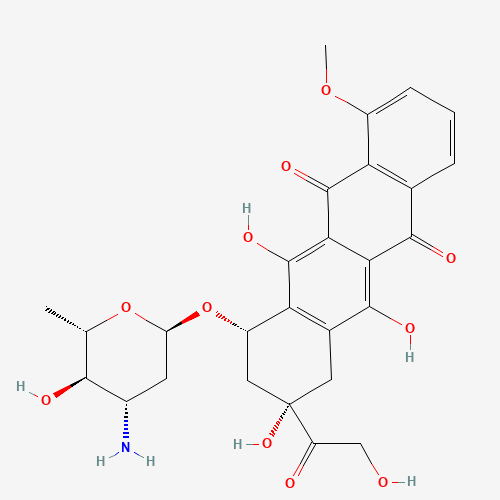
4'-epidoxorubicin is an anthracycline that is the 4'-epi-isomer of doxorubicin. It has a role as an antimicrobial agent, an antineoplastic agent and an EC 5.99.1.3 [DNA topoisomerase (ATP-hydrolysing)] inhibitor. It is a primary alpha-hydroxy ketone, a tertiary alpha-hydroxy ketone, a member of p-quinones, a deoxy hexoside, an aminoglycoside, an anthracycline, an anthracycline antibiotic and a monosaccharide derivative. It is functionally related to a doxorubicin. It is a conjugate base of a 4'-epidoxorubicinium.
科学粮草官-词典编辑部,修订于:2026-07-06
Toxicity
ToxicityFate Summary
ATMOSPHERIC FATE: According to a model of gas/particle partitioning of semivolatile organic compounds in the atmosphere(1), epirubicin, which has an estimated vapor pressure of 2.5X10⁻²³ mm Hg at 25 °C(SRC), determined from a fragment constant method(2), is expected to exist solely in the particulate phase in the ambient atmosphere. Particulate-phase epirubicin may be removed from the air by wet and dry deposition(SRC). Epirubicin contains chromophores that absorb at wavelengths >290 nm(4) and, therefore, may be susceptible to direct photolysis by sunlight(SRC).
Soil Adsorption / Mobility
Using a structure estimation method based on molecular connectivity indices(1), the Koc of epirubicin can be estimated to be 6000(SRC). According to a classification scheme(2), this estimated Koc value suggests that epirubicin is expected to be immobile in soil. An estimated pKa of epirubicin is 9.93(3), indicating that this compound will exist almost entirely in the anion form and cations generally do not adsorb more strongly to soils containing organic carbon and clay than their neutral counterparts(4). Epirubicin was shown to adsorb to suspended solids during treatment of raw wastewater from the oncologic in-patient department of the Vienna University Hospital, sampled for 98 days over 2 years(5). Epirubicin has been detected in the Thames catchment in the UK. It is estimated that th...
Environmental Bioconcentration
An estimated BCF of 1 was calculated in fish for epirubicin(SRC), using a log Kow of 1.27(1) and a regression-derived equation(2). According to a classification scheme(3), this BCF suggests the potential for bioconcentration in aquatic organisms is low(SRC).
Volatilization from Water / Soil
An estimated pKa of 9.93 indicates epirubicin will exist almost entirely in the cation form at pH values of 5 to 9 and, therefore, volatilization from water surfaces is not expected to be an important fate process. Epirubicin is not expected to volatilize from dry soil surfaces(SRC) based upon an estimated vapor pressure of 2.5X10⁻²³ mm Hg(SRC), determined from a fragment constant method(2).
Environmental Abiotic Degradation
... /A study was conducted on/ degradation kinetics of doxorubicin, daunorubicin and epirubicin in aqueous solution under fluorescent light and sunlight were studied using high performance liquid chromatographic methods. The rates of photodegradation of the 3 drugs were similar; they were inversely proportional to the drug concentration and were accelerated by an increase in pH of the vehicle. Photodegradation followed first order kinetics. At concentrations greater than or equal to 500 ug/ml no special precautions appeared to be necessary to protect freshly prepared solutions of these agents from light. Photolysis was very rapid, however, at concentrations in the low microgram range; therefore, when these solutions are used for in vitro work or stability studies, they should be protect...
Effluent Concentrations
Epirubicin has been detected in the Thames catchment in the UK. It is estimated that the drug is present in sewage treatment effluent at a concentration of 9.01X10⁻² ng/L(1).
Artificial Pollution Sources
Epirubicin's production and administration as an antineoplastic(1) may result in its release to the environment through various waste streams(SRC).
Probable Routes of Human Exposure
Occupational exposure to epirubicin may occur through inhalation and dermal contact with this compound at workplaces where epirubicin is produced or used. Exposure to epirubicin among the general population may be limited to those administered the drug. (SRC)
Environmental Fate / Exposure Summary
Epirubicin's production and administration as an antineoplastic may result in its release to the environment through various waste streams. If released to air, an estimated vapor pressure of 2.5X10⁻²³ mm Hg at 25 °C indicates epirubicin will exist solely in the particulate phase in the atmosphere. Particulate-phase epirubicin will be removed from the atmosphere by wet and dry deposition. Epirubicin contains chromophores that absorb at wavelengths >290 nm and, therefore, may be susceptible to direct photolysis by sunlight. If released to soil, epirubicin is expected to be immobile based upon an estimated Koc of 6000. An estimated pKa of epirubicin is 9.93, indicating that this compound will exist largely in the anion form in the environment and anions generally do not adsorb more strongl...
Symptoms
bone marrow aplasia, grade 4 mucositis, and gastrointestinal bleeding
Treatment
If an overdose occurs, supportive treatment (including antibiotic therapy, blood and platelet transfusions, colony-stimulating factors, and intensive care as needed) should be provided until the recovery of toxicities. Delayed CHF has been observed months after anthracycline administration. Patients must be observed carefully over time for signs of CHF and provided with appropriate supportive therapy. (L1712)
Interactions
Do not administer epirubicin in combination with other cardiotoxic agents unless the patient's cardiac function is closely monitored. Patients receiving epirubicin after stopping treatment with other cardiotoxic agents, especially those with long half-lives such as trastuzumab, may also be at an increased risk of developing cardiotoxicity. Concomitant use of Ellence with other cardioactive compounds that could cause heart failure (e.g., calcium channel blockers), requires close monitoring of cardiac function throughout treatment.
Exposure Routes
Intravenous
Toxicity Summary
Epirubicin has antimitotic and cytotoxic activity. It inhibits nucleic acid (DNA and RNA) and protein synthesis through a number of proposed mechanisms of action: Epirubicin forms complexes with DNA by intercalation between base pairs, and it inhibits topoisomerase II activity by stabilizing the DNA-topoisomerase II complex, preventing the religation portion of the ligation-religation reaction that topoisomerase II catalyzes. It also interferes with DNA replication and transcription by inhibiting DNA helicase activity.
Human Toxicity Excerpts
/SIGNS AND SYMPTOMS/ ... Instances of administration of doses higher than recommended have been reported at doses ranging from 150 to 250 mg/sq m. The observed adverse events in these patients were qualitatively similar to known toxicities of epirubicin. Most of the patients recovered with appropriate supportive care.
Carcinogen Classification
No indication of carcinogenicity to humans (not listed by IARC).
Drug Induced Liver Injury
References: DOI:10.1016/j.drudis.2019.09.022
Non-Human Toxicity Values
LD50 Dog iv 2 mg/kg
Non-Human Toxicity Excerpts
/LABORATORY ANIMALS: Developmental or Reproductive Toxicity/ Administration of intravenous epirubicin to rabbits at doses up to 0.2 mg/kg/day (about 0.02 times the maximum recommended single human dose on a body surface area basis) during Days 6 to 18 of gestation was not embryotoxic or teratogenic, but a maternally toxic dose of 0.32 mg/kg/day increased abortions and delayed ossification. Administration of a maternally toxic intravenous dose of 1 mg/kg/day epirubicin to rabbits (about 0.1 times the maximum recommended single human dose on a body surface area basis) on Days 10 to 12 of gestation induced abortion, but no other signs of embryofetal toxicity or teratogenicity were observed. When doses up to 0.5 mg/kg/day epirubicin were administered to rat dams from Day 17 of gestation to...
Populations at Special Risk
The treatment of pregnant women with chemotherapeutic drugs leads to congenital malformations in 10-20% of newborn children. We present a case of an ongoing 19-week-long pregnancy which was diagnosed in a 39-year-old woman who was being treated with CEF (cyclophosphamide, epirubicin, 5-fluorouracil) chemotherapy for an infiltrating ductal carcinoma of the breast. After termination of the pregnancy, subsequent examination of the fetus revealed micrognathia and bilateral malformations of the hands and feet. The peak exposure of the fetus to the chemotherapeutic agents was in the 5th to 6th week of the pregnancy. Both the nature of the malformations and the timing of the administration of chemotherapy are similar to another case reported previously. We conclude that chemotherapy treatments...
Antidote and Emergency Treatment
/SRP:/ Advanced treatment: Consider orotracheal or nasotracheal intubation for airway control in the patient who is unconscious, has severe pulmonary edema, or is in severe respiratory distress. Positive-pressure ventilation techniques with a bag valve mask device may be beneficial. Consider drug therapy for pulmonary edema ... . Consider administering a beta agonist such as albuterol for severe bronchospasm ... . Monitor cardiac rhythm and treat arrhythmias as necessary ... . Start IV administration of D5W TKO /SRP: "To keep open", minimal flow rate/. Use 0.9% saline (NS) or lactated Ringer's (LR) if signs of hypovolemia are present. For hypotension with signs of hypovolemia, administer fluid cautiously. Watch for signs of fluid overload ... . Treat seizures with diazepam or lorazepam...
Effects During Pregnancy and Lactation
◉ Effects on Lactation and Breastmilk