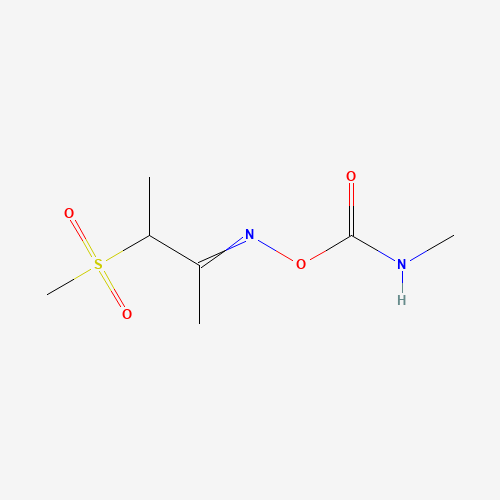
Ecotoxicity Values
LC50 Bufo bufo japonicus (0.34 g, 2.9 cm, tadpole) 40,000 ug/L/3, 6, 24, 48 hr; static
Fate Summary
ATMOSPHERIC FATE: According to a model of gas/particle partitioning of semivolatile organic compounds in the atmosphere(1), butoxycarboxim, which has a vapor pressure of 2.0X10⁻⁶ mm Hg at 20 °C(2), will exist in both the vapor and particulate phases in the ambient atmosphere. Vapor-phase butoxycarboxim is degraded in the atmosphere by reaction with photochemically-produced hydroxyl radicals(SRC); the half-life for this reaction in air is estimated to be 1.4 days(SRC), calculated from its rate constant of 2.4X10⁻¹¹ cu cm/molecule-sec at 25 °C(SRC) that was derived using a structure estimation method(3). Particulate-phase butoxycarboxim may be removed from the air by wet and dry deposition(SRC). Butoxycarboxim is not expected to absorb light with wavelengths >290 nm and is not expected to...
Soil Adsorption / Mobility
Using a structure estimation method based on molecular connectivity indices(1), the Koc for butoxycarboxim can be estimated to be 10(SRC). According to a classification scheme(2), this estimated Koc value suggests that butoxycarboxim is expected to have very high mobility in soil.
Environmental Biodegradation
AEROBIC: The half-life of butoxycarboxim in soil is 41-44 days at 20 °C(1).
Environmental Bioconcentration
An estimated BCF of 3.1 was calculated for butoxycarboxim(SRC), using an estimated log Kow of -0.81(1) and a regression-derived equation(2). According to a classification scheme(3), this BCF suggests the potential for bioconcentration in aquatic organisms is low(SRC).
Volatilization from Water / Soil
The Henry's Law constant for butoxycarboxim is 2.8X10⁻¹² atm-cu m/mole(SRC), derived from its vapor pressure, 2.0X10⁻⁶ mm Hg(1), and water solubility, 2.09X10+5 mg/l(1). This Henry's Law constant indicates that butoxycarboxim is expected to be essentially nonvolatile from water surfaces(2). Butoxycarboxim is not expected to volatilize from dry soil surfaces(SRC) based upon its vapor pressure(1).
Environmental Abiotic Degradation
The rate constant for the vapor-phase reaction of butoxycarboxim with photochemically-produced hydroxyl radicals has been estimated as 2.4X10⁻¹¹ cu cm/molecule-sec at 25 °C(SRC) using a structure estimation method(1). This corresponds to an atmospheric half-life of about 1.4 days at an atmospheric concentration of 5X10+5 hydroxyl radicals per cu cm(1). Aqueous hydrolysis half-lives are 501, 18, and 16 days at pH 5, 7, and 9, respectively(2). Butoxycarboxim is not expected to absorb light with wavelengths >290 nm and is not expected to be susceptible to direct photolysis by sunlight(SRC).
Food Survey Values
Butoxycarboxim was detected in 8% of fifty samples of wheat grains collected from seven areas in Saudi Arabia(1).
Ecotoxicity Excerpts
/OTHER TERRESTRIAL SPECIES/ Not hazardous to bees (special test with 'Plant Pin').
Artificial Pollution Sources
Butoxycarboxim's production may have resulted in its release to the environment through various waste streams; its former use as an insecticide and acaricide(1) would have resulted in its direct release to the environment(SRC).
Probable Routes of Human Exposure
Occupational exposure to butoxycarboxim may have occurred through inhalation and dermal contact with this compound at workplaces where butoxycarboxim was produced or used. Limited monitoring data from Saudi Arabia indicate that the general population may have been exposed to butoxycarboxim via ingestion of food. (SRC)
Environmental Fate / Exposure Summary
Butoxycarboxim's production may have resulted in its release to the environment through various waste streams; its former use as an insecticide and acaricide would have resulted in its direct release to the environment. If released to air, a vapor pressure of 2.0X10⁻⁶ mm Hg at 20 °C indicates butoxycarboxim will exist in both the vapor and particulate phases in the ambient atmosphere. Vapor-phase butoxycarboxim will be degraded in the atmosphere by reaction with photochemically-produced hydroxyl radicals; the half-life for this reaction in air is estimated to be 1.4 days. Particulate-phase butoxycarboxim will be removed from the atmosphere by wet and dry deposition. If released to soil, butoxycarboxim is expected to have very high mobility based upon an estimated Koc of 10. Volatilizati...
Symptoms
As with organophosphates, the signs and symptoms are based on excessive cholinergic stimulation. Unlike organophosphate poisoning, carbamate poisonings tend to be of shorter duration because the inhibition of nervous tissue acetylcholinesterase is reversible, and carbamates are more rapidly metabolized. Muscle weakness, dizziness, sweating and slight body discomfort are commonly reported early symptoms. Headache, salivation, nausea, vomiting, abdominal pain and diarrhea are often prominent at higher levels of exposure. Contraction of the pupils with blurred vision, incoordination, muscle twitching and slurred speech have been reported. (L795)
Treatment
If the compound has been ingested, rapid gastric lavage should be performed using 5% sodium bicarbonate. For skin contact, the skin should be washed with soap and water. If the compound has entered the eyes, they should be washed with large quantities of isotonic saline or water. In serious cases, atropine and/or pralidoxime should be administered. Anti-cholinergic drugs work to counteract the effects of excess acetylcholine and reactivate AChE. Atropine can be used as an antidote in conjunction with pralidoxime or other pyridinium oximes (such as trimedoxime or obidoxime), though the use of '-oximes' has been found to be of no benefit, or possibly harmful, in at least two meta-analyses. Atropine is a muscarinic antagonist, and thus blocks the action of acetylcholine peripherally.
Health Effects
Acute exposure to cholinesterase inhibitors can cause a cholinergic crisis characterized by severe nausea/vomiting, salivation, sweating, bradycardia, hypotension, collapse, and convulsions. Increasing muscle weakness is a possibility and may result in death if respiratory muscles are involved. Accumulation of ACh at motor nerves causes overstimulation of nicotinic expression at the neuromuscular junction. When this occurs symptoms such as muscle weakness, fatigue, muscle cramps, fasciculation, and paralysis can be seen. When there is an accumulation of ACh at autonomic ganglia this causes overstimulation of nicotinic expression in the sympathetic system. Symptoms associated with this are hypertension, and hypoglycemia. Overstimulation of nicotinic acetylcholine receptors in the central...
Adverse Effects
Other Poison - Carbamate
Exposure Routes
Inhalation (L793); oral (L793); dermal (L793)
Toxicity Summary
Butoxycarboxim is a cholinesterase or acetylcholinesterase (AChE) inhibitor. Carbamates form unstable complexes with chlolinesterases by carbamoylation of the active sites of the enzymes. This inhibition is reversible. A cholinesterase inhibitor suppresses the action of acetylcholine esterase. Because of its essential function, chemicals that interfere with the action of acetylcholine esterase are potent neurotoxins, causing excessive salivation and eye-watering in low doses. Headache, salivation, nausea, vomiting, abdominal pain and diarrhea are often prominent at higher levels of exposure. Acetylcholine esterase breaks down the neurotransmitter acetylcholine, which is released at nerve and muscle junctions, in order to allow the muscle or organ to relax. The result of acetylcholine es...
Human Toxicity Excerpts
/SIGNS AND SYMPTOMS/ Principal effects /of anticholinesterases as toxic components of insecticides/ on eye, whether from local contact or systemic poisoning, are miosis and spasm of accommodation for near vision. /Anticholinesterases/
Carcinogen Classification
No indication of carcinogenicity to humans (not listed by IARC).
Non-Human Toxicity Values
LD50 Hen oral 367 mg/kg
Non-Human Toxicity Excerpts
/LABORATORY ANIMALS: Neurotoxicity/ Because of their chemical structure, carbamates do not cause delayed neuropathy. /Carbamate pesticides/
Antidote and Emergency Treatment
Stabilization: Assess the adequacy of the airway and ventilation and use oxygen, suction, intubation, artificial ventilation, intravenous lines, and cardiac monitors as needed. /Carbamates/



 一键配货
一键配货