


 一键配货
一键配货
化合物详情
CAS21609-90-5
分子式C33H48O6
分子量540.73 g/mol
危化品
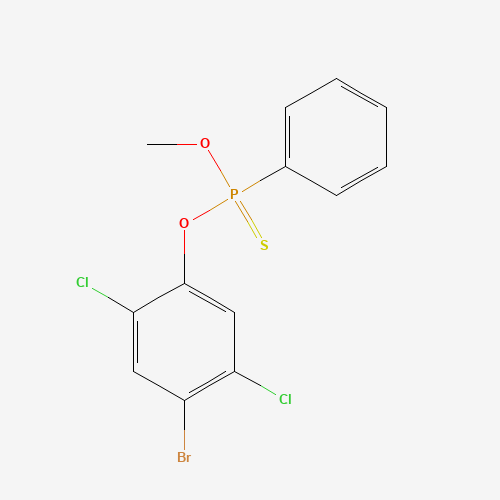
Physical Description | Leptophos appears as white crystalline or colorless amorphous solid, the technical product is a light tan powder. Used as an insecticide; its use is not permitted in the U.S. (EPA, 1998)
科学粮草官-词典编辑部,修订于:2026-07-06
Toxicity
ToxicityFate Summary
ATMOSPHERIC FATE: Based upon a measured vapor pressure of 2.3X10⁻⁸ mm Hg at 20 °C(1), leptophos can exist in both the vapor and particulate phases in the ambient atmosphere, although the particulate phase may dominate(2,SRC). It will degrade rapidly in the vapor phase by reaction with photochemically produced hydroxyl radicals with an estimated half-life of about 5 hr(3,SRC). Particulate phase leptophos and aerosols released to air during spray applications of leptophos insecticide can be removed from air physically by dry and wet deposition(SRC).
Soil Adsorption / Mobility
The adsorption behavior of leptophos in soil and aqueous suspension of soil and sediment was studied in the laboratory(1); based upon results of leaching tests, leptophos was assigned a mobility factor of zero, which indicated that it was not leachable from either sand or various organic soils(1); Freundlich adsorption isotherms measured in a river sediment, sandy loam soil and sand(1) can be used to determine respective log Koc values of 5.07, 4.98 and 4.85(1). An experimentally determined log Koc of 3.97 has also been reported(2). According to a suggested classification scheme(3), these estimated Koc values indicate that leptophos is immobile in soil(SRC).
Environmental Biodegradation
In die-away tests using a natural water (pH 7 collected from a drainage ditch in a vegetable growing area of Canada), sterilized natural water, and distilled water, leptophos degraded only slightly more rapidly in the unsterilized natural water over a 16-week incubation period(1); over the 16-week period, approximately 55-60% of the initial leptophos was degraded with removal only several percent more rapid in the unsterilized natural water as compared to the other waters(1); although some biodegradation was occurring, it was concluded that chemical degradation is more important than microbial degradation(1).
Environmental Bioconcentration
Using a continuous-flow system and a 14-day exposure period a leptophos BCF of 6058 was measured in topmouth gudgeon (Pseudorasbora parva) fish(1-2). This BCF suggests that bioconcentration in aquatic organisms has environmental importance(SRC). A BCF of 773 was estimated from equilibrium concentrations in a bioaccumulation study with bluegill fish(3).
Volatilization from Water / Soil
Based upon a measured vapor pressure of 2.3E-8 mm Hg(1) and a water solubility of 0.0047 mg/L at 20 °C(1), the Henry's Law constant for leptophos can be estimated to be 2.65X10⁻⁶ atm-cu m/mole(SRC). This value of Henry's Law constant indicates slow volatilization from water(2). Based on this Henry's Law constant, the volatilization half-life from a model river (1 m deep flowing 1 m/sec with a wind velocity of 3 m/sec) can be estimated to be about 28 days(2,SRC). The volatilization half-life from a model environmental pond can be estimated to be about 307 days if the effect of adsorption to sediment is ignored(3,SRC); if the maximum effect of adsorption to sediment is included, the estimated volatilization half-life from the pond exceeds five years(3,SRC).
Environmental Abiotic Degradation
The rate constant for the vapor phase reaction of leptophos with photochemically produced hydroxyl radicals has been estimated to be 6.01X10⁻¹¹ cu cm/molecule-sec at 25 °C which corresponds to an atmospheric half-life of about 6.4 hours at an atmospheric concn of 5X10+5 hydroxyl radicals per cu cm(1,SRC). The aqueous hydrolysis half-life of leptophos in sterile water-ethanol (99:1) phosphate buffers at 25 °C was determined to be 350, 170, 35, 5.5 and 2.3 weeks at respective pHs of 4.5, 5.0, 6.0, 7.0 and 8.0(2). The photodegradation half-life of thin films of leptophos exposed to sunlight was experimentally determined to be approximately 20 days(3); the photodegradation half-life methanol solutions of leptophos exposed to sunlight was experimentally determined to be approximately 50 days...
Environmental Water Concentrations
SURFACE WATER: Leptophos has been qualitatively detected in open waters of Lake St Clair of the Great Lakes ecosystem(1).
Food Survey Values
As part of the US Food and Drug Administration's Total Diet Study (Market Basket Survey of ready-to-eat foods) for fiscal year 1977, leptophos was detected in one of 300 food composites comprised of foods collected from 20 cities nationwide(1); the leptophos was detected in a fruit sample at concn of 0.012 ppm(1). As part of the US Food and Drug Administration's Total Diet Study (Market Basket Survey of ready-to-eat foods) for fiscal year 1976, leptophos was detected in two of 240 food composites comprised of foods collected from 20 cities nationwide(2); the leptophos was detected in garden fruit samples at concns of a trace (concn not available) and 0.009 ppm(2). For fiscal year 1975, leptophos was found in one of 240 food composites (garden fruit class) at a concn of 0.04 ppm(3). For...
Artificial Pollution Sources
When used as an insecticide, leptophos is released directly to the environment through applications in sprays, dusts and other routes of application(1-2,SRC). Its' registration has been withdrawn in the US(3).
Sediment/Soil Concentrations
Soils were collected in 1976 from 28 farms located in six widely separated areas of southwestern Ontario(1); leptophos was detected (detection limit of 0.02 ppm) in 6 soils at concns ranging from 0.03 to 0.30 ppm(1).
Probable Routes of Human Exposure
Occupational exposure to leptophos occurs through dermal contact and inhalation of dust and sprays, especially to workers applying the compound as an insecticide(1).
Environmental Fate / Exposure Summary
When used as an insecticide, leptophos is released directly to the environment through applications in sprays, dusts and other routes of application. However, in the US its' registration has been withdrawn. If released to the atmosphere, leptophos will degrade rapidly in the vapor-phase by reaction with photochemically produced hydroxyl radicals (half-life of about 5 hr). Particulate phase leptophos will be removed from air physically by wet and dry deposition. If released to water, leptophos will partition from the water column to sediment and suspended material. The results of one screening study indicate that chemical degradation is more important in natural water than biodegradation. Aqueous hydrolysis rates increase with increasing pH; at 25 °C, aqueous hydrolysis half-lives of 35,...
Adverse Effects
Other Poison - Organophosphate
Average Daily Intake
Based upon monitoring results from the US Food and Drug Administration's Total Diet Study (Market Basket Survey) for fiscal years 1976 and 1977, the average daily intake of leptophos from food for the adult male has been estimated to be 0.0005 and 0.0015 ug/kg body weight/day(1).
Human Toxicity Excerpts
SYMPTOMATOLOGY: 8. DIFFICULTY IN BREATHING, EXCESSIVE SECRETION OF SALIVA & OF RESP TRACT MUCUS, ORONASAL FROTHING, CYANOSIS, PULMONARY RALES & RHONCHI & HYPERTENSION, (PRESUMABLY DUE TO ASPHYXIA). 9. RANDOM JERKY MOVEMENTS, INCONTINENCE, CONVULSIONS, & COMA. 10. DEATH PRIMARILY DUE TO RESP ARREST ARISING FROM FAILURE OF RESP CENTER, PARALYSIS OF RESP MUSCLES, INTENSE BRONCHOCONSTRICTION OR ALL THREE. /PARATHION/
Non-Human Toxicity Values
LD50 Rabbit skin 800 mg/kg









