


 一键配货
一键配货
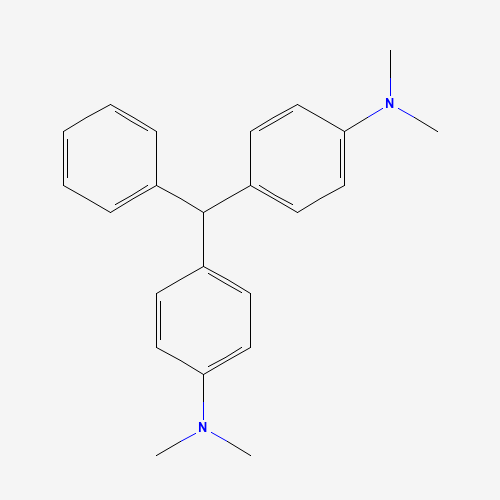
化合物详情
CAS129-73-7
分子式C23H26N2
分子量330.47 g/mol g/mol
危化品
Leucomalachite Green can cause cancer according to California Labor Code.
科学粮草官-词典编辑部,修订于:2026-07-06
Toxicity
ToxicityFate Summary
ATMOSPHERIC FATE: According to a model of gas/particle partitioning of semivolatile organic compounds in the atmosphere(1), leucomalachite green, which has an estimated vapor pressure of 1.9X10⁻⁷ mm Hg at 25 °C(SRC), determined from a fragment constant method(2), will exist in both the vapor and particulate phases in the ambient atmosphere. Vapor-phase leucomalachite green is degraded in the atmosphere by reaction with photochemically-produced hydroxyl radicals(SRC); the half-life for this reaction in air is estimated to be 0.6 hours(SRC), calculated from its rate constant of 2.1X10⁻¹⁰ cu cm/molecule-sec at 25 °C(SRC) that was derived using a structure estimation method(3). Particulate-phase leucomalachite green may be removed from the air by wet or dry deposition(SRC). Leucomalachite g...
Soil Adsorption / Mobility
UNREVIEWED | Using a structure estimation method based on molecular connectivity indices(1), the Koc of leucomalachite green can be estimated to be 9.8X10+4(SRC). According to a classification scheme(2), this estimated Koc value suggests that leucomalachite green is expected to be immobile in soil. The estimated pKa of leucomalachite green is 5.46(3), indicating that this compound will exist partially in the cation form in the environment and cations generally adsorb more strongly to soils containing organic carbon and clay than their neutral counterparts(4).
Environmental Bioconcentration
An estimated BCF of 2800 was calculated in fish for leucomalachite green(SRC), using an estimated log Kow of 5.72(1) and a regression-derived equation(2). According to a classification scheme(3), this BCF suggests the potential for bioconcentration in aquatic organisms is very high(SRC), provided the compound is not metabolized by the organism(SRC).
Volatilization from Water / Soil
The Henry's Law constant for the neutral species of leucomalachite green is estimated as 9.8X10⁻⁹ atm-cu m/mole(SRC) using a fragment constant estimation method(1). This Henry's Law constant indicates that leucomalachite green is expected to be essentially nonvolatile from water and moist soil surfaces(2). The estimated pKa of 5.72(3) indicates leucomalachite green will exist partially in the cation form at pH values of 5 to 9 and therefore volatilization from water surfaces is not expected to be an important fate process(SRC). Leucomalachite green is not expected to volatilize from dry soil surfaces(SRC) based upon an estimated vapor pressure of 1.9X10⁻⁷ mm Hg(SRC), determined from a fragment constant method(4).
Environmental Abiotic Degradation
The rate constant for the vapor-phase reaction of leucomalachite green with photochemically-produced hydroxyl radicals has been estimated as 2.1X10⁻¹⁰ cu cm/molecule-sec at 25 °C(SRC) using a structure estimation method(1). This corresponds to an atmospheric half-life of about 0.6 hours at an atmospheric concentration of 5X10+5 hydroxyl radicals per cu cm(1). Leucomalachite green does not contain chromophores that absorb at wavelengths >290 nm(2) and, therefore, is not expected to be susceptible to direct photolysis by sunlight(SRC).
Fish/Seafood Concentrations
Leocomalachite green is a biometabolic product of malachite green. Malachite green in water originates from contamination as a result of its industrial applications or from its illegal use in aquaculture and is efficiently taken up from the water by fish and distributed to all tissues. The rate of excretion of leucomalachite green from fish is dependent on the fat content of the fish, with more leucomalachite green being retained in fatty fish than in lean fish. Therefore, when fish that have been exposed to malachite green reach the consumer, the amount of leucomalachite green present in the fish is expected to be higher than the parent, due to its longer elimination half-life(1).
Artificial Pollution Sources
Leucomalachite green's production and use as a dye precursor and biochemical lab reagent(1) may result in its release to the environment through various waste streams(SRC). The dye must be protected from light and the atmosphere to prevent oxidation to the malachite green carbinol base(1).
Probable Routes of Human Exposure
NIOSH (NOES Survey 1981-1983) has statistically estimated that 28 workers (none of these were female) were potentially exposed to leucomalachite green in the US(1). The greatest potential for dermal and inhalation exposure to leucomalachite green is expected at the manufacturing site and to a lesser extent during activities at consumer sites(SRC).
Environmental Fate / Exposure Summary
Leucomalachite green's production and use as dye precursor and biochemical lab reagent may result in its release to the environment through various waste streams. If released to air, an estimated vapor pressure of 1.9X10⁻⁷ mm Hg at 25 °C indicates leucomalachite green will exist in both the vapor and particulate phases in the atmosphere. Vapor-phase leucomalachite green will be degraded in the atmosphere by reaction with photochemically-produced hydroxyl radicals; the half-life for this reaction in air is estimated to be 0.6 hours. Particulate-phase leucomalachite green will be removed from the atmosphere by wet or dry deposition. Leucomalachite green contains chromophores that absorb at wavelengths >290 nm and, therefore, may be susceptible to direct photolysis by sunlight. The dye mus...
Effect Level
collection=toxvaldb&kind=^EL$
Adverse Effects
IARC Carcinogen - Class 3: Chemicals are not classifiable by the International Agency for Research on Cancer.
Benchmark Values
collection=toxvaldb&kind=^BV$
Average Daily Intake
Malachite green, originating in water as a result of its industrial applications or from its illegal use in aquaculture, is metabolically reduced by fish to the persistent colorless metabolite, leucomalachite green. The estimated the mean level for malachite green is 30.7 ug/kg fish muscle (97.5th percentile = 138 ug/kg). Assuming the daily consumption of fish in the UK to be 300 g/person, the daily exposure to the sum of malachite green and leucomalachite green can be calculated to be 9.2 and 41 ug/person at the mean and 97.5th percentile, respectively. For a 60-kg person, this would be equivalent to 0.15 ug/kg body weight per day and 0.69 ug/kg body weight per day, respectively(1).
Human Toxicity Excerpts
/ALTERNATIVE and IN VITRO TESTS/ ... Since malachite green (MG), suspected to act as a tumor promoter in vitro and in vivo, might be also present as a residue in fish, the present study was undertaken to ascertain the in vitro toxicity of both compounds in two human tumour cell lines (Caco-2 and HEp-2). After 24 hr incubation with MG, significant decreases of cell viability, measured by neutral red uptake (NRU) or total protein content (TPC) as well as proliferation capability (colony-forming ability, CFA) were noticed in HEp-2 cells; the mean IC(50) value was about 2 uM. As regards the differentiated Caco-2 cells, MG caused a dose-related significant cytotoxicity, measured either by MTT test, the LDH leakage or NRU, with a mean IC(50) value of about 15 uM. By contrast, LMG disclosed, i...
Carcinogen Classification
Summary: Exposure to malachite green chloride in feed resulted in nonneoplastic lesions in the thyroid gland and liver of female rats and the urinary bladder of female mice. Exposure to leucomalachite green in feed resulted in nonneoplastic lesions in the thyroid gland and liver of male and female rats and the urinary bladder of female mice.
Non-Human Toxicity Excerpts
/LABORATORY ANIMALS: Chronic Exposure or Carcinogenicity/ Malachite green is a triphenylmethane dye used in the fish industry as an anti-fungal agent. Leucomalachite green is formed by the metabolic reduction of malachite green and persists in the tissues of exposed fish. In this study, we examined the carcinogenicity of malachite green chloride and leucomalachite green. Female F344 rats (48 per group) were fed diets containing 0, 100, 300, or 600 ppm malachite green chloride for 104 weeks, at which time the extent of tumorigenesis was assessed. Additional groups of 48 female and 48 male F344 rats were fed diets containing 0, 91, 272, or 543 ppm leucomalachite green for 104 weeks. Groups of 48 female B6C3F1 mice were fed diets containing 0, 100, 225, or 450 ppm malachite green chloride...
Antidote and Emergency Treatment
/SRP:/ Advanced treatment: Consider orotracheal or nasotracheal intubation for airway control in the patient who is unconscious, has severe pulmonary edema, or is in severe respiratory distress. Positive-pressure ventilation techniques with a bag valve mask device may be beneficial. Consider drug therapy for pulmonary edema ... . Consider administering a beta agonist such as albuterol for severe bronchospasm ... . Monitor cardiac rhythm and treat arrhythmias as necessary ... . Start IV administration of D5W /SRP: "To keep open", minimal flow rate/. Use 0.9% saline (NS) or lactated Ringer's if signs of hypovolemia are present. For hypotension with signs of hypovolemia, administer fluid cautiously. Watch for signs of fluid overload ... . Treat seizures with diazepam or lorazepam ... . Use...









