


 一键配货
一键配货
化合物详情
CAS3239-44-9
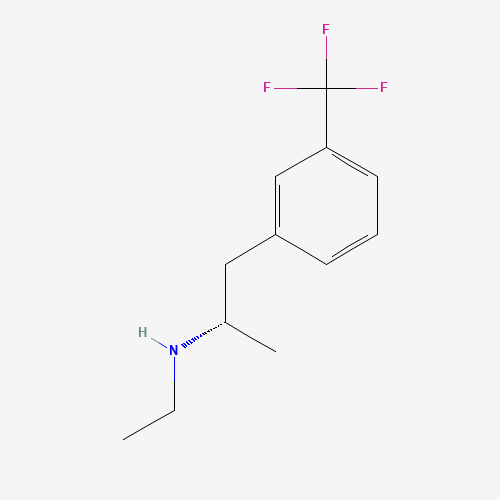
分子式C12H16F3N
分子量267.72 g/mol
非危品
(S)-fenfluramine is the S-enantiomer of fenfluramine. It stimulates the release of serotonin and selectively inhibits its reuptake, but unlike fenfluramine it does not possess catecholamine agonist activity. It was formerly given by mouth as the hydrochloride in the treatment of obesity, but, like fenfluramine, was withdrawn wolrdwide following reports of valvular heart defects. It has a role as a serotonergic agonist, an appetite depressant and a serotonin uptake inhibitor. It is an enantiomer of a (R)-fenfluramine.
科学粮草官-词典编辑部,修订于:2026-07-06
Toxicity
ToxicityBody Burden
It is not known whether dexfenfluramine is excreted into human milk. However, the drug is excreted into rat milk.
Fate Summary
ATMOSPHERIC FATE: According to a model of gas/particle partitioning of semivolatile organic compounds in the atmosphere(1), dexfenfluramine, which has an estimated vapor pressure of 0.04 mm Hg at 25 °C(SRC), determined from a fragment constant method(2), is expected to exist solely as a vapor in the ambient atmosphere. Vapor-phase dexfenfluramine is degraded in the atmosphere by reaction with photochemically-produced hydroxyl radicals(SRC); the half-life for this reaction in air is estimated to be 12 hrs(SRC), calculated from its rate constant of 3.3X10⁻¹¹ cu cm/molecule-sec at 25 °C(SRC) that was derived using a structure estimation method(3). Dexfenfluramine does not contain chromophores that absorb at wavelengths >290 nm and therefore is not expected to be susceptible to direct photo...
Soil Adsorption / Mobility
Using a structure estimation method based on molecular connectivity indices(1), the Koc of dexfenfluramine can be estimated to be 2.1X10+4(SRC). According to a classification scheme(2), this estimated Koc value suggests that dexfenfluramine is expected to be immobile in soil. The estimated pKa of dexfenfluramine is 9.40(3), indicating that this compound will partially exist in the cation form in the environment and cations generally adsorb more strongly to soils containing organic carbon and clay than their neutral counterparts(4).
Environmental Bioconcentration
An estimated BCF of 77 was calculated for dexfenfluramine(SRC), using an estimated log Kow of 3.7(1) and a regression-derived equation(2). According to a classification scheme(3), this BCF suggests the potential for bioconcentration in aquatic organisms is moderate(SRC), provided the compound is not metabolized by the organism(SRC).
Volatilization from Water / Soil
The Henry's Law constant for dexfenfluramine is estimated as 2.7X10⁻⁵ atm-cu m/mole(SRC) using a fragment constant estimation method(1). This Henry's Law constant indicates that dexfenfluramine is expected to volatilize from water surfaces(2). Based on this Henry's Law constant, the volatilization half-life from a model river (1 m deep, flowing 1 m/sec, wind velocity of 3 m/sec)(2) is estimated as 2 days(SRC). The volatilization half-life from a model lake (1 m deep, flowing 0.05 m/sec, wind velocity of 0.5 m/sec)(2) is estimated as 21 days(SRC). However, an estimated pKa of 9.40(3) indicates dexfenfluarmaine will exist partially in the cation form at pH values of 5 to 9 and therefore volatilization from water surfaces is not expected to be an important fate process. Volatilization from...
Environmental Abiotic Degradation
The rate constant for the vapor-phase reaction of dexfenfluramine with photochemically-produced hydroxyl radicals has been estimated as 3.3X10⁻¹¹ cu cm/molecule-sec at 25 °C(SRC) using a structure estimation method(1). This corresponds to an atmospheric half-life of about 12 hours at an atmospheric concentration of 5X10+5 hydroxyl radicals per cu cm(1). Dexfenfluramine is not expected to undergo hydrolysis in the environment due to the lack of functional groups that hydrolyze under environmental conditions(2). Dexfenfluramine does not contain chromophores that absorb at wavelengths >290 nm and therefore is not expected to be susceptible to direct photolysis by sunlight(2).
Environmental Water Concentrations
While data specific to dexenfluramine were not located(SRC, 2005), the literature suggests that some pharmaceutically active compounds originating from human and veterinary therapy are not eliminated completely in municipal sewage treatment plants and are therefore discharged into receiving waters(1). Wastewater treatment processes often were not designed to remove them from the effluent(2). Selected organic waste compounds may be degrading to new and more persistent compounds that may be released instead of or in addition to the parent compound(2). Studies have indicated that several polar pharmaceutically active compounds can leach through subsoils into aquifers(1).
Milk Concentrations
It is not known whether dexfenfluramine is excreted into human milk. However, the drug is excreted into rat milk.
Artificial Pollution Sources
Dexfenfluramine's former production and use for the treatment of severe obesity(1) may have resulted in its release to the environment through various waste streams(SRC).
Probable Routes of Human Exposure
Occupational exposure to dexfenfluramine may have occured through inhalation and dermal contact with this compound at workplaces where dexfenfluramine was produced or used. Exposure to dexfenfluramine among the general population may have been limited to those administered the drug, an anorexic. (SRC)
Environmental Fate / Exposure Summary
Dexfenfluramine's former production and use for the treatment of severe obesity may have resulted in its release to the environment through various waste streams. If released to air, an estimated vapor pressure of 0.04 mm Hg at 25 °C indicates dexfenfluramine will exist solely as a vapor in the atmosphere. Vapor-phase dexfenfluramine will be degraded in the atmosphere by reaction with photochemically-produced hydroxyl radicals; the half-life for this reaction in air is estimated to be 12 hours. Dexfenfluramine does not contain chromophores that absorb at wavelengths >290 nm and therefore is not expected to be susceptible to direct photolysis by sunlight. If released to soil, dexfenfluramine is expected to have no mobility based upon an estimated Koc of 2.1X10+4. The estimated pKa of dex...
Symptoms
Symptoms of overdose include respiratory failure and cardiac arrest leading to death.
Treatment
General supportive measures for oral drug overdose should be instituted. Measures that have been used in dexfenfluramine overdose cases include aspiration of gastric contents, gastric lavage with activated charcoal, osmotic diuresis, forced acid diuresis, and careful monitoring of CNS or respiratory depression. The effectiveness of dialysis is not known. Patients should be followed closely until there is no further evidence of drug-related CNS effects. No specific therapy for dexfenfluramine overdose is known. (L1712)
Lethal Dose
collection=toxvaldb&kind=^LD$
Exposure Routes
Well-absorbed from the gastrointestinal tract.
Toxicity Summary
Dexfenfluramine binds to the serotonin reuptake pump. This causes inhbition of serotonin reuptake. The increased levels of serotonin lead to greater serotonin receptor activation which in turn lead to enhancement of serotoninergic transmission in the centres of feeding behavior located in the hypothalamus. This suppresses the appetite for carbohydrates.
Human Toxicity Excerpts
/EPIDEMIOLOGY STUDIES/ Previous studies have reported small increases in the prevalence of low-grade aortic and mitral regurgitation in patients treated with dexfenfluramine compared with placebo. However, whether valvular abnormalities develop or progress 1 year after discontinuation of dexfenfluramine therapy has not been determined. To assess change in valvular regurgitation and morphologic characteristics 1 year after discontinuation of dexfenfluramine therapy. ... A randomized, double-blind, placebo-controlled, multicenter study. Outpatient obesity centers. Obese persons who had been treated for 2 to 3 months with dexfenfluramine, sustained-release dexfenfluramine, or placebo. Blinding was maintained, and patients returned for repeated echocardiography at 1 year. ... 914 patients w...
Carcinogen Classification
No indication of carcinogenicity to humans (not listed by IARC).
Non-Human Toxicity Values
LD50 Rat oral 114.6 mg/kg
Non-Human Toxicity Excerpts
/GENOTOXICITY/ Dexfenfluramine did not exhibit mutagenic potential in the Ames test, gene conversion-DNA repair test, evaluation of the clastogenic effect on human lymphocyte cultures, mouse lymphoma cell mutation test, or mouse micronucleus test.
Populations at Special Risk
Clinical studies of dexfenfluramine did not include sufficient numbers of patients 65 years of age and older to determine whether geriatric patients respond differently than younger patients. Because geriatric patients generally are more sensitive to drugs that affect the CNS, dexfenfluramine should be used with caution in these patients. The greater frequency of decreased hepatic, renal, and/or cardiac function and of concomitant disease and drug therapy observed in the elderly should also be considered. /Dexfenfluramine/
Antidote and Emergency Treatment
Specific treatment /includes/ barbiturate sedatives or diazepam sometimes used to control excessive CNS stimulation. Intravenous diazepam to control seizures; phenytoin to control seizures that are refractory to diazepam. When hyperthermia and rhabdomyolysis are present, curarization may be required. Intravenous phentolamine or nitrates, if necessary, to control acute, severe hypertension. Intravenous lidocaine for cardiac arrhythmias. Beta- adrenergic blocking agent for control of tachycardia. /Appetite Suppressants, Sympathomimetic/









