


 一键配货
一键配货
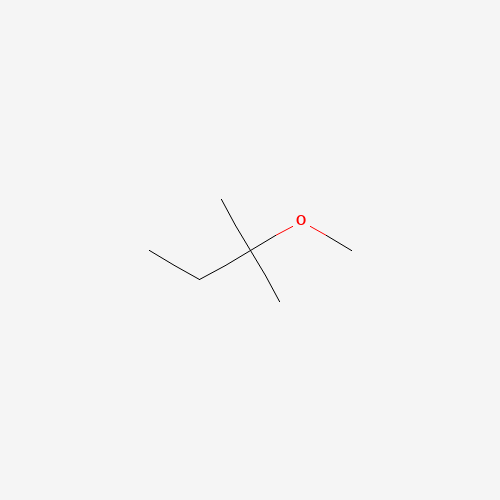
化合物详情
CAS994-05-8
分子式C6H14O
分子量102.17 g/mol g/mol
危化品
structure given in first source
科学粮草官-词典编辑部,修订于:2026-07-06
Toxicity
ToxicityBody Burden
On average, levels of tert-amyl methyl ether in urine samples from Finnish gasoline road-tanker drivers after a work shift and 16 hours later were reported to be 16 and 9 nmol/L, respectively(1). Breathing zone concentrations among Finnish gasoline lorry drivers were reported at a geometric mean of 0.98 mg/cu m, range of 0.22 to 6.9 mg/cu m; study conducted in August, 1995. Concentrations in blood and urine were 79 to 151 and 7 to 40 nmol/L, respectively(2).
Ecotoxicity Values
EC50; Species: Pseudokirchneriella subcapitata (Green algae, 1x10+4 cells/mL); Conditions: freshwater, static, 22.6-23.9 °C, pH 7.9-9.7; Concentration: >100000 ug/L for 72 hr; Effect: decreased population growth rate /97.17% purity/
Fate Summary
ATMOSPHERIC FATE: According to a model of gas/particle partitioning of semivolatile organic compounds in the atmosphere(1), tert-amyl methyl ether, which has a vapor pressure of 75.2 mm Hg at 25 °C(2), is expected to exist solely as a vapor in the ambient atmosphere. Vapor-phase tert-amyl methyl ether is degraded in the atmosphere by reaction with photochemically-produced hydroxyl radicals(SRC); the half-life for this reaction in air is estimated to be 3 days(SRC), calculated from its rate constant of 5.50X10⁻¹² cu cm/molecule-sec at 25 °C(3). tert-Amyl methyl ether does not contain chromophores that absorb at wavelengths >290 nm(4), and therefore is not expected to be susceptible to direct photolysis by sunlight(SRC).
Soil Adsorption / Mobility
The Koc of tert-amyl methyl ether has been reported to range from 19 to 160(1,2). According to a classification scheme(3), these Koc values suggest that tert-amyl methyl ether is expected to have very high to moderate mobility in soil. Using a model system simulating horizontal ground water flow in the saturated zone, consisting of only soil and water phases (an unconfined sand aquifer was selected as an example case), a Koc of 60 was calculated(4).
Environmental Biodegradation
ANAEROBIC: tert-Amyl methyl ether was not biodegraded using inocula derived from a gasoline-impacted aquifer, fuel impacted river sediment, nor industrial and sewage impacted creek sediments(1). No biodegradation was observed after 80 days when incubated using inoculum from an anaerobic granular treating distillery waste water (Nedalco, The Netherlands) nor sediment from the Rhine River, Wageningen, The Netherlands(2).
Environmental Bioconcentration
An estimated BCF of 5 was calculated in fish for tert-amyl methyl ether(SRC), using a log Kow of 1.55(1) and a regression-derived equation(2). According to a classification scheme(3), this BCF suggests the potential for bioconcentration in aquatic organisms is low(SRC).
Volatilization from Water / Soil
The Henry's Law constant for tert-amyl methyl ether is 1.32X10⁻³ atm-cu m/mole(1). This Henry's Law constant indicates that tert-amyl methyl ether is expected to volatilize rapidly from water surfaces(2). Based on this Henry's Law constant, the volatilization half-life from a model river (1 m deep, flowing 1 m/sec, wind velocity of 3 m/sec)(2) is estimated as 4 hours(SRC). The volatilization half-life from a model lake (1 m deep, flowing 0.05 m/sec, wind velocity of 0.5 m/sec)(2) is estimated as 4 days(SRC). tert-Amyl methyl ether's Henry's Law constant indicates that volatilization from moist soil surfaces may occur(SRC). tert-Amyl methyl ether is expected to volatilize from dry soil surfaces(SRC) based upon a vapor pressure of 75.2 mm Hg(3).
Environmental Abiotic Degradation
The rate constant for the vapor-phase reaction of tert-amyl methyl ether with photochemically-produced hydroxyl radicals is 5.50X10⁻¹² cu cm/molecule-sec at 25 °C(1). This corresponds to an atmospheric half-life of about 3 days at an atmospheric concentration of 5X10+5 hydroxyl radicals per cu cm(1). The rate constant for the vapor-phase reaction of tert-amyl methyl ether with photochemically-produced nitrate radicals is 1.218X10⁻¹² cu cm/molecule-sec at 257-367 K. Degradation products identified were tert-amyl formate, formaldehyde, and tert-amyl nitrate(2). tert-Amyl methyl ether is not expected to undergo hydrolysis in the environment due to the lack of functional groups that hydrolyze under environmental conditions(3). tert-Amyl methyl ether does not contain chromophores that absorb...
Environmental Water Concentrations
DRINKING WATER: The U.S. Geological Survey surveyed 1,206 well samples in 2006; tert-amyl methyl ether was detected in 6 samples, detection frequency 0.50%(1). tert-Amyl methylether was detected (range of 0.4-0.7 ug/L) in 1.4% of 579 groundwater sources and 375 surface-water sources, randomly collected from May 3, 1999 through October 200 from throughout the US, Native American lands, and Puerto Rico(2).
Effluent Concentrations
tert-Amyl methyl ether was detected in 3.1% of 249 storm water samples collected from 46 different sampling locations in North Carolina from November 1998 through October 1999. The mean and maximum concentrations were 0.09 and 0.23 ug/L, respectively. Samples were collected from urban land-use areas where fuel oxygenates might have been expected to occur(1).
ICSC Environmental Data
This substance may be hazardous to the environment. Special attention should be given to ground water contamination.
Artificial Pollution Sources
tert-Amyl methyl ether's production and use as a gasoline additive as an octane booster(1) may result in its release to the environment through various waste streams(SRC).
Probable Routes of Human Exposure
Occupational exposure to tert-amyl methyl ether may occur through inhalationand dermal contact with this compound at workplaces where tert-amyl methyl ether is produced or used. On average, gasoline road-tanker drivers in Finland are exposed to tert-amyl methyl ether vapors at a mean concentration of 0.3 mg/cu m during a three-hour shift(1). Limited and use monitoring data indicate that the general population may be exposed to tert-amyl methyl ether via inhalation of ambient air and ingestion of drinking water(SRC).
Environmental Fate / Exposure Summary
tert-Amyl methyl ether's production and use as a gasoline additive may result in its release to the environment through various waste streams. If released to air, a vapor pressure of 75.2 mm Hg at 25 °C indicates tert-amyl methyl ether will exist solely as a vapor in the atmosphere. Vapor-phase tert-amyl methyl ether will be degraded in the atmosphere by reaction with photochemically-produced hydroxyl radicals; the half-life for this reaction in air is estimated to be 3 days. tert-Amyl methyl ether does not contain chromophores that absorb at wavelengths >290 nm, and therefore is not expected to be susceptible to direct photolysis by sunlight. If released to soil, tert-amyl methyl ether is expected to have very to moderate mobility based upon a Koc range of 19 to 160. Volatilization fro...
Symptoms
Ingestion Exposure: See Inhalation.
Toxicity Data
LC50 (rat) = >5,400 mg/m3/4H
Adverse Effects
Reproductive Toxin - A chemical that is toxic to the reproductive system, including defects in the progeny and injury to male or female reproductive function. Reproductive toxicity includes developmental effects. See Guidelines for Reproductive Toxicity Risk Assessment.
Exposure Routes
The substance can be absorbed into the body by inhalation and by ingestion.
Toxicity Summary
Human Health. tert-amyl methyl ether (TAME) is absorbed efficiently from the rat intestine. TAME is rapidly absorbed from lungs; the respiration net uptake is 40 %. Studies with tert-methyl butyl ether (MTBE) suggest one third or less of a dermal TAME dose is absorbed. In rats, TAME is distributed evenly in the body. Urine is the main route of elimination. Based on human volunteer studies, the half-lives in blood varied between 1.2 and 6.3 hours. The main urine metabolites are 2-methyl-2,3- butanediol, 2-hydroxy-2-methylbutyric acid and 3-hydroxy-3-methylbutyric acid. Free and conjugated TAA (tert-amyl alcohol) and TAME were only minor metabolites in urine. The acute toxicity of TAME is not high. The LC50 value via inhalation is over 5.3 mg/l. The predicted oral LD50 was for females 160...
Human Toxicity Excerpts
/SIGNS AND SYMPTOMS/ Effects of short-term exposure: If this liquid is swallowed, aspiration into the lungs may result in chemical pneumonitis. Exposure at high levels could cause lowering of consciousness. Effects of long-term exposure: The liquid defats the skin.
Carcinogen Classification
IARC Monographs: Volume 138
Non-Human Toxicity Values
LC50 Rat inhalation >5,400 mg/cu m /4 hr
Non-Human Toxicity Excerpts
/LABORATORY ANIMALS: Subchronic or Prechronic Exposure/ Rats (strain and sex not given) were given tert-amyl methyl ether (TAME) by gavage daily for 29 days, dosage: 0-1000 mg/kg bw, 10 rats/group. 2/10 rats in high dose group died. Food consumption and body weight reduced, adrenal gland and kidney weights elevated, but no histopathological abnormalities.
Antidote and Emergency Treatment
/SRP:/ Advanced treatment: Consider orotracheal or nasotracheal intubation for airway control in the patient who is unconscious, has severe pulmonary edema, or is in severe respiratory distress. Positive-pressure ventilation techniques with a bag-valve-mask device may be beneficial. Consider drug therapy for pulmonary edema ... . Monitor cardiac rhythm and treat arrhythmias if necessary ... . Start IV administration of D5W /SRP: "To keep open", minimal flow rate/. Use 0.9% saline (NS) or lactated Ringer's (LR) if signs of hypovolemia are present. For hypotension with signs of hypovolemia, administer fluid cautiously. Consider vasopressors if patient is hypotensive with a normal fluid volume. Watch for signs of fluid overload ... . Use proparacaine hydrochloride to assist eye irrigation...
USGS Health-Based Screening Levels for Evaluating Water-Quality
Reference: Smith, C.D. and Nowell, L.H., 2024. Health-Based Screening Levels for evaluating water-quality data (3rd ed.). DOI:10.5066/F71C1TWP









