


 一键配货
一键配货
化合物详情
CAS33245-39-5
分子式C12H13ClF3N3O4
分子量355.7 g/mol
非危品
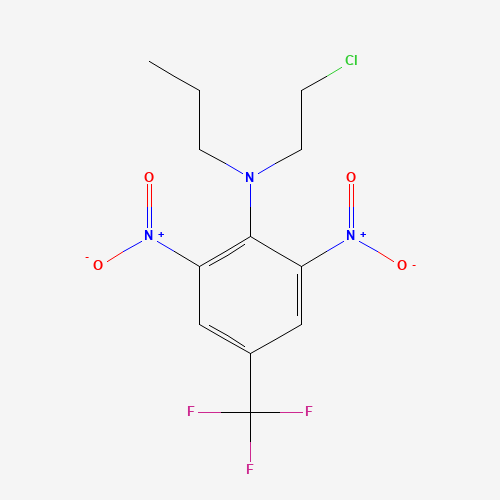
Fluchloralin is a C-nitro compound.
科学粮草官-词典编辑部,修订于:2026-07-06
Toxicity
ToxicityEPA Ecotoxicity
Pesticide Ecotoxicity Data from EPA: 22
Fate Summary
ATMOSPHERIC FATE: According to a model of gas/particle partitioning of semivolatile organic compounds in the atmosphere(1), fluchloralin, which has a vapor pressure of 3X10⁻⁵ mm Hg at 20 °C(1) is expected to exist in both the vapor and particulate phases in the ambient atmosphere. Vapor-phase fluchloralin is degraded in the atmosphere by reaction with photochemically produced hydroxyl radicals(SRC); the half-life for this reaction in air is estimated to be about 25 hours(SRC) calculated from its rate constant of 1.6X10⁻¹¹ cu cm/molecule-sec(SRC), derived using a structure estimation method(3). Fluchloralin absorbs light greater than 290 nm and is susceptible to photolysis in the atmosphere based on its rate of photolysis in aqueous solution(4). Particulate-phase fluchloralin may be phys...
Soil Adsorption / Mobility
... IS STRONGLY ADSORBED BY CLAY COLLOIDS & ORGANIC MATTER & THESE TWO CHARACTERISTICS INFLUENCE THE NECESSARY HERBICIDAL RATE REQUIRED.
Environmental Biodegradation
In greenhouse studies using a silt loam and a clay loam soil, fluchloralin had a half-life of 3.3 to 5.1 months(1). In laboratory soil metabolism studies, fluchloralin metabolites were found to include a benzimidazole derivative, a quinoxaline derivative and various fluchloralin dealkylation derivatives(2). A field study in Arkansas found half-lives of 12.2-17.6 weeks(3); a laboratory study at 25 °C found half-lives of 8.4 weeks for moisture conditions at field capacity and 2.9 weeks under flooded conditions(4). At 4 °C, half-lives were 28.7 weeks (field capacity) and 19.5 weeks (flooded conditions)(3).
Environmental Bioconcentration
An estimated BCF value of 733 was calculated for fluchloralin(SRC), using an estimated log Kow of 5.07(1) and a regression-derived equation(2). According to a classification scheme(3), this BCF value suggests the potential for bioconcentration in aquatic organisms is high(SRC).
Volatilization from Water / Soil
Laboratory studies were conducted to measure 3-hr vapor losses of dinitroaniline herbicides from various soils(1); from Lakeland sand at 7% soil moisture, vapor losses of fluchloralin were about 1, 2 and 11% at respective temperatures of 30, 40 and 50 °C(1); from Lakeland sand at 15.3% soil moisture, vapor losses of fluchloralin were about 0.5, 2 and 8.5% at respective temperatures of 30, 40 and 50 °C(1); from Littleton silt loam and Hagerstown clay loam at 50 °C and 25% soil moisture, the respective vapor losses were about 2.5 and 5%(1). In another soil volatilization study, volatilization losses of fluchloralin ranged from about 8 to 30% at 25 °C under dry conditions, field capacity or flooded conditions(2); at 4 °C, losses ranged from about 1-4%(2).
Environmental Abiotic Degradation
The direct photolysis of fluchloralin was examined in 5 ppm aqueous solutions exposed to natural sunlight(1); after 13 and 48 days of exposure, 84 and 97%, respectively, of initial fluchloralin had photolyzed(1); the photolysis products included 2,6-dinitro-N-propyl-4-(trifluoromethyl)benzenamine, 2,6-dinitro-4-trifluoromethylaniline, and several benzimidazole derivatives(1). Fluchloralin applied to a sandy loam soil was irradiated for a 48-hr period with a photoreactor simulating sunlight; 20% photodegradation was observed(1). When a thin film of fluchloralin on a Pyrex surface was irradiated for a 48-hr period, 52% of initial fluchloralin photolyzed(1). (14)C labeled fluchloralin was applied to dry thin layer soil plates and exposed to unfiltered solar radiation for 7 days in July(2);...
Food Survey Values
In a US monitoring survey of 6970 produce samples (fruits and vegetables) collected between 1989 and 1991, fluchloralin was detected (detection limit of 0.05 ppm) in only one sample(1); the concn in the sample (onions) was not reported(1).
Ecotoxicity Excerpts
/AQUATUC SPECIES/ Hazards to fish: High toxicity poses potential threat to fish populations. ... Potential problems with endangered species: USDI has made a jeopardy assessment, finding threats to slackwater darter and 11 freshwater mussels from use of fluchloralin on soybeans.
Artificial Pollution Sources
Fluchloralin's former production and use in the US as a selective pre-planting herbicide(1) resulted in its direct release to the environment(SRC).
Sediment/Soil Concentrations
LOW LEVEL SOIL RESIDUES MAY PERSIST FOR MORE THAN ONE SEASON AFTER APPLICATION, AND PHYTOTOXICITY TO VERY SENSITIVE CROPS MAY OCCUR.
Probable Routes of Human Exposure
Occupational exposure and general population exposure should be low or non-existent since fluchloralin is no longer produced or used in the US. In the past, fluchloralin was used as an herbicide and exposure to this compound was primarily by dermal contact in the field where it was applied. (SRC)
Environmental Fate / Exposure Summary
Fluchloralin's former production and use in the US as a selective pre-planting herbicide resulted in its direct release to the environment. If released to air, a vapor pressure of 3X10⁻⁵ mm Hg at 20 °C indicates fluchloralin will exist in both the vapor and particulate phases in the atmosphere. Vapor-phase fluchloralin will be degraded in the atmosphere by reaction with photochemically-produced hydroxyl radicals; the half-life for this reaction in air is estimated to be 25 hours. Direct photolysis in the atmosphere is also likely to occur since fluchloralin absorbs light greater than 290 nm and undergoes photolysis in aqueous solutions exposed to sunlight. Particulate-phase fluchloralin will be removed from the atmosphere by wet and dry deposition. If released to soil, fluchloralin is e...
Human Toxicity Excerpts
/SIGNS AND SYMPTOMS/ Symptomatology indicates overdosing may produce /CNS depression/ and other general CNS involvement.
Non-Human Toxicity Values
LD50 Rat oral 1,550 mg/kg









