


 一键配货
一键配货
化合物详情
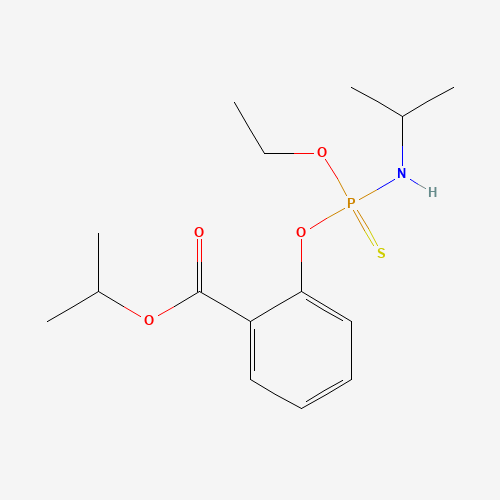
CAS25311-71-1
分子式C15H24NO4PS
分子量345.394 g/mol
危化品
Physical Description | Isofenphos is a colorless oil. Non corrosive. Used as an insecticide.
科学粮草官-词典编辑部,修订于:2026-07-06
Toxicity
ToxicityEPA Ecotoxicity
Pesticide Ecotoxicity Data from EPA: 61
Ecotoxicity Values
USDA APHIS Chemical Effects: collection=usda_chemeffect&query_type=synonym&query='^25311-71-1$'
Fate Summary
ATMOSPHERIC FATE: According to a model of gas/particle partitioning of semivolatile organic compounds in the atmosphere(1), isofenphos, which has a vapor pressure of 3.00X10⁻⁶ mm Hg at 25 °C(2), will exist in both the vapor and particulate phases in the ambient atmosphere(SRC). Vapor-phase isofenphos is degraded in the atmosphere by reaction with photochemically-produced hydroxyl radicals(SRC); the half-life for this reaction in air is estimated to be 1.4 hrs(SRC), calculated from its rate constant of 2.75X10⁻¹⁰ cu cm/molecule-sec at 25 °C(SRC) that was derived using a structure estimation method(3). Particulate-phase isofenphos may be removed from the air by wet and dry deposition(SRC).
Soil Adsorption / Mobility
The Koc of isofenphos ranged from 633 to 1,474 on four soils(1). According to a classification scheme(2), these Koc values suggest that isofenphos is expected to have low mobility in soil(SRC).
Environmental Biodegradation
ANAEROBIC: Isofenphos is stable under anaerobic aquatic conditions(1). In an anaerobic aquatic metabolism study, the distribution of applied isofenphos residues increased from 30% to >60% in the pond water and decreased from 69% to <30% in the sediment after 1 year (isofenphos comprised 90% of the residues)(1). This data suggests, at least in stagnant waters, a significant portion of applied isofenphos will remain in the water column(1).
Environmental Bioconcentration
BCFs of 94.5 (fillet), 469 (viscera), and 277 (whole body) in fish tissues were measured for isofenphos(1). According to a classification scheme(2), these BCF values suggests the potential for bioconcentration in aquatic organisms is high(SRC).
Volatilization from Water / Soil
The Henry's Law constant for isofenphos is 4.15X10⁻⁸ atm-cu m/mole(1). This Henry's Law constant indicates that isofenphos is expected to be essentially nonvolatile from water surfaces(2). Isofenphos is not expected to volatilize from dry soil surfaces(SRC) based upon a vapor pressure of 3.00X10⁻⁶ mm Hg(3).
Environmental Abiotic Degradation
The rate constant for the vapor-phase reaction of isofenphos with photochemically-produced hydroxyl radicals has been estimated as 2.75X10⁻¹⁰ cu cm/molecule-sec at 25 °C(SRC) using a structure estimation method(1). This corresponds to an atmospheric half-life of about 1.4 hrs at an atmospheric concentration of 5X10+5 hydroxyl radicals per cu cm(1). Isophenphos is stable to hydrolysis at pHs 5 and 7 and degrades slowly at pH 9 with a half-life of 131 days(2). At pH 6.1, isophenphos degraded in ultrapure water in 174 and 265 days at 22 and 6 °C, respectively(3). Isophenophos is stable to photolysis in water but degrades on soil exposed to light with a half-life of 72 days(2). In the presence of photosensitizers found in both river and seawater, photolysis half-lives in these waters were 2...
Environmental Water Concentrations
SURFACE WATER: The concn of isofenphos in surface water from a golf course putting green was 1,200 ppb(1); the putting green had been treated with 450 mg/sq m of isofenphos(1). No concentration was reported for one stream sample in Illinois. Isofenphos was not found above the limit of detection/quantification (0.03 to 0.5 ug/l) in 237 New York water samples (231 stream, 4 canal, and 2 lake samples)(2).
Food Survey Values
In Canada between 1992-1994, isofenphos was found in 1 of 105 broccoli (fresh) samples and 1 of 211 cauliflower (fresh) samples at concns <0.05 ppm(1). In Canada between 1989-1991, isofenphos was found in 1 of 1,044 samples of potato (fresh) and 2 of 187 samples of broccoli (fresh) at concns of 0.05 ppm(2).
Atmospheric Concentrations
URBAN/SUBURBAN: The concn of isofenphos in ambient air from Kitakyushu, Japan was 10 ng/cu m in July 1991 and 0.73 ng/cu m in April 1992(1).
Artificial Pollution Sources
Isofenphos' former(1) production may have resulted in its release to the environment through various waste streams; its former use as an insecticide on crops and turf grass(2) resulted in its direct release to the environment(SRC).
Sediment/Soil Concentrations
SEDIMENT: In Florida, isofenphos was not detected (limits of detection ranging from 1.2 to 36 mg/kg, dry weight) in 68 sediment samples taken from lakes, estuaries, streams and outflows(1).
Probable Routes of Human Exposure
Occupational exposure to isofenphos may occur through inhalation of dust and dermal contact with this compound at workplaces where isofenphos is produced or used. The general population may be exposed to isofenphos in areas were it is used as a pesticide. (SRC)
Other Environmental Concentrations
The concentration of isofenphos was 210 and 380 ng/g in house dust from two New Jersey homes in 1991(1); isofenfos was not detected in indoor air in these homes(1).
Environmental Fate / Exposure Summary
Isofenphos' former production may have resulted in its release to the environment through various waste streams; its former use as an insecticide on crops and turf grass resulted in its direct release to the environment. If released to air, a vapor pressure of 3.00X10⁻⁶ mm Hg at 25 °C indicates isofenphos will exist in both the vapor and particulate phases in the ambient atmosphere. Vapor-phase isofenphos will be degraded in the atmosphere by reaction with photochemically-produced hydroxyl radicals; the half-life for this reaction in air is estimated to be 1.4 days. Particulate-phase isofenphos will be removed from the atmosphere by wet and dry deposition. If released to soil, isofenphos is expected to have low mobility based upon a range of Koc values from 633 to 1,474. Volatilization...
Toxicity Data
LC50 (rat) = 144 mg/m3/4h
Adverse Effects
Other Poison - Organophosphate
RAIS Toxicity Values
Oral Chronic Reference Dose Reference: OPP
Human Toxicity Excerpts
The organophosphate pesticide, isofenphos, is associated with human myeloid leukemia. In this study we describe metabolic changes in K562 myeloid blast cells from exposure to varying concentrations of isofenphos using the stable [1,2-13C(2)]glucose isotope as the single tracer and biological mass spectrometry. Isofenphos (1, 10, 100 microg/ml/72 hr) treated K562 cells showed increases of 10.7, 33.8 and 39.7% in lactate production as well as a 14.2% increase (1 microg/ml/72 hr) in 13C incorporation into nucleic acid ribose from glucose. Concomitantly, we observed a decrease in glucose oxidation and the synthesis of glutamate, palmitate and stearate from glucose. Our results demonstrate that this organophosphate pesticide exerts a leukemogenic effect by the recruitment of glucose carbons...
Non-Human Toxicity Excerpts
The neuropathic potential of acute and repeated exposures of the phosphoramidates tabun (GA) and isofenphos (IFP), of diisopropyl fluorophosphate (DFP) and paraoxon (PO) were examined in the hen with treatments for up to 90 days via intramuscular injections of the highest tolerated doses with atropine protection. Plasma acetylcholinesterase (AChE), non-specific butyrylcholinesterase (BChE) and creatine kinase (CK) activities were measured in order to monitor whether the compounds were present at biologically active concentrations. Locomotor behavior was observed and tissues from the peripheral and central nervous systems were examined for signs of organophosphate-induced delayed neuropathy (OPIDN). No behavioral or histological evidence of OPIDN was observed after treatments with GA, IF...
Antidote and Emergency Treatment
Advanced treatment: Consider orotracheal or nasotracheal intubation for airway control in the patient who is unconscious or has severe pulmonary edema. Positive pressure ventilation techniques with a bag valve mask device may be beneficial. Monitor cardiac rhythm and treat arrhythmias if necessary ... . Start an IV with D5W /SRP: "To keep open", minimal flow rate/. Use lactated Ringer's if signs of hypovolemia are present. Administer atropine. Correct hypoxia before giving atropine ... . Administer pralidoxime chloride (2 PAM). USE UNDER DIRECT PHYSICIAN ORDERS ONLY ... . Treat seizures with adequate atropinization and correction of hypoxia. Rarely is diazepam necessary ... . For hypotension with signs of hypovolemia, administer fluid cautiously and consider vasopressors for hypotension...
USGS Health-Based Screening Levels for Evaluating Water-Quality
Reference: Smith, C.D. and Nowell, L.H., 2024. Health-Based Screening Levels for evaluating water-quality data (3rd ed.). DOI:10.5066/F71C1TWP









