


 一键配货
一键配货
化合物详情
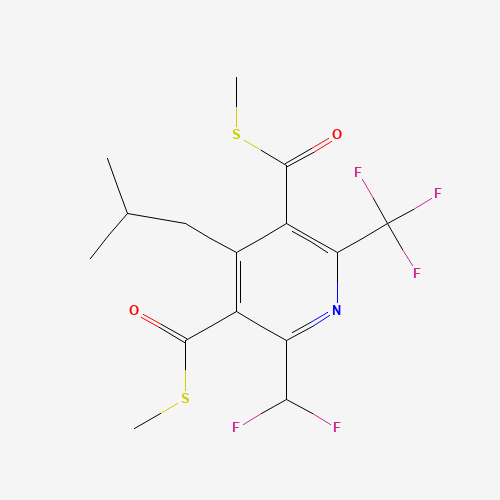
CAS97886-45-8
分子式C15H16F5NO2S2
分子量401.415 g/mol
非危品
Dithiopyr is a member of pyridines, an organofluorine compound and a thioester.
科学粮草官-词典编辑部,修订于:2026-07-06
Toxicity
ToxicityBody Burden
Based on urine sample residues of dicarbothioic acid, the equivalent dithiopyr exposure to ChemLawn lawn care workers applying dithiopyr was 1.45-13.7 ug body dose(1); the mean 72-hr body dose estimate was 4.60X10⁻⁵ mg/kg/lb applied(1).
EPA Ecotoxicity
Pesticide Ecotoxicity Data from EPA: 48
Ecotoxicity Values
EC50; Species: Pseudokirchneriella subcapitata (Green Algae); Conditions: freshwater, static; Concentration: 20 ug/L for 5 days (95% confidence interval: 17-24 ug/L); Effect: population abundance /94.3% purity/
Fate Summary
ATMOSPHERIC FATE: According to a model of gas/particle partitioning of semivolatile organic compounds in the atmosphere(1), dithiopyr, which has a vapor pressure of 4.0X10⁻⁶ mm Hg at 25 °C(2), will exist in both the vapor and particulate phases in the ambient atmosphere. Vapor-phase dithiopyr is degraded in the atmosphere by reaction with photochemically-produced hydroxyl radicals(SRC); the half-life for this reaction in air is estimated to be 54 hours(SRC), calculated from its rate constant of 7.1X10⁻¹² cu cm/molecule-sec at 25 °C(SRC) that was derived using a structure estimation method(2). Particulate-phase dithiopyr may be removed from the air by wet and dry deposition(SRC). Dithiopyr absorbs at wavelengths >290 nm(3) and, therefore, may be susceptible to direct photolysis by sunlig...
Soil Adsorption / Mobility
Dithiopyr has a reported Koc range of 1141-3748(1) and a single reported Koc value of 1920(2). According to a classification scheme(3), this estimated Koc value suggests that dithiopyr is expected to have low to slight mobility in soil. Dithiopyr has a low potential for leaching into groundwater(4). Vertical mobility of dithiopyr through soil, even in conditions highly susceptible to herbicide leaching, was found not to exceed 24 inches and was often not more than 9 to 12 inches(4). Research conducted to evaluate the movement of dithiopyr from golf courses found that most of the applied dithiopyr was detected in the top 0-12.5 cm of the rooting media at the end of greenhouse experiments and that the highest concentration in runoff from simulated fairways did not exceed 40 ug/L (less tha...
Environmental Biodegradation
AEROBIC: Bacterial and fungal populations were shown to effect dithiopyr dissipation rates after herbicidal applications(1); field testing found overall dissipation half-lives to range from 17.3-25.0 days(1). Biological degradation studies conducted in sterile versus non-sterile rooting material and rooting material leachate collected from established golf course greens demonstrated that faster degradation occurred in the non-sterile media(2); for example, at 20 °C, pH 6.8 and dark conditions, the leachate dithiopyr half-life was 515 days in sterile media and 200 days in the non-sterile media(2). Aerobic soil metabolism studies under laboratory conditions found dithiopyr degraded to the normal acid, reverse acid and diacid(3). Field dissipation tests in fields with vegetation found dith...
Environmental Bioconcentration
An estimated BCF of 633 was calculated in fish for dithiopyr(SRC), using a log Kow of 4.75(1) and a regression-derived equation(2). According to a classification scheme(3), this BCF suggests the potential for bioconcentration in aquatic organisms is high(SRC), provided the compound is not metabolized by the organism(SRC).
Volatilization from Water / Soil
The Henry's Law constant for dithiopyr is estimated as 1.53X10⁻⁶ atm-cu m/mole(SRC) derived from its vapor pressure, 4.0X10⁻⁶ mm Hg(1), and water solubility, 1.38 mg/L(1). This Henry's Law constant indicates that dithiopyr is expected to volatilize from water surfaces(2). Based on this Henry's Law constant, the volatilization half-life from a model river (1 m deep, flowing 1 m/sec, wind velocity of 3 m/sec)(2) is estimated as 48 days(SRC). The volatilization half-life from a model lake (1 m deep, flowing 0.05 m/sec, wind velocity of 0.5 m/sec)(2) is estimated as 356 days(SRC). Dithiopyr's estimated Henry's Law constant indicates that volatilization from moist soil surfaces may occur(SRC). With respect to most compounds, dithiopyr would not be expected to volatilize from dry soil surface...
Environmental Abiotic Degradation
The rate constant for the vapor-phase reaction of dithiopyr with photochemically-produced hydroxyl radicals has been estimated as 7.1X10⁻¹² cu cm/molecule-sec at 25 °C(SRC) using a structure estimation method(1). This corresponds to an atmospheric half-life of about 54 hours at an atmospheric concentration of 5X10+5 hydroxyl radicals per cu cm(1). Hydrolysis studies with dithiopyr in sterile water at pH 5 and pH 7 at 25 °C found no degradation after 30 days, and at pH 9, <2% degradation yielding an approximate half-life of 1053 days(2); the results indicated that ester hydrolysis was slowly occurring in alkaline conditions, and that hydrolysis was not an important route of degradation in the environment(2). Dithiopyr absorbs at wavelengths >290 nm(3) and, therefore, may be susceptible t...
Artificial Pollution Sources
Dithiopyr's production may result in its release to the environment through various waste streams; its use as a herbicide for pre-emergent and early post-emergent control of crabgrass and other annual grasses and weeds(1) will result in its direct release to the environment(SRC). Dithiopyr is used primarily in the professional turf, golf course and ornamental markets and is not currently registered for use in the US for foods or agricultural uses(1).
Probable Routes of Human Exposure
Occupational exposure to dithiopyr may occur through inhalation and dermal contact with this compound at workplaces where dithiopyr is produced or used. The general population may be exposed to dithiopyr via inhalation and dermal contact in localized areas where dithiopyr is being applied or recently applied as a herbicide. (SRC)
Environmental Fate / Exposure Summary
Dithiopyr's production may result in its release to the environment through various waste streams; its use as a herbicide for pre-emergent and early post-emergent control of crabgrass and other annual grasses and weeds will result in its direct release to the environment. Dithiopyr is used primarily in the professional turf, golf course and ornamental markets and is not currently registered for use in the US for foods or agricultural uses. If released to air, a vapor pressure of 4.0X10⁻⁶ mm Hg at 25 °C indicates dithiopyr will exist in both the vapor and particulate phases in the atmosphere. Vapor-phase dithiopyr will be degraded in the atmosphere by reaction with photochemically-produced hydroxyl radicals; the half-life for this reaction in air is estimated to be 54 hours. Particulate-...
Effect Level
collection=toxvaldb&kind=^EL$
Lethal Dose
collection=toxvaldb&kind=^LD$
Toxicity Summary
IDENTIFICATION AND USE: Dithiopyr is a herbicide used preemergence and early postemergence for selective control of crabgrass and other susceptible annual grasses and broadleaf weeds in established lawns and ornamental turf. HUMAN STUDIES: Worker exposure is monitored by both passive dosimetry and biological monitoring techniques such as urinalysis. ANIMAL STUDIES: Severe dermal irritation has been noted in rabbits. In a 90 day subchronic study in rats the effect was an increase in organ weight and diffused hepatocellular swelling. In a rat and rabbit developmental toxicity study there were no developmental effects at 1000 mg/kg/day. Dithiopyr was not mutagenic in the Ames assays for mutagenicity with Ames (TA) strains of Salmonella typhimurium LT2 at limit of solubility (3,000 mg/plate...
Lethal Concentration
collection=toxvaldb&kind=^LC$
RAIS Toxicity Values
Oral Chronic Reference Dose Reference: OPP
Human Toxicity Excerpts
/BIOMONITORING/ ChemLawn lawn care specialists were monitored for worker exposure by both passive dosimetry and biological monitoring techniques in the performance of normal duties of mixing/loading and application of Dimension herbicide to turfgrass. Passive dosimetry was performed, utilizing cotton gauze patches, silica gel air sampling absorption media, and hand washes as per US Environmental Protection Agency Pesticide Assessment Guidelines. Biological monitoring was performed by analysis of all urine specimens collected from each specialist from initiation until 72 hr after application of dithiopyr. The mean body dose estimate from urinalysis of the specimens collected over the 72 hr period was 4.60 x 10(-5) mg/kg/lb applied. The passive dosimetry body dose estimates using dermal d...
Carcinogen Classification
No indication of carcinogenicity to humans (not listed by IARC).
Non-Human Toxicity Values
LD50 Rat (male) oral >4,100 mg/kg /Dimension Turf Herbicide, 12.5% a.i./
Reference and Risk Values
collection=toxvaldb&kind=^RRV$
Non-Human Toxicity Excerpts
/LABORATORY ANIMALS: Acute Exposure/ Primary eye irritation (rabbit): Corneal corrosion reversible within 24 days, and possibly within 7 days; corneal opacity reversible within 7 days. /Dimension Turf Herbicide, 12.5% a.i./
Antidote and Emergency Treatment
/SRP:/ Advanced treatment: Consider orotracheal or nasotracheal intubation for airway control in the patient who is unconscious, has severe pulmonary edema, or is in severe respiratory distress. Positive-pressure ventilation techniques with a bag valve mask device may be beneficial. Consider drug therapy for pulmonary edema ... . Consider administering a beta agonist such as albuterol for severe bronchospasm ... . Monitor cardiac rhythm and treat arrhythmias as necessary ... . Start IV administration of D5W TKO /SRP: "To keep open", minimal flow rate/. Use 0.9% saline (NS) or lactated Ringer's (LR) if signs of hypovolemia are present. For hypotension with signs of hypovolemia, administer fluid cautiously. Watch for signs of fluid overload ... . Treat seizures with diazepam (Valium) or l...









