


 一键配货
一键配货
化合物详情
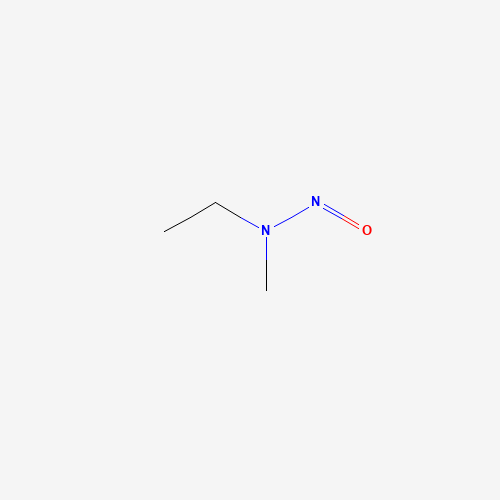
CAS10595-95-6
分子式C3H8N2O
分子量88.11 g/mol
非危品
N-Nitrosomethylethylamine can cause cancer according to California Labor Code.
科学粮草官-词典编辑部,修订于:2026-07-06
Toxicity
ToxicityFate Summary
ATMOSPHERIC FATE: According to a model of gas/particle partitioning of semivolatile organic compounds in the atmosphere(1), N-nitrosomethylethylamine, which has an estimated vapor pressure of 1.1 mm Hg at 20 °C(2), is expected to exist solely as a vapor in the ambient atmosphere. Vapor-phase N-nitrosomethylethylamine is degraded in the atmosphere by reaction with photochemically-produced hydroxyl radicals(SRC); the half-life for this reaction in air is estimated to be 1.6 days(SRC), calculated from its rate constant of 1.0X10⁻¹¹ cu cm/molecule-sec at 25 °C(SRC) that was derived using a structure estimation method(3). Vapor-phase N-nitrosomethylethylamine may degrade readily via direct photolysis(SRC) based on rapid degradation in aqueous solution which has estimated half-lives of 5.8 mi...
Soil Adsorption / Mobility
Using a structure estimation method based on molecular connectivity indices(1), the Koc of N-nitrosomethylethylamine can be estimated to be 43(SRC). According to a classification scheme(2), this estimated Koc value suggests that N-nitrosomethylethylamine is expected to have very high mobility in soil.
Environmental Biodegradation
ANAEROBIC: Anaerobic biodegradation tests using mixed digester sludge liquors as inocula found initial N-nitrosomethylethylamine concentrations of 16 uM decreased to 6.5 uM over a 170 day incubation period(1).
Environmental Bioconcentration
An estimated BCF of 3 was calculated in fish for N-nitrosomethylethylamine(SRC), using a log Kow of 0.04(1) and a regression-derived equation(2). According to a classification scheme(3), this BCF suggests that bioconcentration in aquatic organisms is low(SRC).
Volatilization from Water / Soil
The Henry's Law constant for N-nitrosomethylethylamine is estimated as 1.44X10⁻⁶ atm-cu m/mole(SRC) using a fragment constant estimation method(1). This value indicates that N-nitrosomethylethylamine is expected to volatilize slowly from water surfaces(2). Based on this Henry's Law constant, the estimated volatilization half-life from a model river (1 m deep, flowing 1 m/sec, wind velocity of 3 m/sec) is estimated as approximately 24 days(2,SRC). The estimated volatilization half-life from a model lake (1 m deep, flowing 0.05 m/sec, wind velocity of 0.5 m/sec) is estimated as approximately 177 days(2,SRC). N-Nitrosomethylethylamine's Henry's Law constant indicates that volatilization from moist soil surfaces may occur(SRC). N-Nitrosomethylethylamine is expected to volatilize from dry so...
Environmental Abiotic Degradation
The rate constant for the vapor-phase reaction of N-nitrosomethylethylamine with photochemically-produced hydroxyl radicals has been estimated as 1.0X10⁻¹¹ cu cm/molecule-sec at 25 °C(SRC) using a structure estimation method(1). This corresponds to an atmospheric half-life of about 1.6 days at an atmospheric concentration of 5X10+5 hydroxyl radicals per cu cm(1). N-Nitrosomethylethylamine absorbs light in the environmental spectrum (>290 nm) and is reported to be photochemically reactive and sensitive to UV light(2). Nitrosamines (such as N-nitrosomethylethylamine) are reported to photolyze rapidly in aqueous solution and in the gas-phase with a rate constant of about 0.12/min in sunlight at a zenith angle of 40 deg N(3); this corresponds to half-life of about 5.8 min(SRC). The direct p...
Environmental Water Concentrations
SURFACE WATER: N-Nitrosomethylethylamine was detected in six of seven surface water samples collected from river and lake sites in Canada and the US in 2006 at concentrations ranging from 0 to 0.55 ng/L(1); concentrations increased after commercial disinfection treatment via ozone/OCl(1).
Food Survey Values
N-Nitrosomethylethylamine was found at levels of 1.1 ug/kg in 1 of 6 samples of smoked horsemeat and at levels of 0.2 ug/kg in 1 of 5 luncheon meats(1). Concentrations of 0.2 ug/kg have been reported in bacon and chicken and in complete meals containing mushrooms(1); concentrations of 1 ug/kg have been reported for cured meats(1).
Natural Pollution Sources
Nitrosamines, such as N-nitrosomethylethylamine, can be formed in the atmosphere at night-time by reaction of atmospheric amines with nitrous acid, which is formed by the reaction of nitrous oxides with water vapor(1); N-nitrosomethylethylamine is expected to form from methylethyl amine or from any tertiary amine that contains at least one ethyl and one methyl function(1). N-Nitrosomethylethylamine has been identified as a chemical component in tobacco(2).
Artificial Pollution Sources
No evidence was found that N-nitrosomethylethylamine has been produced commercially(1). N-Nitrosomethylethylamine has been detected in mainstream and sidestream tobacco smoke from cigarettes and cigars(1-4). N-Nitrosomethylethylamine can be produced during commercial water disinfection processes involving ozone/OCl(5).
Probable Routes of Human Exposure
The general population will be exposed to N-nitrosomethylethylamine via inhalation of tobacco smoke and ingestion of food containing N-nitrosomethylethylamine(SRC). N-Nitrosomethylethylamine has been detected in mainstream and sidestream tobacco smoke from cigarettes and cigars(1-3). N-Nitrosomethylethylamine has also been detected in various food products such as smoked and cured meats(1); in general, nitrosamines have been identified in foods processed with nitrites or nitrates(2).
Other Environmental Concentrations
N-Nitrosomethylethylamine levels of 0.4 to 8 ug/cigarette have been detected in mainstream tobacco smoke from cigarettes and small cigars(1); levels of 9 to 30 ug/cigarette have been detected in sidestream tobacco smoke(1); levels of 75 ug/cigarette have been detected in sidestream smoke of small cigars(1). N-Nitrosomethylethylamine concns of 1 to 40 ng/cigarette were detected in smoke condensate from various cigarettes and cigars(2). N-Nitrosomethylethylamine levels of 3.9-41.2 ng/cigarette were detected in the mainstream smoke of 20 commercial brands of filter and non-filter cigarettes(3); levels were much lower in the cigarette tobacco(3).
Environmental Fate / Exposure Summary
No evidence was found that N-nitrosomethylethylamine has been produced commercially. N-Nitrosomethylethylamine has been identified as a chemical component in tobacco and mainstream and sidestream tobacco smoke. It may be formed in the atmosphere by reaction with atmospheric amines and nitrous acid. It may also be formed during commercial water disinfection processes involving ozone/OCl. If released to the atmosphere, N-nitrosomethylethylamine is expected to exist solely as a vapor in the ambient atmosphere based upon its estimated vapor pressure of 1.1 mm Hg at 20 °C. Vapor-phase N-nitrosomethylethylamine will be degraded in the atmosphere by reaction with photochemically-produced hydroxyl radicals; the half-life for this reaction in air is estimated to be 1.6 days. Vapor-phase degradat...
Cancer Sites
Hepatic
Adverse Effects
IARC Carcinogen - Class 3: Chemicals are not classifiable by the International Agency for Research on Cancer.
RAIS Toxicity Values
Oral Slope Factor Reference: IRIS Current
Human Toxicity Excerpts
/GENOTOXICITY/ The role of human cytochrome P450 (CYP) in the metabolic activation of N-alkylnitrosamines was examined by Ames test using genetically engineered Salmonella typhimurium (S. typhimurium)YG7108 cells expressing each form of human CYP together with human NADPH-cytochrome P450 reductase (OR). The relationship between the structure of N-alkylnitrosamines and CYP form(s) involved in the activation was evaluated. Eleven strains of S. typhimurium YG7108 cells expressing each form of CYP (CYP1A1, CYP1A2, CYP1B1, CYP2A6, CYP2C8, CYP2C9, CYP2C19, CYP2D6, CYP2E1, CYP3A4 or CYP3A5) were employed. Eight N-alkylnitrosamines including ... N-nitrosomethylethylamine (NMEA) ... were examined. ... N-alkylnitrosamines with relatively short alkyl chains such as ... NMEA were primarily activate...
Carcinogen Classification
IARC Monographs: Volume Sup 7: Overall Evaluations of Carcinogenicity: An Updating of IARC Monographs Volumes 1 to 42, 1987; 440 pages; ISBN 92-832-1411-0 (out of print)
Non-Human Toxicity Values
LD50 BD Rat 90 mg/kg
Non-Human Toxicity Excerpts
/GENOTOXICITY/ In vitro binding of the tobacco-specific nitrosamines, methylethylnitrosamine (MEN) and nitrosonornicotine (NNN), to exogenous DNA and guanosine was studied in a rat liver microsome-catalyzed system. MEN (N-(ethyl-1-(14)C)) binds covalently to calf thymus DNA whereas NNN (N'-(pyrrolidine-2-(14)C)) binds only to guanosine but not to DNA. Pretreatment of the rats with either phenobarbital (PB) or 3-methylcholanthrene (MC) greatly diminishes the binding of (14)C-MEN to DNA. Both MEN-demethylase and -deethylase activities are stimulated by PB pretreatment and inhibited by MC pretreatment, but the degree of stimulation and inhibition of the two dealkylases are not the same. Addition of cytosol to the incubation system does not enhance but suppresses the binding of (14)C-MEN to...
1 or Cancer Risk Level 1E-06
Soil Saturation Concentration (mg/kg): 1.08e+05
Evidence for Carcinogenicity
CLASSIFICATION: B2; probable human carcinogen. BASIS FOR CLASSIFICATION: Increased incidences of tumors of the liver and other sites in two rat strains. HUMAN CARCINOGENICITY DATA: Inadequate. ANIMAL CARCINOGENICITY DATA: Sufficient.
Hazard Quotient Level 3 or Cancer Risk Level 1E-04
Soil Saturation Concentration (mg/kg): 1.08e+05









