


 一键配货
一键配货
化合物详情
CAS56-86-0
分子式C5H9NO4
分子量147.13 g/mol g/mol
危化品
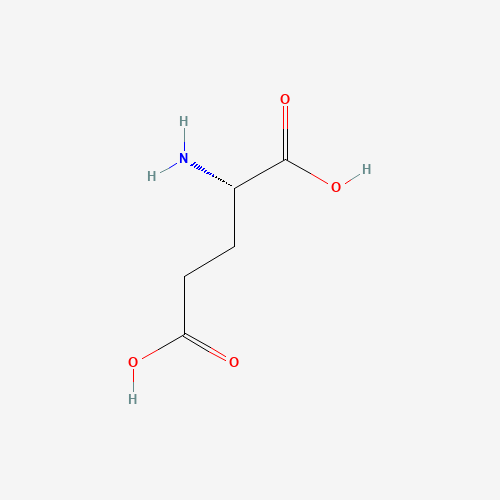
L-glutamic acid is an optically active form of glutamic acid having L-configuration. It has a role as a ferroptosis inducer, a neurotransmitter, a micronutrient, a nutraceutical, a mouse metabolite and an Escherichia coli metabolite. It is a L-alpha-amino acid, a glutamic acid, a glutamine family amino acid and a proteinogenic amino acid. It is a conjugate acid of a L-glutamate(1-). It is an enantiomer of a D-glutamic acid.
科学粮草官-词典编辑部,修订于:2026-07-06
Toxicity
ToxicityFate Summary
ATMOSPHERIC FATE: According to a model of gas/particle partitioning of semivolatile organic compounds in the atmosphere(1), glutamic acid, which has an extrapolated vapor pressure of 1.7X10⁻⁸ mm Hg at 25 °C(2), will exist in both the vapor and particulate phases in the ambient atmosphere. Vapor-phase glutamic acid is degraded in the atmosphere by reaction with photochemically-produced hydroxyl radicals(SRC); the half-life for this reaction in air is estimated to be 9.4 hours(SRC), calculated from its rate constant of 4.1X10⁻¹¹ cu cm/molecule-sec at 25 °C(SRC) that was derived using a structure estimation method(3). Particulate-phase glutamic acid may be removed from the air by wet and dry deposition(SRC). Aliphatic amino acids exhibit no absorption in the UV region above 220 nm(4), ther...
Soil Adsorption / Mobility
Using a structure estimation method based on molecular connectivity indices(1), the Koc of glutamic acid can be estimated to be 13(SRC). According to a classification scheme(2), this estimated Koc value suggests that glutamic acid is expected to have very high mobility in soil. Glutamic acid is a zwitterionic amino acid with pKa values of 2.19, 4.25 and 9.67(3) indicating that this compound will exist almost entirely in ionic form (anion, cation or both) in the environment and cations generally adsorb (anions generally do not adsorb) more strongly to soils containing organic carbon and clay than their neutral counterparts(4).
Environmental Biodegradation
ANAEROBIC: Glutamic acid was completely biodegraded after 7 days of incubation using an anaerobic test protocol(1).
Environmental Bioconcentration
An estimated BCF of 3 was calculated in fish for glutamic acid(SRC), using a log Kow of -3.69(1) and a regression-derived equation(2). According to a classification scheme(3), this BCF suggests the potential for bioconcentration in aquatic organisms is low(SRC).
Volatilization from Water / Soil
Glutamic acid is a zwitterionic amino acid with pKa values of 2.19, 4.25 and 9.67(1) indicating that this compound will exist almost entirely in ionic form (anion, cation or both) in the environment. Since ionized compounds are not expected to volatilize from water, glutamic acid is expected to be essentially nonvolatile from water surfaces and moist soils(SRC). Glutamic acid is not expected to volatilize from dry soil surfaces(SRC) based upon an extrapolated vapor pressure of 1.7X10⁻⁸ mm Hg at 25 °C(2).
Environmental Abiotic Degradation
The rate constant for the vapor-phase reaction of glutamic acid with photochemically-produced hydroxyl radicals has been estimated as 4.1X10⁻¹¹ cu cm/molecule-sec at 25 °C(SRC) using a structure estimation method(1). This corresponds to an atmospheric half-life of about 9.4 hours at an atmospheric concentration of 5X10+5 hydroxyl radicals per cu cm(1). Aliphatic amino acids exhibit no absorption in the UV region above 220 nm(2), therefore glutamic acid is not expected to be susceptible to direct photolysis by sunlight(SRC). The rate constant for the reaction of hydroxyl radicals in aqueous solutions at pH 6.5 is 2.3X10+8 L/mol-sec(3); this corresponds to an aquatic half-life of 9 years at an aquatic concentration of 1X10-17 hydroxyl radicals per liter(4). Glutamic acid is not expected t...
Environmental Water Concentrations
RAIN/SNOW: Glutamic acid was detected at concentrations of 2-471 nM in precipitation samples collected near Charlottesville, VA between April 1988 and April 1989(1).
Milk Concentrations
Previous short observational studies on the free amino acid (FAA) content of human milk have shown that glutamine and glutamic acid increase in the first 4 to 6 weeks of life. Changes in human milk content of free amino acids (FAAs) was determined at colostrum, 1 month, and 3 months of lactation in 16 healthy lactating women after delivery of full-term infants. Milk was collected at the end of each feeding (hindmilk) during 24 hours. Glutamic acid and taurine were the most abundant FAAs at colostrum. Although taurine remained stable throughout lactation, glutamic acid (the prevalent FAA) and glutamine increased approximately 2.5 and 20 times, respectively, with progressing lactation representing more than 50% of total FAA at 3 months. The content of essential FAA was also stable, so the...
Natural Pollution Sources
Glutamic acid is a non-essential amino acid that occurs in plants and animals(1,2) and is formed via protein metabolism(2). Specific soil microorganisms generate and excrete glutamic acid(3). Glutamic acid has been quantified in numerous plant species(4).
Artificial Pollution Sources
Glutamic acid's production and use as an intermediate to manufacture monosodium glutamate (a food additive), pesticides (glufosinate), medicinals and polyglutamic acid esters(1) and use as a nutritional supplement(2) may result in its release to the environment through various waste streams(SRC). Its use as a seed treatment in agriculture(3) will result in its direct relase to the environment(SRC).
Sediment/Soil Concentrations
SOIL: Soil samples collected from an active landfill site in Spain contained glutamic acid concentrations of 1.0-4.7 nmol/g(1).
Probable Routes of Human Exposure
NIOSH (NOES Survey 1981-1983) has statistically estimated that 11,240 workers (5,754 of these were female) were potentially exposed to glutamic acid in the US(1). Occupational exposure to glutamic acid may occur through inhalation and dermal contact with this compound at workplaces where glutamic acid is produced or used. Monitoring and use data indicate that the general population may be exposed to glutamic acid via ingestion of food and dermal contact with this consumer products containing glutamic acid(SRC).
Environmental Fate / Exposure Summary
Glutamic acid's production and use as an intermediate to manufacture monosodium glutamate (a food additive), pesticides (glufosinate), medicinals and polyglutamic acid esters and use as a nutritional supplement may result in its release to the environment through various waste streams. Its use as a seed treatment in agriculture will result in its direct relase to the environment. Glutamic acid is a non-essential amino acid that occurs in plants and animals and is formed via protein metabolism. Specific soil microorganisms generate and excrete glutamic acid. Glutamic acid has been quantified in numerous plant species. If released to air, an extrapolated vapor pressure of 1.7X10⁻⁸ mm Hg at 25 °C indicates glutamic acid will exist in both the vapor and particulate phases in the atmosphere....
Interactions
The purpose of this study was to evaluate the extent to which orally administered glutamic acid hydrochloride decreased mean gastric pH in both fasting and simulated hypochlorhydric states. Patients with elevated gastric pH resulting from physiologic or pharmacologic decreases in acid secretion may experience a decrease in drug absorption when receiving pH-dependent drugs or dosage formulations. Although various doses of oral glutamic acid (GA) have been used to lower gastric pH and enhance drug absorption, the in vivo effect of a specific dose and regimen on the magnitude and duration of gastric pH is unknown. This study was conducted in six young, healthy, male volunteers using the Heidelberg capsule technique to measure gastric pH. In Phase I, all subjects received two 680 mg (340 mg...
Exposure Routes
Absorbed from the lumen of the small intestine into the enterocytes.Absorption is efficient and occurs by an active transport mechanism.
Toxicity Summary
Glutamate activates both ionotropic and metabotropic glutamate receptors. The ionotropic ones being non-NMDA (AMPA and kainate) and NMDA receptors. Free glutamic acid cannot cross the blood-brain barrier in appreciable quantities; instead it is converted into L-glutamine, which the brain uses for fuel and protein synthesis. It is conjectured that glutamate is involved in cognitive functions like learning and memory in the brain, though excessive amounts may cause neuronal damage associated in diseases like amyotrophic lateral sclerosis, lathyrism, and Alzheimer's disease. Also, the drug phencyclidine (more commonly known as PCP) antagonizes glutamate at the NMDA receptor, causing behavior reminiscent of schizophrenia. Glutamate in action is extremely difficult to study due to its transi...
Human Toxicity Excerpts
/OTHER TOXICITY INFORMATION/ From comparisons of plasma glutamate levels, healthy term and premature infants have already developed the capability to metabolize glutamates. Ingestion of monosodium glutamate (MSG) solutions has been demonstrated to cause transient clinical symptoms resembling those of "Chinese Restaurant Syndrome" and there is evidence that some individuals may respond to relatively small doses. Similar symptoms can be evoked by certain other food substances. ...According to industry sources, MSG is not added to infant and junior foods. Because, however, a proportion of the consuming public may be sensitive acute responders, even though the unpleasant symptoms are transient, ...there should be some constraint placed on the addition of MSG to processed foods. ...There is...
Carcinogen Classification
No indication of carcinogenicity to humans (not listed by IARC).
Antidote and Emergency Treatment
/SRP:/ Advanced treatment: Consider orotracheal or nasotracheal intubation for airway control in the patient who is unconscious, has severe pulmonary edema, or is in severe respiratory distress. Early intubation, at the first sign of upper airway obstruction, may be necessary. Positive-pressure ventilation techniques with a bag valve mask device may be beneficial. Consider drug therapy for pulmonary edema ... . Consider administering a beta agonist such as albuterol for severe bronchospasm ... . Monitor cardiac rhythm and treat arrhythmias as necessary ... . Start IV administration of D5W /SRP: "To keep open", minimal flow rate/. Use 0.9% saline (NS) or lactated Ringer's (LR) if signs of hypovolemia are present. For hypotension with signs of hypovolemia, administer fluid cautiously. Con...









