

 一键配货
一键配货
化合物详情
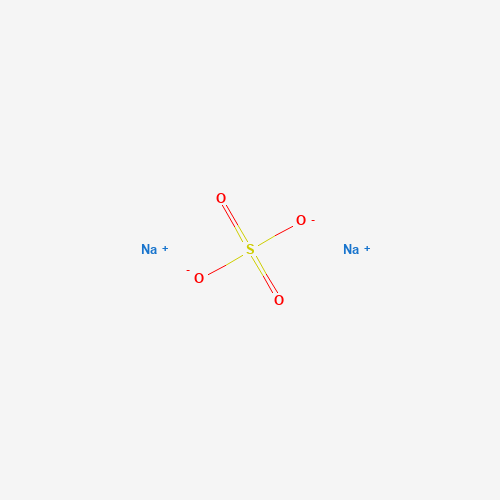
CAS7757-82-6
分子式Na2O4S
非危品
Sodium sulfate is an inorganic sodium salt.
科学粮草官-词典编辑部,修订于:2026-07-06
Toxicity
ToxicityBody Burden
Both sodium and sulfate ions are among the most common ions found in all living organisms. In mammals, sulfate is an normal metabolite of sulfur-containing amino-acids, it is normally incorporated in a variety of body compounds and it plays an important role in detoxification/ excretion processes due to sulfoconjugation(1).
Fate Summary
ATMOSPHERIC FATE: Sodium sulfate is an inorganic compound with a very high melting point of 884 °C(1). Therefore, it is expected to exist solely in the particulate phase in the ambient atmosphere(SRC). Particulate-phase sodium sulfate may be removed from the air by wet and dry deposition(SRC).
Soil Adsorption / Mobility
A study on soil changes with sodium sulfate showed that dilute solutions (0.1 and 0.01 N) penetrated at rates similar to that of water(1). The soil aggregation changed significantly in the top 10 cm as compared to water, but at depths greater than 10 cm was similar to water(1). Since sodium sulfate is soluble in water it is expected to infiltrate the soil(2). Most of the ions will migrate downwards through the soil with the penetrating water, as it does not interact with soil(2).
Environmental Biodegradation
Sodium sulfate is not biodegradable as typically noted for biodegradability, but it takes part in the sulfur cycle, in which sulfate is either incorporated into living organisms or reduced to sulfides by anaerobic bacteria, deposited as sulfur, or re-oxidised in the atmosphere and oceans to sulfur dioxide and sulfate. In anaerobic environments sulfate is biologically reduced to hydrogen sulphide by sulfate reducing bacteria, or incorporated into living organisms as source of sulphur, and thereby included in the sulphur cycle(1).
Environmental Bioconcentration
The BCF of sodium sulfate is very low (estimated to be 0.5) and therefore bioconcentration is not expected(1). Sodium and sulfate ions are essential to all living organisms and their intracellular and extracellular concentrations are actively regulated(1).
Volatilization from Water / Soil
In water sodium sulfate completely dissociates into sodium and sulfate ions(1); therefore, volatilization from water surfaces or moist soil is not expected to be an important fate process(SRC). Evaporation of sodium sulfate at 20 °C is reported to be negligible(2).
Environmental Abiotic Degradation
In water sodium sulfate completely dissociates into sodium and sulfate ions. The ions cannot hydrolyse(1).
Environmental Water Concentrations
SEAWATER: Seawater contains levels of about 2700 ppm(1). /Sulfate/
Food Survey Values
Sodium sulfate is ubiquitous in nature, it is naturally present in common foodstuffs, has wide dispersive use and is added to processed food and beverages(1).
Natural Pollution Sources
Sodium sulfate is relatively common in alkali lakes, ground water, & sea water, as well as in the... minerals thenardite; hanksite; sulphohalite; galubzrite; loeweite; ferronatrite; mirabilit e; bloedite; tychite; aphthitalite; tamarugite; mendozite
Artificial Pollution Sources
Sodium sulfate's production and use in soaps and detergents, glass, paper and pulp, carpet fresheners(1) and in the dyeing and printing of textiles(2) may result in its release to the environment through various waste streams(SRC). Sodium sulfate is used extensively as a natural filler in powdered laundry detergents(1). Sodium sulfate in moderation is used as a diuretic and cathartic for humans and animals and it is used in consumer products such as laxatives and antacids(1) and as a food additive(3,4). Sodium sulfate has been detected in cigarette tobacco(5). About half of all sodium sulfate produced is by a synthetic by-product of rayon, dichromate, phenol, or potash production(1).
Probable Routes of Human Exposure
NIOSH (NOES Survey 1981-1983) has statistically estimated that 1,332,131 workers (543,877 of these are female) were potentially exposed to sodium sulfate in the US(1). Occupational exposure to sodium sulfate may occur through inhalation of dust and dermal contact with this compound at workplaces where sodium sulfate is produced or used(2). Monitoring data indicate that the general population may be exposed to sodium sulfate via inhalation of dust from consumer products, ingestion of food and drinking water, and dermal contact with consumer products containing sodium sulfate(SRC). Occupational exposure to sodium sulfate is likely by inhalation of the dust(2).
Other Environmental Concentrations
Sodium sulfate concentrations in household detergents used for textile laundering (powders and tablets) vary widely, ranging from 0 to 56.7 % with an average of 20.8%(1).
Environmental Fate / Exposure Summary
Sodium sulfate's production and use in soaps and detergents, glass, paper and pulp, carpet fresheners and in the dyeing and printing of textiles may result in its release to the environment through various waste streams. Sodium sulfate is used extensively as a natural filler in powdered laundry detergents. Minerals of sodium sulfate occur naturally throughout the world. Sodium sulfate occurs in nature as the minerals mirabilite, thenardite and astrakanite. If released to air, sodium sulfate is expected to exist solely in the particulate phase in the atmosphere since it is an inorganic compound with a very high melting point (884 °C). Particulate-phase sodium sulfate will be removed from the atmosphere by wet and dry deposition. If released to soil, sodium sulfate is expected to have ver...
Symptoms
Ingestion Exposure: Nausea. Vomiting. Abdominal pain. Diarrhoea.
Interactions
Two experiments were conducted to investigate the effects of sodium sulfate water and the efficacy of nonnutritive feed additives in nursery pig diets. In Exp. 1, 320 barrows (5.4 +/- 0.1 kg BW and 21 d of age) were allotted to 1 of 8 treatments for 24 d in a 2 x 4 factorial with 2 levels of sodium sulfate water (control or 3,000 mg sodium sulfate/L added), and 4 dietary zeolite (clinoptilolite) levels (0, 0.25, 0.50, or 1%). Fecal samples were collected on d 5, 9, 16, and 23; visually scored for consistency (1 = firm and 5 = watery); and analyzed for DM. No interactions of sodium sulfate x zeolite were observed for any response criteria. ...
Toxicity Summary
IDENTIFICATION AND USE: Sodium sulfate is a white powder, or crystals. It is used for standardizing dyes, in freezing mixtures, and in dying and printing textiles. It is also used as cathartic and purgative in humans and in veterinary medicine. HUMAN STUDIES: It may result in gastrointestinal irritation and diarrhea. ANIMAL STUDIES: Poultry mortality was 33% after drinking water containing 7500 mg/L sodium sulfate for 15 days. Outbreaks of poisoning in pigs due to overdosage were characterized by twitching, tremors and convulsions. The most noticeable lesion at post mortem was widespread vacuolation and necrosis of cerebral cortex. ECOTOXICITY STUDIES: Plants were injured by sodium sulfate levels of 4000 mg/L in soil; 710 mg/L depressed root growth and water absorption. Among aquatic sp...
Average Daily Intake
A normal daily intake of sodium sulfate of 7.5 mg/kg/day has been estimated which is mostly from food and drinking water(1).
Human Toxicity Excerpts
/EPIDEMIOLOGY STUDIES/ ... A study was conducted on 119 workers from five sodium sulfate surface solution mines in Saskatchewan. The investigation involved the older workers and the workers at highest dust exposure levels and included general medical screening with emphasis on the existence of hypertension, edema, calcium tetany, anemia, common skin problems, nasal septum perforation, persistent diarrhea; lung function tests; serum analyses for sulfate, calcium, sodium, and chloride content; and urinary inorganic sulfate output. All measured properties, including lung function, serum sulfate, calcium and electrolytes, were found to be within normal ranges. Forty-two workers with more than 10 years exposure experience show no significant differences in these properties compared to 77 wor...
Non-Human Toxicity Values
LD50 Rabbit percutaneous > 4.0 g/kg
Antidote and Emergency Treatment
/SRP:/ Advanced treatment: Consider orotracheal or nasotracheal intubation for airway control in the patient who is unconscious, has severe pulmonary edema, or is in severe respiratory distress. Positive-pressure ventilation techniques with a bag valve mask device may be beneficial. Consider drug therapy for pulmonary edema ... . Consider administering a beta agonist such as albuterol for severe bronchospasm ... . Monitor cardiac rhythm and treat arrhythmias as necessary ... . Start IV administration of D5W TKO /SRP: "To keep open", minimal flow rate/. Use 0.9% saline (NS) or lactated Ringer's (LR) if signs of hypovolemia are present. For hypotension with signs of hypovolemia, administer fluid cautiously. Watch for signs of fluid overload ... . Treat seizures with diazepam or lorazepam...