


 一键配货
一键配货
化合物详情
CAS122-14-5
分子式C9H12NO5PS
分子量277.23 g/mol g/mol
危化品
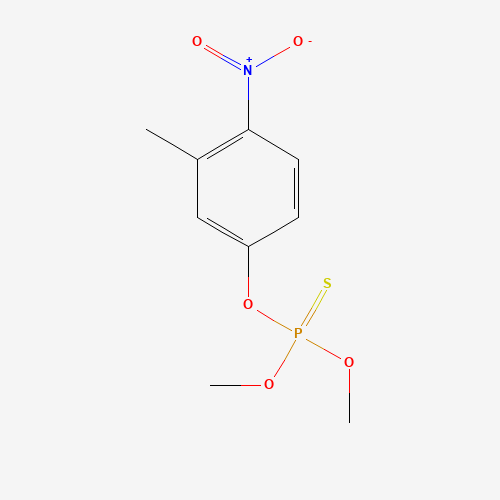
Physical Description | Fenitrothion is a brownish-yellow oil. Used as a selective acaricide and a contact and stomach insecticide against chewing and sucking insects on rice, orchard fruits, vegetables, cereals, cotton and forest. Also used against flies, mosquitoes, and cockroaches. (EPA, 1998)
科学粮草官-词典编辑部,修订于:2026-07-06
Toxicity
ToxicityBody Burden
The rate of exposure to fenitrothion on different body parts of Chinese pesticide applicators in tea plantations were as follows (ug/sq cm): face, 5.92-15.1; chest, 5.86-10.5; abdomen, 9.97-51.4; thigh, 33.4-204; and ankle, 23.9-288(1). The total dermal exposure of applicators to fenitrothion was estimated to be 1152 mg/kg excluding hands; exposure on hands was estimated to be 115 mg/kg(1).
EPA Ecotoxicity
Pesticide Ecotoxicity Data from EPA: 106
Ecotoxicity Values
USDA APHIS Chemical Effects: collection=usda_chemeffect&query_type=synonym&query='^122-14-5$'
Soil Adsorption / Mobility
Measured fenitrothion Koc values of 593 and 254 in Tsukuba and Kanuma soils(1) and 1531, 1201, 833, and 1061 in 4 rice soils(2) have been determined. A study conducted on organic and silty clay loam soil, from the Boreal Forest in Ontario, Canada, indicate a maximum adsorption rate of 92 ug/g and 81 ug/g, respectively, in 30 hrs when fenitrothion-acetone is added to the soils(3). In the same experiment, studies with a buffer solution showed 38 and 48% desorption rate after 50 hrs extraction time(3). According to a classification scheme(4), these Koc values suggests that fenitrothion is expected to have low to moderate mobility in soil(SRC). The soil sorption coefficients ((ug pesticide/g soil)/(ug pesticide/g water)) for fenitrothion were 25.1 in clay loam and 3.5 in high clay soil. The...
Environmental Biodegradation
ANAEROBIC: In an experiment with five alluvial Indian rice soils, biodegradation half-lives ranged from 3.9-10.9 days under flooded conditions, where the nitro group was reduced to form aminofenitrothion(1). The biodegradation half-lives of fenitrothion in cyclone fermentors with a mixture of microorganisms from activated sludge, soil and sediments were 1 day with cometabolites (glucose and peptone were added as carbon source of cometabolites) and anaerobic conditions, and 9.8 days in the absence of cometabolites and anaerobic conditions(2).
Environmental Bioconcentration
BCF values of 8.0 to 53.6 and 1.5 to 101.7 were calculated in fish for fenitrothion(SRC), using carp (Cyprinus carpio) which were exposed over an 8-week period at concentrations of 20 and 2 ppb, respectively(1). Measured BCF values of 246 in topmouth gudgeon(2), 225-650 in lake trout(3), and 129 in mussels(4) have also been reported. An experiment using the European eel measured BCFs of 2.6-24.8(5). Average BCFs of 71.1, 141, 37.5, 24.6, and 30.8 were measured in the female guppy, male guppy, killifish, goldfish and white cloud mountain fish, respectively(6). Bioconcentration factors for fenitrothion in whole body freshwater fish ranged from 158.0 (+/-29.3) at 6 hr to 364 (+/-97.8) at 168 hr using willow shiner (Gnathopogon caerulescens) which were exposed to 25 ug/L (+/-3.5) in continu...
Volatilization from Water / Soil
The Henry's Law constant for fenitrothion is 9.3X10⁻⁷ atm-cu m/mole(1). This Henry's Law constant indicates that fenitrothion is expected to be essentially nonvolatile from water surfaces(2). However, volatilization half-life of fenitrothion from a 5 mg/L distilled water solution at a temperature 20 °C was determined to be 65 days(4). Addition of fulvic acid at a concentration 5 mg/L increased the volatilization half-life to more than 180 days(4). However, the volatilization half-life from surface slicks after spraying fenitrothion formulation over a pond water was only 18 minutes at 20 °C(4). Fenitrothion's Henry's Law constant(1) indicates that volatilization from moist soil surfaces would occur slowly(SRC). Fenitrothion is not expected to volatilize from dry soil surfaces(SRC) based...
Environmental Abiotic Degradation
The rate constant for the vapor-phase reaction of fenitrothion with photochemically-produced hydroxyl radicals has been reported as 6.21X10⁻¹¹ cu cm/molecule-sec at 25 °C(1). This corresponds to an atmospheric half-life of about 6.4 hours at an atmospheric concentration of 5X10+5 hydroxyl radicals per cu cm(SRC). In estuarine waters, fenitrothion degradation occurred via photolysis which produced fenitrooxon and the S-methyl isomer of fenitrothion, both of which are then converted to 3-methyl-4-nitrophenol via hydrolysis(2). The hydrolysis half-lives of fenitrothion were 247.5, 86.1 and 4.3 days, at pH 5, 7 and 9, respectively, in buffered solutions at 20 °C(3). At pH 5 and 7, a de-alkylated product and methanol were formed; at pH 9, dimethyl phosphoric acid and 3-methyl-4-nitrophenol w...
Environmental Water Concentrations
RAIN/SNOW/FOG: Fenitrothion was detected at a concentration of 32.9 ng/L in an ice core collected in 1998 from the summit of Austofonna and at concentrations ranging from not detected to 320 ng/L in ice samples taken from several sites in Russia(1). Fenitrothion was detected at a concentration range of less than 0.01 to 0.86 ug/L in rain water collected in New Brunswick, Canada in 1978( 2).
Food Survey Values
Fenitrothion residues were detected at an average concentration of 28.0 ppb with a detection frequency of 50% in unprocessed vegetable samples and at an average concentration of 6.0 ppb with a detection frequency of 22.2% in processed vegetable samples collected in 1997-1998 from Alexandria City in Egypt(1). Results from an agricultural product monitoring effort in the Hyogo Prefecture, Japan during April 1995 through March 2000 reported fenitrothion detections in 4 out of 106 samples of mandarin oranges at concentrations between less than 0.01 and less than 0.05 ug/g(2). Fenitrothion was not detected in seven tomato plant samples at an LOD of 0.0018 mg/g, nor in 2 onion samples at an LOD of 0.0004 mg/g, collected July and Aug 2006 in a survey of agricultural areas in Belgrade, Serbia(3...
Plant Concentrations
It was reported that fenitrothion persisted in leaf tissues and may act as a micro sink for the pesticide(1).
Effluent Concentrations
Following an accidental pesticide storehouse fire in Switzerland on November 1, 1986, the estimated concentration of fenitrothion in Rhine River water at Village Neuf was 15-65 ug/L(1).
ICSC Environmental Data
The substance is very toxic to aquatic organisms. The substance may cause long-term effects in the aquatic environment. Bioaccumulation of this chemical may occur in fish. This substance may be hazardous to the environment. Special attention should be given to crustacea and bees. This substance does enter the environment under normal use. Great care, however, should be taken to avoid any additional release, for example through inappropriate disposal.
Atmospheric Concentrations
INDOOR: The concentrations of fenitrothion in room air following application of fenitrothion for pest control at the recommended rate inside a dormitory room were 3.3 ug/cu m on day 0, 1.1 ug/cu m on day 1, 0.8 ug/cu m on day 2 and 0.5 ug/cu m on day 3 after application(1).
Fish/Seafood Concentrations
In study published in 1987, fenitrothion was not detected in fish collected from neighboring unsprayed streams following application of the pesticide in a nearby forest(1). It was not detected in fish analyzed from Egyptian local markets in 1991-1992(2).
Artificial Pollution Sources
Fenitrothion's production may result in its release to the environment through various waste streams; its use as an indoor/outdoor ant and roach insecticide(1) will result in minimal release to the environment(SRC). It's former use as an agricultural insecticide(2) resulted in its direct release to the environment(SRC).
Sediment/Soil Concentrations
SEDIMENT: Following the spraying of a stream in New Brunswick, Canada at a peak water concentration of 15.2 ug/L, the max concentration of fenitrothion in a bottom sediment was 0.9 ug/g (ppm)(1). The concentration of fenitrothion in sediments generally decreased as the distance downstream from the treated area increased(1). During the summer of 1974, no fenitrothion was detected in sediment from the upper Great Lakes at a detection limit of 0.02 ug/g(2). Concentration of fenitrothion ranged from less than 0.01 to 0.21 ug/g in unsprayed stream and pond sediments located approx. 200 m from a conifer forest in New Brunswick, Canada which was sprayed with fenitrothion(3). No fenitrothion was detected in these sediments (detection limit 0.01 ppm) a year later suggesting that fenitrothion is...
Probable Routes of Human Exposure
In a 1998 occupational monitoring study of 5 females aged 20 to 49 yrs, inhalation was found to be the most likely route of exposure to fenitrothion as a result of manual operations in greenhouses(1).
Other Environmental Concentrations
In studies conducted in the 1980's and 90's, fenitrothion was detected in water-cress, moss and several aquatic organisms following application on forest and streams(1,2). Following spray applications in Canadian forest, fenitrothion was detected in Poplar (Populus tremuloides), green birch (Betula populifolia), fir (Abies balsamea) and other foilages(2-4). In a Piedmont site, New Hope Forest near Research Triangle Park, North Carolina, an aqueous solution of 2% fenitrothion was sprayed uniformly to the soil and litter of a loblolly pine forest. Trees were not sprayed. Less than 2% of the fenitrothion applied was found in the soil at day 1, and by day 107, this had decreased to 0.3%(5).
Environmental Fate / Exposure Summary
Fenitrothion's production may result in its release to the environment through various waste streams; its use as an indoor/outdoor ant and roach insecticide will result in minimal release to the environment. It's use outside the US as an agricultural insecticide will result in its direct release to the environment. If released to air, a vapor pressure of 5.40X10⁻⁵ mm Hg at 20 °C indicates fenitrothion will exist in both the vapor and particulate phases in the atmosphere. Vapor-phase fenitrothion will be degraded in the atmosphere by reaction with photochemically-produced hydroxyl radicals; the half-life for this reaction in air is estimated to be 6.4 hours. Particulate-phase fenitrothion will be removed from the atmosphere by wet and dry deposition. Fenitrothion contains chromophores th...
Symptoms
Symptoms of low dose exposure include excessive salivation and eye-watering. Acute dose symptoms include severe nausea/vomiting, salivation, sweating, bradycardia, hypotension, collapse, and convulsions. Increasing muscle weakness is a possibility and may result in death if respiratory muscles are involved. Hypertension, hypoglycemia, anxiety, headache, tremor and ataxia may also result.
Treatment
If the compound has been ingested, rapid gastric lavage should be performed using 5% sodium bicarbonate. For skin contact, the skin should be washed with soap and water. If the compound has entered the eyes, they should be washed with large quantities of isotonic saline or water. In serious cases, atropine and/or pralidoxime should be administered. Anti-cholinergic drugs work to counteract the effects of excess acetylcholine and reactivate AChE. Atropine can be used as an antidote in conjunction with pralidoxime or other pyridinium oximes (such as trimedoxime or obidoxime), though the use of '-oximes' has been found to be of no benefit, or possibly harmful, in at least two meta-analyses. Atropine is a muscarinic antagonist, and thus blocks the action of acetylcholine peripherally.
Interactions
The effects of a combination of fenitrothion with malathion in male rats were more than additive. The potentiation was most pronounced (half of the expected LD50) with a combination rate of 1:1. No potentiation was observed with other tested organophosphates, ie bromophos, amidithion, and trichlorfon.
Toxicity Data
LC50 (rat) > 2,200 mg/m3/4h
Health Effects
Acute exposure to cholinesterase inhibitors can cause a cholinergic crisis characterized by severe nausea/vomiting, salivation, sweating, bradycardia, hypotension, collapse, and convulsions. Increasing muscle weakness is a possibility and may result in death if respiratory muscles are involved. Accumulation of ACh at motor nerves causes overstimulation of nicotinic expression at the neuromuscular junction. When this occurs symptoms such as muscle weakness, fatigue, muscle cramps, fasciculation, and paralysis can be seen. When there is an accumulation of ACh at autonomic ganglia this causes overstimulation of nicotinic expression in the sympathetic system. Symptoms associated with this are hypertension, and hypoglycemia. Overstimulation of nicotinic acetylcholine receptors in the central...
Adverse Effects
Other Poison - Organophosphate
Exposure Routes
The substance can be absorbed into the body by inhalation of its aerosol, through the skin and by ingestion.
Toxicity Summary
Fenitrothion is a cholinesterase or acetylcholinesterase (AChE) inhibitor. A cholinesterase inhibitor (or 'anticholinesterase') suppresses the action of acetylcholinesterase. Because of its essential function, chemicals that interfere with the action of acetylcholinesterase are potent neurotoxins, causing excessive salivation and eye-watering in low doses, followed by muscle spasms and ultimately death. Nerve gases and many substances used in insecticides have been shown to act by binding a serine in the active site of acetylcholine esterase, inhibiting the enzyme completely. Acetylcholine esterase breaks down the neurotransmitter acetylcholine, which is released at nerve and muscle junctions, in order to allow the muscle or organ to relax. The result of acetylcholine esterase inhibitio...
Average Daily Intake
The daily dietary intakes of fenitrothion per unit body weight to different U.S. subgroups of populations during 1982-1984 were as follows (in ng/kg body wt/day): 6-11 months, 0.2; 2 yr, 0.8; 14-16 yr female, 0.3, 14-16 yr. male, 0.4; 25-30 yr female, 0.3; 25-30 yr male, 0.3(1). The daily dietary intakes of fenitrothion to different subgroups of U.S. populations during 1988 were as follows (in ng/kg body wt/day): 6-11 months, 1.4; 14-16 yr male, 2.3; 60-65 yr female, 1.7(2).
RAIS Toxicity Values
Oral Chronic Reference Dose Reference: OPP
Human Toxicity Values
Probable oral lethal dose (human) 50-500 mg/kg, between 1 teaspoon and 1 oz for 70 kg person (150 lb).
Acceptable Daily Intakes
FAO/WHO ADI: 0.005 mg/kg
Carcinogen Classification
No indication of carcinogenicity to humans (not listed by IARC).
Evidence for Carcinogenicity
Cancer Classification: Group E Evidence of Non-carcinogenicity for Humans









