


 一键配货
一键配货
化合物详情
CAS482-27-9
分子式C13H10O5
分子量246.22 g/mol g/mol
危化品
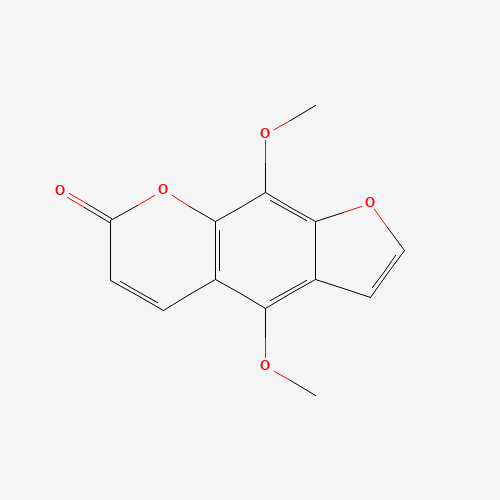
Isopimpinellin is a member of psoralens.
科学粮草官-词典编辑部,修订于:2026-07-06
Toxicity
ToxicityFate Summary
ATMOSPHERIC FATE: According to a model of gas/particle partitioning of semivolatile organic compounds in the atmosphere(1), isopimpinellin, which has an estimated vapor pressure of 6.8X10⁻⁷ mm Hg at 25 °C(SRC), determined from a fragment constant method(2), is expected to exist solely in the particulate phase in the ambient atmosphere. Particulate-phase isopimpinellin may be removed from the air by wet and dry deposition(SRC). Isopimpinellin has a light absorption peak at 313 nm(3) and, therefore, may be susceptible to direct photolysis by sunlight(SRC).
Soil Adsorption / Mobility
Using a structure estimation method based on molecular connectivity indices(1), the Koc of isopimpinellin can be estimated to be 320(SRC). According to a classification scheme(2), this estimated Koc value suggests that isopimpinellin is expected to have moderate mobility in soil(SRC).
Environmental Bioconcentration
An estimated BCF of 14 was calculated in fish for isopimpinellin(SRC), using an estimated log Kow of 2.22(1) and a regression-derived equation(1). According to a classification scheme(2), this BCF suggests the potential for bioconcentration in aquatic organisms is low.
Volatilization from Water / Soil
The Henry's Law constant for isopimpinellin is estimated as 2.4X10⁻⁹ atm-cu m/mole(SRC) using a fragment constant estimation method(1). This Henry's Law constant indicates that isopimpinellin is expected to be essentially nonvolatile from water and moist soil surfaces(2). Isopimpinellin is not expected to volatilize from dry soil surfaces(SRC) based upon an estimated vapor pressure of 6.8X10⁻⁷ mm Hg(SRC), determined from a fragment constant method(1).
Environmental Abiotic Degradation
The lactone ring in analogous isopsoralen is susceptible to alkaline hydrolysis(1); therefore, isopimpinellin may undergo hydrolysis under alkaline environmental conditions(SRC). Isopimpinellin has a light absorption peak at 313 nm(2) and, therefore, may be susceptible to direct photolysis by sunlight(SRC).
Food Survey Values
Isopimpinellin was detected in 12 industrial cold-pressed key and Persian lime oils at 350-365 and 169-293 mg/100 g of oil, respectively(1). Lime oil contained 7422 mg/L of isopimpinellin, it was not detected (detection limit 0.026 mg/L) in lemon, bergamot, grapefruit, mandarin or bitter orange oils(2). Isopimpinellin was detected at 1.4 mg/kg fresh weight in clementine peel extract, at a trace in lemon, grapefruit, bergamot and pummelo peel extracts, but not detected (detection limit 0.03 mg/kg fresh weight) in orange peel extract(3).
Plant Concentrations
[Table#8584]: IkdlbnVzIHNwZWNpZXMiLCJGYW1pbHkiLCJDb21tb24gbmFtZShzKXQiLCJQYXJ0IiwiQ29uY24gKHBwbSkiCiJBbmdlbGljYSBhcmNoYW5nZWxpY2EiLCJBcGlhY2VhZSIsIldpbGQgUGFyc25pcCIsIkZydWl0IiwiMTgiCiJBcGl1bSBncmF2ZW9sZW5zIiwiQXBpYWNlYWUiLCJDZWxlcnkiLCJQZXRpb2xlOyBTaG9vdCIsIjAuNS00MTsgMTIyIgoiQ2l0cnVzIGF1cmF0aWZvbGlhIiwiUnV0YWNlYWUiLCJMaW1lIiwiRnJ1aXQiLCJOb3QgUmVwb3J0ZWQiCiJDaXRydXMgbGltb24iLCJSdXRhY2VhZSIsIkxlbW9uIiwiUGxhbnQiLCJOb3QgUmVwb3J0ZWQiCiJIZXJhY2xldW0gbGFjaW5pYXR1bSIsIkFwaWFjZWFlIiwiTGFjaW5pYXRlIENvdy1wYXJzbmlwIiwiUm9vdCIsIjE0MC04MjUiCiJNdXJyYXlhIGtvZW5pZ2lpIiwiUnV0YWNlYWUiLCJJbmRpYW4gQ3VycnkgVHJlZS8gQ3VycnkgTGVhZi8gQ3VycnkgTGVhZiBUcmVlIiwiU2VlZCIsIjcuMCIKIlBldHJvc2VsaW51bSBjcmlzcHVtIiwiQXBpYWNlYWUiLCJQYXJzbGV5IiwiTGVhZjsgU2hvb3QiLCIxLjgtMjg7IDAuMy03OSIK
Natural Pollution Sources
Coumarin derivative isolated from Cnidii Monnieri Fructus extract.
Probable Routes of Human Exposure
Occupational exposure may be limited to dermal exposure where plants that contain isopimpinellin are processed. Monitoring data indicate that the general population may be exposed to isopimpinellin via ingestion of food containing isopimpinellin. (SRC)
Environmental Fate / Exposure Summary
Isopimpinellin is a compound found in many plants of the Apiaceae (ex. celery, parsnips) and Rutaceae (ex. lemon, lime) families. If released to air, an estimated vapor pressure of 6.8X10⁻⁷ mm Hg at 25 °C indicates isopimpinellin will exist solely in the particulate phase in the atmosphere. Particulate-phase isopimpinellin will be removed from the atmosphere by wet or dry deposition. Isopimpinellin absorbs light at wavelengths >290 nm and, therefore, may be susceptible to direct photolysis by sunlight. If released to soil, isopimpinellin is expected to have moderate mobility based upon an estimated Koc of 320. Volatilization from moist soil surfaces is not expected to be an important fate process based upon an estimated Henry's Law constant of 2.4X10⁻⁹ atm-cu m/mole. Isopimpinellin is n...
Interactions
The current study was designed to determine the mechanistic basis for differences in the effects of naturally occurring furanocoumarins on skin tumor initiation by 7,12-dimethylbenz[a]anthracene (DMBA). Female SENCAR mice were pretreated topically with bergamottin, imperatorin, or isopimpinellin (100-3200 nmol), 7,8-benzoflavone (7,8-BF, 5-40 nmol, a known inhibitor of DMBA skin carcinogenesis in mice), or acetone (vehicle control) 5 min prior to topical treatment with DMBA (10 nmol). Imperatorin, isopimpinellin, and 7,8-BF, but not bergamottin, significantly blocked total DMBA-DNA adduct formation. HPLC analysis of DNA adducts revealed that bergamottin preferentially inhibited formation of anti-DMBA diol-epoxide (DMBADE) derived DNA adducts, imperatorin, and isopimpinellin inhibited bo...
Health Effects
The furocoumarin 8-methoxypsoralen is carcinogenic to humans, and possibly 5-methoxypsoralen as well (L135). There is some evidence from mouse studies that other furocoumarins are carcinogenic when combined with exposure to UVA radiation (A15105). The SKLM regards the additional risk of skin cancer arising from the consumption of typical quantities of furocoumarin-containing foods, which remain significantly below the range of phototoxic doses, as insignificant. However, the consumption of phototoxic quantities cannot be ruled out for certain foods, particularly celery and parsnips, that may lead to significant increases in furocoumarin concentrations, depending on the storage, processing and production conditions. (L2157) Furocoumarin photochemotherapy is known to induce a number of si...
Toxicity Summary
Isopimpinelin strongly inhibits insulin-stimulated lipogenesis. It induces hepatic GSTs and is potent inhibitor of cytochrome P450 1A1/1B1. Oral administration of isopimpinellin, blocks DNA adducts formation and skin tumor initiation by 7,12-dimehylbenz[a]anthracene in SENCAR mice and in mouse mammary gland (L579). The mechanism of action many furocoumarins is based on their ability to form photoadducts with DNA and other cellular components such as RNA, proteins, and several proteins found in the membrane such as phospholipases A2 and C, Ca-dependent and cAMPdependent protein-kinase and epidermal growth factor. Furocoumarins intercalate between base pairs of DNA and after ultraviolet-A irradiation, giving cycloadducts. (L579)
Human Toxicity Excerpts
/ALTERNATIVE and IN VITRO TESTS/ Coumarin is 7-hydroxylated by the P450 isoform Cyp2a-5 in mice and CYP2A6 in humans. Various drugs, endogenous substances, plant substances and carcinogens, altogether about 90 chemicals, were evaluated as possible inhibitors of coumarin 7-hydroxylase (COH) activity in mouse microsomes. The effects of selected compounds on COH activity in human liver microsomes were also tested. The furanocoumarin derivatives methoxsalen (8-methoxypsoralen) and psoralen proved to be the most potent inhibitors of mouse COH activity (IC50 values 1.0 and 3.1 uM, respectively). The furanocoumarins bergapten (5-methoxypsoralen), isopimpinellin (5,8-dimethoxypsoralen), imperatorin and sphondin also effectively inhibited mouse COH activity (IC50 values 19-40 uM). Methoxsalen, i...
Carcinogen Classification
Not listed by IARC. IARC has assessed other furocoumarins, classifying 8-methoxypsoralen as carcinogenic to humans (Group 1), 5-methoxypsoralen as possibly carcinogenic to humans (Group 2A), and certain other furocoumarins as not being classifiable as to their carcinogenicity to humans (Group 3). (L135)
Non-Human Toxicity Excerpts
/ALTERNATIVE and IN VITRO TESTS/ OBJECTIVES: Coumarins are naturally occurring chemicals with potential as chemopreventive agents, several with known action on the cytochrome P450 1A family. We examined whether cytochrome P450 1B1 (CYP1B1) was inhibited by coumarins, whether such inhibition was competitive, and whether inhibition varied between common polymorphic variants of this enzyme. METHODS: We tested the inhibition properties of four coumarins, bergamottin, isopimpinellin, isoimperatorin, and imperatorin in an assay for oxidation of (-)benzo[a]pyrene-7R-trans-7,8-dihyrodiol (B[a]P-7,8-diol) by CYP1B1 using yeast-microsome expressed enzymes. These assays were performed with wild-type enzyme and five single-amino acid polymorphic variants. RESULTS: All four coumarins are competitive...
Antidote and Emergency Treatment
/SRP:/ Advanced treatment: Consider orotracheal or nasotracheal intubation for airway control in the patient who is unconscious, has severe pulmonary edema, or is in severe respiratory distress. Positive-pressure ventilation techniques with a bag valve mask device may be beneficial. Consider drug therapy for pulmonary edema ... . Consider administering a beta agonist such as albuterol for severe bronchospasm ... . Monitor cardiac rhythm and treat arrhythmias as necessary ... . Start IV administration of D5W TKO /SRP: "To keep open", minimal flow rate/. Use 0.9% saline (NS) or lactated Ringer's (LR) if signs of hypovolemia are present. For hypotension with signs of hypovolemia, administer fluid cautiously. Watch for signs of fluid overload ... . Treat seizures with diazepam (Valium) or l...









