


 一键配货
一键配货
化合物详情
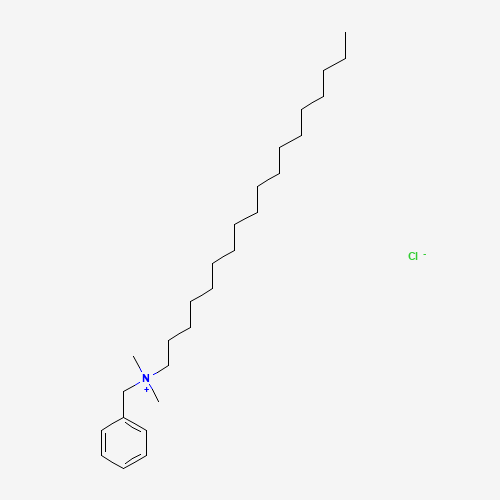
CAS122-19-0
分子式C27H50ClN·xH2O
分子量424.15 g/mol g/mol
危化品
Physical Description | Benzyldimethyloctadecylammonium chloride appears as white solid or thick liquid with a mild odor. (USCG, 1999)
科学粮草官-词典编辑部,修订于:2026-07-06
Toxicity
ToxicityFate Summary
ATMOSPHERIC FATE: According to a model of gas/particle partitioning of semivolatile organic compounds in the atmosphere(1), benzyldimethylstearylammonium chloride, which has an estimated vapor pressure of 1.2X10⁻¹³ mm Hg at 25 °C(SRC), using a fragment constant estimation method(2), is expected to exist in the particulate phase in the ambient atmosphere. Particulate-phase benzyldimethylstearylammonium chloride may be removed from the air by wet and dry deposition(SRC).
Soil Adsorption / Mobility
Using a structure estimation method based on molecular connectivity indices(1), the Koc for benzyldimethylstearylammonium chloride can be estimated to be 3X10+7(SRC). According to a classification scheme(2), this estimated Koc value suggests that benzyldimethylstearylammonium chloride is expected to be immobile in soil.
Environmental Biodegradation
AEROBIC: Benzyldimethystearylammonium chloride did not degrade after 10 days using the MITI test(1). The SCAS method and the OECD Confirmatory test showed 94 and 95% degradation of benzyldimethylstearylammonium chloride, respectively(2).
Environmental Bioconcentration
An estimated BCF of 71 was calculated for benzyldimethylstearylammonium chloride(SRC), using a log Kow of 3.23(1) and a regression-derived equation(2). According to a classification scheme(3), this BCF suggests the potential for bioconcentration in aquatic organisms is moderate.
Volatilization from Water / Soil
The Henry's Law constant for benzyldimethylstearylammonium chloride is estimated as 4.2X10⁻¹¹ atm-cu m/mole(SRC) using a fragment constant estimation method(1). This Henry's Law constant indicates that benzyldimethylstearylammonium chloride is expected to be essentially nonvolatile from water surfaces(2). Benzyldimethylstearylammonium chloride's estimated Henry's Law constant(1) indicates that volatilization from moist soil surfaces will not occur(SRC). Benzyldimethylstearylammonium chloride is not expected to volatilize from dry soil surfaces(SRC) based upon a an estimated vapor pressure of 1.2X10⁻¹³ mm Hg(SRC), determined from a fragment constant method(3).
Environmental Abiotic Degradation
Benzyldimethylstearylammonium chloride is not expected to undergo hydrolysis in the environment due to the lack of hydrolyzable functional groups(3) nor to directly photolyze due to the lack of absorption in the environmental UV spectrum (>290 nm).
Artificial Pollution Sources
Benzyldimethylstearylammonium chloride's production and use in contraceptive formulations(1), in industrial and institutional cleaners, various detergents, emulsion polymerization process, and paper and textile processing(2) may result in its release to the environment through various waste streams(SRC).
Probable Routes of Human Exposure
NIOSH (NOES Survey 1981-1983) has statistically estimated that 25,059 workers (15,638 of these are female) are potentially exposed to benzyldimethylstearylammonium chloride in the US(1). Occupational exposure to benzyldimethylstearylammonium chloride may occur via dermal contact with this compound at workplaces where benzyldimethylstearylammonium chloride is produced or used(SRC). The general population may be exposed to benzyldimethylstearylammonium chloride by using consumer products containing benzyldimethylstearylammonium chloride(SRC).
Environmental Fate / Exposure Summary
Benzyldimethylstearylammonium chloride's production and use as in contraceptive formulations, in industrial and institutional cleaners, various detergents, emulsion polymerization process, and paper and textile processing may result in its release to the environment through various waste streams. If released to air, an estimated vapor pressure of 1.2X10⁻¹³ mm Hg at 25 °C indicates benzyldimethylstearylammonium chloride will exist solely in the particulate phase in the ambient atmosphere. Particulate-phase benzyldimethylstearylammonium chloride will be removed from the atmosphere by wet and dry deposition. If released to soil, benzyldimethylstearylammonium chloride is expected to have no mobility based upon an estimated Koc of 3X10+7. Volatilization from moist soil surfaces is not expect...
Toxicity Data
LC50 (rat) = 3,280 mg/m3/4h
Adverse Effects
Skin Sensitizer - An agent that can induce an allergic reaction in the skin.
Toxicity Summary
Cosmetic Ingredient Review Finding(s): Safe in the present practices of use and concentration. Ingredient, concentration, and use information are available in documents discoverable at https://cir-reports.cir-safety.org
Human Toxicity Excerpts
Poison by intraperitoneal route. Moderately toxic by ingestion. A human skin irritant and severe experimental eye irritant.
Non-Human Toxicity Values
LD50 Guinea pig oral 500 mg/kg
Non-Human Toxicity Excerpts
CAPILLARY PERMEABILITY IN RABBIT AND MOUSE WAS INCREASED WHEN DODECYLDIMETHYLBENZYLAMMONIUM CHLORIDE WAS INTRACUTANEOUSLY INJECTED. THE PERMEABILITY THRESHOLDS WERE 0.01% AND 0.005% WHEN INJECTED INTO RABBIT AND MOUSE, RESPECTIVELY. THE PERMEABILITY THRESHOLD INCREASED 100-200-FOLD IN THE PRESENCE OF A KERATINOUS LAYER.









