


 一键配货
一键配货
化合物详情
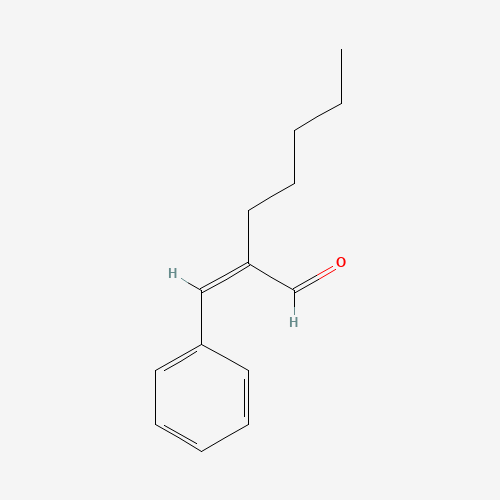
CAS122-40-7
分子式C14H18O
分子量202.29 g/mol
非危品
Pentyl cinnamaldehyde is a member of cinnamaldehydes.
科学粮草官-词典编辑部,修订于:2026-07-06
Toxicity
ToxicityFate Summary
ATMOSPHERIC FATE: According to a model of gas/particle partitioning of semivolatile organic compounds in the atmosphere(1), alpha-amyl cinnamaldehyde, which has an estimated vapor pressure of 0.00431 mm Hg at 25 °C(SRC), determined from a fragment constant method(2), is expected to exist solely as a vapor in the ambient atmosphere. Vapor-phase alpha-amyl cinnamaldehyde is degraded in the atmosphere by reaction with photochemically-produced hydroxyl radicals(SRC); the half-life for this reaction in air is estimated to be 7.2 hours(SRC), calculated from its rate constant of 5.4X10⁻¹¹ cu cm/molecule-sec at 25 °C(SRC) that was derived using a structure estimation method(2). Vapor-phase alpha-amyl cinnamaldehyde is also degraded in the atmosphere by reaction with ozone(SRC); the half-life fo...
Soil Adsorption / Mobility
Using a structure estimation method based on molecular connectivity indices(1), the Koc of alpha-amyl cinnamaldehyde can be estimated to be 680(SRC). According to a classification scheme(2), this estimated Koc value suggests that alpha-amyl cinnamaldehyde is expected to have low mobility in soil.
Environmental Biodegradation
AEROBIC: alpha-Amyl cinnamaldehyde, present at 100 mg/L, reached 51% of its theoretical BOD in 4 weeks using an activated sludge inoculum at 30 mg/L in the Japanese MITI test(1). Using OECD Method 301B (CO2 evolution), alpha-amyl cinnamaldehyde had a 65% degradation in 28 days indicating it was readily biodegradable(2). Using OECD Method 301F (Respirometric method/SAPROMAT), alpha-amyl cinnamaldehyde had a 90% degradation 28 days indicating it was readily biodegradable(2).
Environmental Bioconcentration
An estimated BCF of 586 was calculated in fish for alpha-amyl cinnamaldehyde(SRC), using a log Kow of 4.70(1) and a regression-derived equation(2). According to a classification scheme(3), this BCF suggests the potential for bioconcentration in aquatic organisms is high(SRC), provided the compound is not metabolized by the organism(SRC).
Volatilization from Water / Soil
The Henry's Law constant for alpha-amyl cinnamaldehyde is estimated as 7.8X10⁻⁶ atm-cu m/mole(SRC) using a fragment constant estimation method(1). This Henry's Law constant indicates that alpha-amyl cinnamaldehyde is expected to volatilize from water surfaces(2). Based on this Henry's Law constant, the volatilization half-life from a model river (1 m deep, flowing 1 m/sec, wind velocity of 3 m/sec)(2) is estimated as 6.8 days(SRC). The volatilization half-life from a model lake (1 m deep, flowing 0.05 m/sec, wind velocity of 0.5 m/sec)(2) is estimated as 54 days(SRC). alpha-Amyl cinnamaldehyde's Henry's Law constant indicates that volatilization from moist soil surfaces may occur(SRC). alpha-Amyl cinnamaldehyde is not expected to volatilize from dry soil surfaces(SRC) based upon an esti...
Environmental Abiotic Degradation
The rate constant for the vapor-phase reaction of alpha-amyl cinnamaldehyde with photochemically-produced hydroxyl radicals has been estimated as 5.4X10⁻¹¹ cu cm/molecule-sec at 25 °C(SRC) using a structure estimation method(1). This corresponds to an atmospheric half-life of about 7.2 hours at an atmospheric concentration of 5X10+5 hydroxyl radicals per cu cm(1). The rate constant for the vapor-phase reaction of alpha-amyl cinnamaldehyde with ozone has been estimated as 2.2X10⁻¹⁷ cu cm/molecule-sec at 25 °C(SRC) using a structure estimation method(1). This corresponds to an atmospheric half-life of about 12.6 hours at an atmospheric concentration of 7X10+11 ozone molecules per cu cm(1). alpha-Amyl cinnamaldehyde is stable to hydrolysis in water(2); the aldehyde group has a potential to...
Natural Pollution Sources
alpha-Amyl cinnamaldehyde is a naturally occurring substance; /cinnamaldehyde/ is the predominant constituent of cassia oil and Ceylon cinnamon bark oil and is a common component of traditional foods; responsible for the spicy aroma strongly reminiscent of cinnamon spice(1).
Artificial Pollution Sources
alpha-Amyl cinnamaldehyde's production and use in perfumery and flavoring(1) may result in its release to the environment through various waste streams(SRC).
Probable Routes of Human Exposure
NIOSH (NOES Survey 1981-1983) has statistically estimated that 79,408 workers (47,945 of these were female) were potentially exposed to alpha-amyl cinnamaldehyde in the US(1). Occupational exposure to alpha-amyl cinnamaldehyde may occur through inhalation of vapor and dermal contact with this compound at workplaces where butyric anhydride is produced or used(SRC). The general population will be exposed to alpha-amyl cinnamaldehyde through its use in consumer products such as soaps, detergents and perfumes(2).
Environmental Fate / Exposure Summary
alpha-Amyl cinnamaldehyde's production and use in perfumery and flavoring(1) may result in its release to the environment through various waste streams. If released to air, an estimated vapor pressure of 0.00431 mm Hg at 25 °C indicates alpha-amyl cinnamaldehyde will exist solely as a vapor in the atmosphere. Vapor-phase alpha-amyl cinnamaldehyde will be degraded in the atmosphere by reaction with photochemically-produced hydroxyl radicals; the half-life for this reaction in air is estimated to be 7.2 hours. Vapor-phase alpha-amyl cinnamaldehyde will also be degraded in the atmosphere by reaction with ozone; the half-life for this reaction in air is estimated to be 12.6 hours. If released to soil, alpha-amyl cinnamaldehyde is expected to have low mobility based upon an estimated Koc of...
Human Toxicity Excerpts
/SIGNS AND SYMPTOMS/ Sensitivity to alpha-amylcinnamic aldehyde (alpha-AcAld) is apparently uncommon, but, like allergy to alpha-amylcinnamic alcohol (alpha-AcAlc), it often accompanies allergy to the perfume in Mycolog cream. Although alpha-AcAlc is a known ingredient, alpha-AcAld is not. However, gas-liquid chromatographic analysis shows alpha-AcAld to be present. Of fourteen persons sensitive to either chemical, ten reacted to both. Of these, one man and three women were markedly sensitive, and all three women had chronic recalcitrant vulvar eczema. That condition might have been the cause as well as the result of sensitization, but reexposure to a suspected product reproduced the eruption in both persons tested. Its use with other potent sensitizers, e.g., ethylenediamine, to treat...
Carcinogen Classification
No indication of carcinogenicity to humans (not listed by IARC).
Non-Human Toxicity Values
LD50 Rat oral 3730 mg/kg
Antidote and Emergency Treatment
/SRP:/ Advanced treatment: Consider Consider orotracheal or nasotracheal intubation for airway control in the patient who is unconscious, has severe pulmonary edema, or is in severe respiratory distress. Intubation should be considered at the first sign of upper airway obstruction caused by edema. Positive-pressure ventilation techniques with a bag valve mask device may be beneficial. Consider drug therapy for pulmonary edema ... . Consider administering a beta agonist such as albuterol for severe bronchospasm ... . Start IV administration of D5W /SRP: "To keep open", minimal flow rate/. Use 0.9% saline (NS) or lactated Ringer's (LR) if signs of hypovolemia are present. For hypotension with signs of hypovolemia, administer fluid cautiously. Consider vasopressors if patient is hypotensiv...









