


 一键配货
一键配货
化合物详情
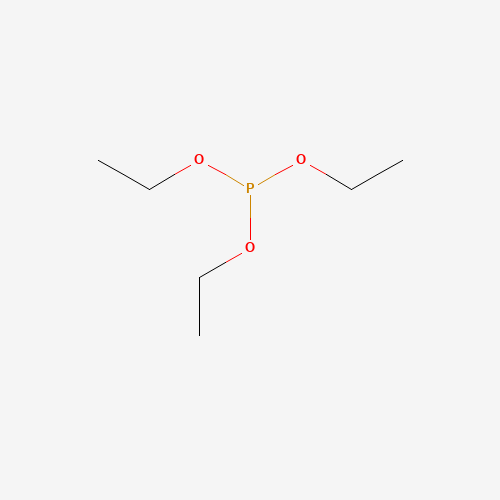
CAS122-52-1
分子式C6H15O3P
分子量166.16 g/mol g/mol
危化品
Physical Description | Triethyl phosphite appears as a clear colorless liquid with a strong foul odor. Flash point 130 °F. Less dense than water and insoluble in water. Vapors heavier than air.
科学粮草官-词典编辑部,修订于:2026-07-06
Toxicity
ToxicityEcotoxicity Values
LC50; Species: Brachydanio rerio (Fish) age 7 months, length 2.5-3.5 cm; Conditions: static, 20.9-22.6 °C; Concentration: 251.6 mg/L for 96 hr /calculated from diethyl phosphite/ /purity 98.8%/
Fate Summary
ATMOSPHERIC FATE: According to a model of gas/particle partitioning of semivolatile organic compounds in the atmosphere(1), triethyl phosphite, which has a vapor pressure of 1.95 mm Hg at 20 °C(SRC), is expected to exist solely as a vapor in the ambient atmosphere. Vapor-phase triethyl phosphite is degraded in the atmosphere by reaction with photochemically-produced hydroxyl radicals(SRC); the half-life for this reaction in air is estimated to be 6.6 hours(SRC), calculated from its rate constant of 5.8X10⁻¹¹ cu cm/molecule-sec at 25 °C(SRC) that was derived using a structure estimation method(3). Triethyl phosphite does not absorb at wavelengths >290 nm(4) and therefore is not expected to be susceptible to direct photolysis by sunlight(SRC).
Soil Adsorption / Mobility
Adsorption to soils or suspended solids and sediment is not expected to be an important fate process(SRC) due to the rapid hydrolysis of triethyl phosphite(1).
Environmental Biodegradation
AEROBIC: In 2 tests on ready biodegradation, triethyl phosphite was degraded by 49-69%, therefore, it did not reach the criteria for ready biodegradability(1). However, from the degradation curve it can be assumed that hydrolysis was the prerequisite for biodegradation(1). Using OECD Guideline 302C (Inherent Biodegradability: Modified MITI Test II) with an activated sludge inoculum, triethyl phosphite was degraded >100% based on O2 consumption and 73% based on DOC removal classifying the compound as inherently biodegradable(2); the complete disappearance of triethyl phosphite to monoethyl and diethyl phosphite and phosphorous acid in the test system is likely the result of hydrolysis followed by biodegradation(1,2). Biodegradation is not expected to be an important fate process for trie...
Environmental Bioconcentration
Bioconcentration is not expected to be an important fate process(SRC) due to the rapid hydrolysis of triethyl phosphite(SRC).
Volatilization from Water / Soil
Volatilization from water surfaces or moist soil is not expected to be an important fate process(SRC) due to the hydrolysis of triethyl phosphite(1). Triethyl phosphite is expected to volatilize from dry soil surfaces(SRC) based upon a vapor pressure of 1.95 mm at 20 °C(1).
Environmental Abiotic Degradation
The rate constant for the vapor-phase reaction of triethyl phosphite with photochemically-produced hydroxyl radicals has been estimated as 5.8X10⁻¹¹ cu cm/molecule-sec at 25 °C(SRC) using a structure estimation method(1). This corresponds to an atmospheric half-life of about 6.6 hours at an atmospheric concentration of 5X10+5 hydroxyl radicals per cu cm(1). In acid solution (pH=4), triethyl phosphite hydrolyzes immediately forming diethyl phosphite and ethanol(2). At pH 7, triethyl phosphite hydrolyzes completely within 20 minutes; after 3 hours 89.3% diethyl phosphite and 10.7% monoethyl phosphite are formed(2). At pH 9, the half-life of triethyl phosphite in water is approximately 5.1 hours; 70% of the substance remains unhydrolyzed after 3 hours(2). The UV absorption spectrum of trie...
Artificial Pollution Sources
Triethyl phosphite's production and use an intermediate for the production of flame retardants, optical brighteners, pesticides, antioxidants, and pharmaceuticals(1,2) may result in its release to the environment through various waste streams(SRC).
Probable Routes of Human Exposure
NIOSH (NOES Survey 1974) has statistically estimated that 5,414 workers are potentially exposed to triethyl phosphite in the US(1). Occupational exposure to triethyl phosphite may occur through inhalation and dermal contact with this compound at workplaces where triethyl phosphite is produced or used(SRC). Exposure to the general population to triethyl phosphite is unlikely(SRC), since it is only used as a chemical intermediate and is expected to rapidly hydrolyze in the environment(2).
Environmental Fate / Exposure Summary
Triethyl phosphite's production and use an intermediate for the production of flame retardants, optical brighteners, pesticides, antioxidants, and pharmaceuticals may result in its release to the environment through various waste streams. Hydrolysis is expected to be an important fate process for triethyl phosphite. If released to air, a vapor pressure of 1.95 mm Hg at 20 °C indicates triethyl phosphite will exist solely as a vapor in the atmosphere. Vapor-phase triethyl phosphite will be degraded in the atmosphere by reaction with photochemically-produced hydroxyl radicals; the half-life for this reaction in air is estimated to be 6.6 hours. Triethyl phosphite does not absorb at wavelengths >290 nm and therefore is not expected to be susceptible to direct photolysis by sunlight. If rel...
Symptoms
Ingestion Exposure: Abdominal pain.
Toxicity Data
LC50 (rat) = 11,063 mg/m3/6H
Exposure Routes
The substance can be absorbed into the body by inhalation of its vapour and by ingestion.
Toxicity Summary
IDENTIFICATION AND USE: Triethyl phosphite is a colorless liquid with a characteristic, obnoxious phosphite odor. It is a chemical intermediate for vinyl phosphate insecticides, for phosphonate insecticides; sugarcane ripener. Schedule 3B precursor to dimethyl methylphosphonate, which is a sarin precursor and nerve agent simulant. HUMAN EXPOSURE AND TOXICITY: Human blood monocyte carboxylesterase is inhibited by triethyl phosphite. ANIMAL STUDIES: Triethyl phosphite showed slightly irritating effects on the eyes of 3 male rabbits. All animals showed slight or clearly visible conjunctival erythema in the treated eyes. Slight chemosis and increased secretion were recorded in two animals, each. The findings appeared within one hr and were completely reversible within 48 hr. Six rabbits rev...
Human Toxicity Excerpts
/ALTERNATIVE and IN VITRO TESTS/ Human blood monocyte carboxylesterase (CBE) is inhibited by a variety of organophosphorus compounds including arylphosphates and arylphosphites and some alkylphosphites. Triphenyl phosphate and triphenyl phosphite with Ki values of 8 x 10(-9) M and 4.8 x 10(-8) M, respectively, are the most potent inhibitors of this enzyme evaluated by this study. The arylphosphates vary in their capacity to inhibit carboxylesterase activity. Diphenyl phosphate with its strong negative charge is not a potent inhibitor (Ki = 1 x 10(-4) M), whereas if its negative charge is neutralized, as in diphenyl methyl phosphate, its capacity to inhibit carboxylesterase is significantly increased. Compounds with increased bulk, such as trinaphthyl phosphate, only inhibit the enzyme a...
Antidote and Emergency Treatment
Advanced treatment: Consider orotracheal or nasotracheal intubation for airway control in the patient who is unconscious, has severe pulmonary edema, or is in severe respiratory distress. Positive-pressure ventilation techniques with a bag-valve-mask device may be beneficial. Consider drug therapy for pulmonary edema ... . Monitor cardiac rhythm and treat arrhythmias if necessary ... . Start IV administration of D5W TKO /SRP: "To keep open", minimal flow rate/. Use 0.9% saline (NS) or lactated Ringer's (LR) if signs of hypovolemia are present. For hypotension with signs of hypovolemia, administer fluid cautiously. Watch for signs of fluid overload ... . Treat seizures with diazepam (Valium) or lorazepam (Ativan) ... . Monitor for signs of hypoglycemia (decreased LOC, tachycardia, pallor...









