


 一键配货
一键配货
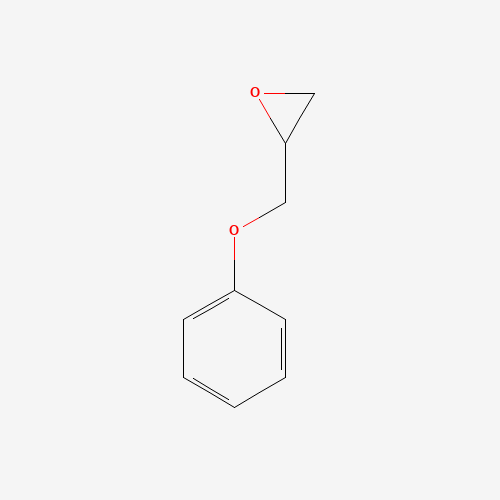
化合物详情
CAS122-60-1
分子式C9H10O2
分子量150.18 g/mol g/mol
危化品
Phenyl Glycidyl Ether can cause cancer according to The World Health Organization's International Agency for Research on Cancer (IARC). It can cause male reproductive toxicity according to California Labor Code.
科学粮草官-词典编辑部,修订于:2026-07-06
Toxicity
ToxicityEcotoxicity Values
LC50 Carassius auratus (Goldfish) 43 mg/L/96 hr; static
Fate Summary
ATMOSPHERIC FATE: According to a model of gas/particle partitioning of semivolatile organic compounds in the atmosphere(1), phenyl glycidyl ether, which has a vapor pressure of 1.0X10⁻² mm Hg at 25 °C(2), is expected to exist solely as a vapor in the ambient atmosphere. Vapor-phase phenyl glycidyl ether is degraded in the atmosphere by reaction with photochemically-produced hydroxyl radicals(SRC); the half-life for this reaction in air is estimated to be 13 hrs(SRC), calculated from its rate constant of 2.9X10⁻¹¹ cu cm/molecule-sec at 25 °C(SRC) that was derived using a structure estimation method(3). Phenyl glycidyl ether does not contain chromophores that absorb at wavelengths >290 nm and therefore is not expected to be susceptible to direct photolysis by sunlight(4).
Soil Adsorption / Mobility
The Koc of phenyl glycidyl ether is estimated as 60(SRC), using a water solubility of 2,400 mg/L(1) and a regression-derived equation(2). According to a classification scheme(3), this estimated Koc value suggests that phenyl glycidyl ether is expected to have high mobility in soil.
Environmental Biodegradation
AEROBIC: A 5-day theoretical BOD of 6% was measured for phenyl glycidyl ether using a standard dilution method and an effluent from a biological sanitary waste treatment plant as the inoculum(1). A 5-day theoretical BOD of 0% was measured using a BOD dilution method and an acclimated sewage inoculum(2). Phenyl glycidyl ether, present at 100 mg/L, reached 33% of its theoretical BOD in 4 weeks using an activated sludge inoculum at 30 mg/L and the Japanese MITI test(3).
Environmental Bioconcentration
An estimated BCF of 8 was calculated for phenyl glycidyl ether(SRC), using a water solubility of 2,400 mg/L(1) and a regression-derived equation(2). According to a classification scheme(3), this BCF suggests the potential for bioconcentration in aquatic organisms is low(SRC).
Volatilization from Water / Soil
The Henry's Law constant for phenyl glycidyl ether is estimated as 8.2X10⁻⁷ atm-cu m/mole(SRC) derived from its vapor pressure, 1.0X10⁻² mm Hg(1), and water solubility, 2,400 mg/L(1). This Henry's Law constant indicates that phenyl glycidyl ether is expected to be essentially nonvolatile from water surfaces(2). Phenyl glycidyl ether's estimated Henry's Law constant indicates that volatilization from moist soil surfaces may not occur(SRC). The potential for volatilization of phenyl glycidyl ether from dry soil surfaces may(SRC) based upon its vapor pressure(1).
Environmental Abiotic Degradation
The rate constant for the vapor-phase reaction of phenyl glycidyl ether with photochemically-produced hydroxyl radicals has been estimated as 2.9X10⁻¹¹ cu cm/molecule-sec at 25 °C(SRC) using a structure estimation method(1). This corresponds to an atmospheric half-life of about 13 hours at an atmospheric concentration of 5X10+5 hydroxyl radicals per cu cm(1). Glycidyl ethers, such as phenyl glycidyl ether, can react readily with water and with nucleophiles such as proteins and nucleic acids(2). Epoxides in general hydrolyze rapidly at 25 °C and pH 7(3) through neutral, acid, or base-mediated reactions(4). Hydrolysis products are usually the corresponding diol and sometimes re-arranged products(4). While data specific to phenyl glycidyl ether were not located(SRC, 2006), the hydrolysis h...
Effluent Concentrations
Phenyl glycidyl ether was qualitatively detected in water samples collected from an advanced waste treatment facility in Lake Tahoe, CA on Oct 24, 1974)(1).
ICSC Environmental Data
The substance is harmful to aquatic organisms. The substance may cause long-term effects in the aquatic environment.
Natural Pollution Sources
Phenyl glycidyl ethers are not known to occur as natural products(1).
Artificial Pollution Sources
Phenyl glycidyl ether's production and use as a component in epoxy resins(1) may result in its release to the environment through various waste streams(SRC).
Probable Routes of Human Exposure
Total workers exposed all industries: 356 in small industries (1-99 employees); 6,127 in medium industries (100-499 employees); 4,068 in large industries (500+ employees)
Environmental Fate / Exposure Summary
Phenyl glycidyl ether's production and use as a component of epoxy resins may result in its release to the environment through various waste streams. If released to air, a vapor pressure of 1.0X10⁻² mm Hg at 25 °C indicates phenyl glycidyl ether will exist solely as a vapor in the atmosphere. Vapor-phase phenyl glycidyl ether will be degraded in the atmosphere by reaction with photochemically-produced hydroxyl radicals; the half-life for this reaction in air is estimated to be 13 hrs. Phenyl glycidyl ether does not contain chromophores that absorb at wavelengths >290 nm and therefore is not expected to be susceptible to direct photolysis by sunlight. If released to soil, phenyl glycidyl ether is expected to have high mobility based upon an estimated Koc of 60. Volatilization from moist...
Symptoms
irritation eyes, skin; upper respiratory system; skin sensitization; narcosis; possible hematopoietic, reproductive effects; [potential occupational carcinogen]
Cancer Sites
[in animals: nasal cancer]
Target Organs
Eyes, skin, central nervous system, hematopoietic system, reproductive system
Toxicity Data
LC50 (rat) >100 ppm/8h
Adverse Effects
ACGIH Carcinogen - Confirmed Animal.
Exposure Routes
inhalation, skin absorption, ingestion, skin and/or eye contact
Carcinogen Classification
IARC Monographs: Volume 71: (1999) Re-evaluation of Some Organic Chemicals, Hydrazine and Hydrogen Peroxide (Part 1, Part 2, Part 3)









