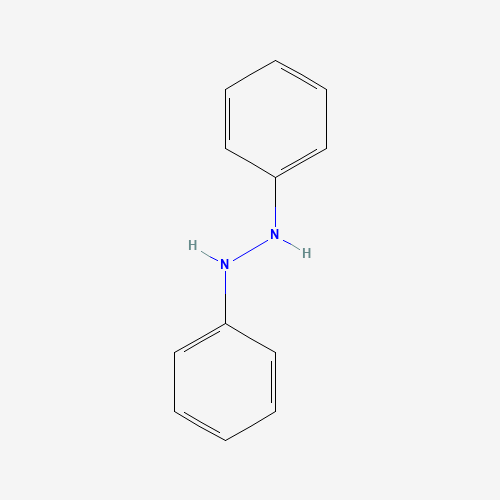
Ecotoxicity Values
USDA APHIS Chemical Effects: collection=usda_chemeffect&query_type=synonym&query='^122-66-7$'
Fate Summary
ATMOSPHERIC FATE: According to a model of gas/particle partitioning of semivolatile organic compounds in the atmosphere(1), 1,2-diphenylhydrazine, which has a vapor pressure of 4.4X10⁻⁴ mm Hg at 25 °C(2), will exist in both the vapor and particulate phases in the ambient atmosphere. Vapor-phase 1,2-diphenylhydrazine is degraded in the atmosphere by reaction with photochemically-produced hydroxyl radicals(SRC); the half-life for this reaction in air is estimated to be about 5 hours(SRC), from its rate constant of 8.5X10⁻¹¹ cu cm/molecule-sec at 25 °C(SRC) derived using a structure estimation method(3). Particulate-phase 1,2-diphenylhydrazine may be physically removed from the air by wet and dry deposition(SRC). 1,2-Diphenylhydrazine absorbs light greater than 290 nm(4), and may be suscep...
Soil Adsorption / Mobility
The Koc of 1,2-diphenylhydrazine is estimated as approximately 950(SRC), using a measured log Kow of 2.94(1) and a regression-derived equation(2). According to a classification scheme(3), this estimated Koc value suggests that 1,2-diphenylhydrazine has low mobility in soil(SRC).
Environmental Biodegradation
1,2-Diphenylhydrazine is degraded by sludge microorganisms(1). Using a static screening test, 1,2-diphenylhydrazine was inoculated with domestic wastewater and incubated for 7 days followed by 3 weekly subcultures (totaling 28 days of incubation); degradation of 1,2-diphenylhydrazine at 5 mg/l was reported as 80, 73, 66, and 77% for the original, first, second, and third subculture. Degradation of 1,2-diphenylhydrazine at 10 mg/l was reported as 72, 55, 40, and 40% for the original, first, second, and third subculture(2). This pattern was believed to indicate a process of initially significant degradation with gradual adaptation followed by a deadaptive process(2).
Environmental Bioconcentration
The weighted average bioconcentration factor for 1,2-diphenylhydrazine was reported to be 29 for the edible portions of fish and shellfish consumed by Americans(1). According to a classification scheme(2), this BCF value suggests that bioconcentration in aquatic organisms is low(SRC)
Volatilization from Water / Soil
The Henry's Law constant for 1,2-diphenylhydrazine is estimated as 4.8X10⁻⁷ atm-cu m/mole(SRC) derived from its vapor pressure, 4.4X10⁻⁴ mm Hg(1), and water solubility, 221 mg/L(2). This Henry's Law constant indicates that 1,2-diphenylhydrazine is expected to be essentially nonvolatile from water surfaces(3). 1,2-Diphenylhydrazine's estimated Henry's Law constant indicates that volatilization from moist soil surfaces is not expected(SRC). 1,2-Diphenylhydrazine is not expected to volatilize from dry soil surfaces(SRC) based upon its vapor pressure(1).
Environmental Abiotic Degradation
Although 1,2-diphenylhydrazine absorbs UV radiation beyond 316 nm(1), UV photolysis in solutions or organic solvents yields only azobenzene when aerated and azobenzene and aniline under a nitrogen atmosphere(2). 1,2-Diphenylhydrazine is rapidly oxidized to azobenzene in aerobic solutions and the reaction is catalyzed by common environmental cations such as copper(II) and iron(III). The half-lives from the uncatalyzed and catalyzed reaction are 5.78 and 1.16 min, respectively, at pH 10(2). No rates were calculated at pH 7, although it was reported that this reaction proceeded at an observable rate even in acidic solution(2). This redox reaction is readily reversible, and therefore, the reaction may not lead to ultimate destruction but does provide a mechanism for environmental degradatio...
Environmental Water Concentrations
GROUNDWATER: 1,2-Diphenylhydrazine was detected in groundwater samples at Love Canal, Niagara Falls, NY(1). One of 29 groundwater well samples at the Forest Waste Disposal Site, Otisville, MI contained 1,2-diphenylhydrazine at unreported concentrations(2).
Effluent Concentrations
1,2-Diphenylhydrazine was detected in 1.2% of 1,205 effluent samples collected in a national survey at a median concn less than 10 ug/l(1). Influent at the Moccasin Bend Wastewater Treatment Plant, Chattanooga, TN contained 1,2-diphenylhydrazine in 14% of 35 samples; 8% of the primary effluent samples contained 1,2-diphenylhydrazine at an average concentration of <1 ug/l (2). In a second study at the same treatment plant, 17% of 29 influent samples, 10% of 30 primary effluent samples, and 0 of 30 secondary effluent samples contained 1,2- diphenylhydrazine, where present, at an average concentration of <1 ug/l(2). Effluent samples collected from the Cedar Creek Wastewater Reclamation Plant, Nassau County, NY contained below detection limit concentrations of 1,2-diphenylhydrazine (detecti...
ICSC Environmental Data
The substance is very toxic to aquatic organisms. Bioaccumulation of this chemical may occur in fish.
Fish/Seafood Concentrations
1,2-Diphenylhydrazine was detected in the tissues of fish collected nearshore from several Lake Michigan tributaries and embayments(1), and Great Lakes harbors and tributary mouths(2).
Artificial Pollution Sources
1,2-Diphenylhydrazine's production and use as a chemical intermediate(1,2) may result in its release to the environment through various waste streams(SRC). It also may be produced in wastewater receiving azobenzene where conditions are reducing(3).
Sediment/Soil Concentrations
1,2-Diphenylhydrazine was detected in sediment and soil samples at Love Canal, Niagara Fall, NY(1).
Probable Routes of Human Exposure
Examination of 194 employees in a plant manufacturing benzidine showed 20 cases of tumors in the urinary system after an exposure to 0.03-0.1 ug benzidine and 0.006-3000 ug hydrazobenzene/l of air for 8 years on the average. The highest rate of tumor incidence was between the 6th and 10th year of exposure.
Environmental Fate / Exposure Summary
1,2-Diphenylhydrazine's production and use as a chemical intermediate may result in its release to the environment through various waste streams. It may also be produced in wastewater receiving azobenzene where conditions are reducing. If released to air, a vapor pressure of 4.4X10⁻⁴ mm Hg at 25 °C indicates that 1,2-diphenylhydrazine will exist in both the vapor and particulate phases in the ambient atmosphere. Vapor-phase 1,2-diphenylhydrazine is degraded in the atmosphere by reaction with photochemically-produced hydroxyl radicals with an estimated half-life of about 5 hours. Particulate-phase 1,2-diphenylhydrazine may be physically removed from the air by wet and dry deposition. 1,2-Diphenylhydrazine absorbs light greater than 290 nm and may be susceptible to direct photolysis; howe...
Symptoms
Irritatinon to the eyes, nose and respiratory system, depending on the route of exposure. Cough, redness of the exposed surface. (L463)
Treatment
Consider gastric lavage after ingestion of a potentially life-threatening amount of poison if it can be performed soon after ingestion. Following inhalation, move patient to fresh air. Monitor for respiratory distress. If cough or difficulty breathing develops, evaluate for respiratory tract irritation, bronchitis, or pneumonitis. Administer oxygen and assist ventilation as required. Treat bronchospasm with inhaled beta2 agonist and oral or parenteral corticosteroids. Irrigate exposed eyes with copious amounts of room temperature water for at least 15 minutes. If the exposure occurs through dermal contact remove contaminated clothing and wash exposed area thoroughly with soap and water. A physician may need to examine the area if irritation or pain persists. (T36)
Target Organs
Cancer, Hepatic (Liver)
Toxicity Data
LD50: 959 mg/kg (Oral, Rat) (L463)
Health Effects
Nonneoplastic liver lesions, hepatocellular carcinomas and/or neoplastic liver nodules; seizures and coma. (L463)
Adverse Effects
NTP Carcinogen - Reasonably anticipated to be a human carcinogen.
Exposure Routes
The substance can be absorbed into the body by inhalation and by ingestion.
Toxicity Summary
Two of the known metabolites, aniline and benzidine, may contribute to the toxicity and/or carcinogenicity of 1,2-diphenylhydrazine. Nonneoplastic liver lesions, hepatocellular carcinomas and/or neoplastic liver nodules indicate that the liver is a target of 1,2-diphenylhydrazine toxicity. As aniline and other aromatic amino metabolites of 1,2-diphenylhydrazine (e.g., aminophenols) are methemoglobinforming compounds by either oral or inhalation routes of exposure, it is possible that 1,2-diphenylhydrazine may cause methemoglobinemia in humans. (L463)
CDC-ATSDR Toxicological Profile
RAIS Toxicity Values
Oral Slope Factor Reference: IRIS Current
Human Toxicity Excerpts
/CASE REPORTS/ In the past, isolated cases of irritant cystitis with incontinence and hematuria have been seen on exposure to high concentrations of hydrazobenzene.
Carcinogen Classification
Not listed by IARC. Benzidine, a metabolite of 1,2-diphenylhydrazine, is carcinogenic to humans (Group 1). Aniline, another metabolite, is not classifiable as to its carcinogenicity to humans (Group 3). (L135)
Populations at Special Risk
Biological half-lives were significantly different among the three acetylation phenotypes (analysis of variance, P < 0.05): 3.94+/-1.70 hours for slow acetylators, 2.25+/-0.37 hours for intermediate acetylators, and 1.86+/-0.67 hours for rapid acetylators. /Hydrazine/
1 or Cancer Risk Level 1E-06
Fraction of Contaminant Absorbed Dermally from Soil: 0.1
Hazard Quotient Level 3 or Cancer Risk Level 1E-04
Fraction of Contaminant Absorbed Dermally from Soil: 0.1
USGS Health-Based Screening Levels for Evaluating Water-Quality
Reference: Smith, C.D. and Nowell, L.H., 2024. Health-Based Screening Levels for evaluating water-quality data (3rd ed.). DOI:10.5066/F71C1TWP



 一键配货
一键配货