
 一键配货
一键配货
化合物详情
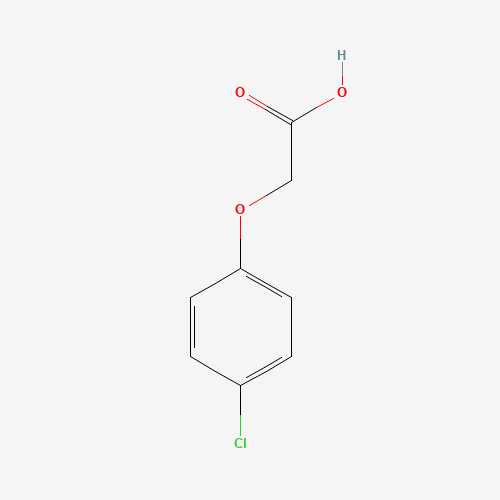
CAS122-88-3
分子式C8H7ClO3
分子量186.59 g/mol g/mol
危化品
(4-chlorophenoxy)acetic acid is a chlorophenoxyacetic acid that is phenoxyacetic acid carrying a chloro substituent at position 4. It has a role as a phenoxy herbicide. It is a chlorophenoxyacetic acid and a member of monochlorobenzenes. It is a conjugate acid of a (4-chlorophenoxy)acetate.
科学粮草官-词典编辑部,修订于:2026-07-06
Toxicity
ToxicityEcotoxicity Values
USDA APHIS Chemical Effects: collection=usda_chemeffect&query_type=synonym&query='^122-88-3$'
Fate Summary
ATMOSPHERIC FATE: According to a model of gas/particle partitioning of semivolatile organic compounds in the atmosphere(1), 4-chlorophenoxyacetic acid, which has an estimated vapor pressure of 3.2X10⁻⁴ mm Hg at 25 °C(2), is expected to exist solely in the vapor-phase in the ambient atmosphere. Vapor-phase 4-chlorophenoxyacetic acid is degraded in the atmosphere by reaction with photochemically-produced hydroxyl radicals(SRC); the half-life for this reaction in air is estimated to be 35 hours(SRC), calculated from its rate constant of 1.1X10⁻¹¹ cu cm/molecule-sec at 25 °C(SRC) that was derived using a structure estimation method(3). 4-Chlorophenoxyacetic acid was degraded 30% upon exposure to natural sunlight over the course of 24 hours, suggesting photodegradation is an important enviro...
Soil Adsorption / Mobility
The Rf value for 4-chlorophenoxyacetic acid ranged from 0.74 at pH 4.0 to 0.93 at pH 7 using a Rothansted silty clay loam(1). At pH 7.8-7.9, 4-chlorophenoxyacetic acid was found not to be significantly adsorbed to clay(2). Sorption of 4-chlorophenoxy acetic acid to clay is pH dependent and increases with decreasing ionization(3). Using a structure estimation method based on molecular connectivity indices(4), the Koc for 4-chlorophenoxy acetic acid can be estimated to be 18(SRC). According to a classification scheme(5), this estimated Koc value suggests that 4-chlorophenoxy acetic acid is expected to have very high mobility in soil(SRC). In addition, the pKa of 4-chlorophenoxy acetic acid is 3.56(6), indicating that this compound will primarily exist as an anion in the environment, and a...
Environmental Biodegradation
ANAEROBIC: 4-Chlorophenoxyacetic acid underwent complete removal using an an anaerobic digester sludge in 8 days, initial concentration not provided(1).
Environmental Bioconcentration
An estimated BCF of 3 was calculated for 4-chlorophenoxyacetic acid(SRC), using a log Kow of 2.25(1) and a regression-derived equation(2). According to a classification scheme(3), this BCF suggests the potential for bioconcentration in aquatic organisms is low(SRC).
Volatilization from Water / Soil
The pKa of 4-chlorophenoxyacetic acid is 3.56(1), indicating that this compound will exist predominantly as an anion under environmental conditions. Volatilization will not occur from water and moist soils since anions do not volatilize(SRC). 4-Chlorophenoxyacetic acid is not expected to volatilize from dry soil surfaces(SRC), based upon an estimated vapor pressure of 3.2X10⁻⁴ mm Hg at 25 °C(SRC), determined from a fragment constant estimation method(2).
Environmental Abiotic Degradation
Under sunlight or UV (300-450 nm) 4-CPA in aqueous solutions decomposed mainly to p-chlorophenol, phenol, hydroquinone, p-chlorophenyl formate, phenoxyacetic acid, p-hydroxyphenoxacetic acid and humic acids. In the presence of cyanide ions, irradiation of 4-CPA produced p-chlorobenzonitrile.
Environmental Water Concentrations
DRINKING WATER: 4-Chlorophenoxyacetic acid was qualitatively detected in treated drinking water supplies in the U.K.(1).
Artificial Pollution Sources
4-Chlorophenoxyacetic acid's production may result in its release to the environment through various waste streams; it's use as a plant growth regulator and as an aid in setting fruit(1) will result in its direct release to the environment(SRC).
Probable Routes of Human Exposure
Occupational exposure to 4-chlorophenoxyacetic acid may occur by inhalation or dermal contact during its production or application as a plant growth regulator(SRC). Products containing 4-chlorophenoxyacetic acid are intended primarily for commercial use and are not likely to be used at residential sites; therefore, exposure to the general population is expected to be low(1).
Environmental Fate / Exposure Summary
4-Chlorophenoxyacetic acid's production may result in its release to the environment through various waste streams; it's use as a plant growth regulator and as an aid in setting fruit will result in its direct release to the environment. If released to air, an estimated vapor pressure of 3.2X10⁻⁴ mm Hg at 25 °C indicates 4-chlorophenoxyacetic acid will exist solely as a vapor in the ambient atmosphere. Vapor-phase 4-chlorophenoxyacetic acid will be degraded in the atmosphere by reaction with photochemically-produced hydroxyl radicals; the half-life for this reaction in air is estimated to be 35 hours. 4-Chlorophenoxyacetic acid was degraded 30% upon exposure to natural sunlight over the course of 24 hours, suggesting photodegradation in air is an important environmental fate process. If...
Toxicity Data
LC50 (rat) > 5,250 mg/m3
Adverse Effects
Occupational hepatotoxin - Secondary hepatotoxins: the potential for toxic effect in the occupational setting is based on cases of poisoning by human ingestion or animal experimentation.
RAIS Toxicity Values
Oral Chronic Reference Dose Reference: OPP
Non-Human Toxicity Values
LD50 Rabbit dermal >2,000 mg/kg /from table/