


 一键配货
一键配货
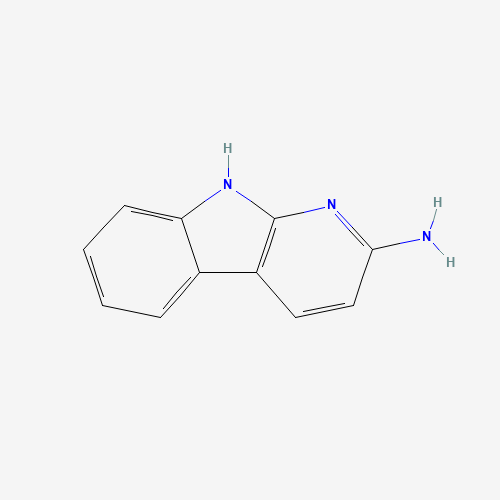
化合物详情
CAS26148-68-5
分子式C11H9N3
分子量183.21 g/mol g/mol
危化品
A-alpha-C (2-Amino-9H-pyrido[2,3-b]indole) can cause cancer according to The World Health Organization's International Agency for Research on Cancer (IARC).
科学粮草官-词典编辑部,修订于:2026-07-06
Toxicity
ToxicityFate Summary
ATMOSPHERIC FATE: According to a model of gas/particle partitioning of semivolatile organic compounds in the atmosphere(1), 2-amino-9H-pyrido(2,3-b)indole (A-alpha-C), which has an estimated vapor pressure of 2.2X10⁻⁷ mm Hg at 25 °C(SRC), determined from a fragment constant method(2), will exist in both the vapor and particulate phases in the ambient atmosphere. Vapor-phase 2-amino-9H-pyrido(2,3-b)indole (A-alpha-C) is degraded in the atmosphere by reaction with photochemically-produced hydroxyl radicals(SRC); the half-life for this reaction in air is estimated to be 0.64 hours(SRC), calculated from its rate constant of 2.0X10⁻¹⁰ cu cm/molecule-sec at 25 °C(SRC) that was derived using a structure estimation method(3). Particulate-phase 2-amino-9H-pyrido(2,3-b)indole (A-alpha-C) may be r...
Soil Adsorption / Mobility
Using a structure estimation method based on molecular connectivity indices(1), the Koc for 2-amino-9H-pyrido(2,3-b)indole (A-alpha-C) can be estimated to be 18000(SRC). According to a classification scheme(2), this estimated Koc value suggests that 2-amino-9H-pyrido(2,3-b)indole (A-alpha-C) is expected to be immobile in soil. The estimated pKa of 2-amino-9H-pyrido(2,3-b)indole (A-alpha-C) is 6.6(3), indicating that this compound will partially exist in the protonated form and cations generally adsorb to organic carbon and clay more strongly than their neutral counterparts(4).
Environmental Bioconcentration
An estimated BCF of 20 was calculated for 2-amino-9H-pyrido(2,3-b)indole (A-alpha-C)(SRC), using a log Kow of 2.60(1) and a regression-derived equation(2). According to a classification scheme(3), this BCF suggests the potential for bioconcentration in aquatic organisms is low(SRC).
Volatilization from Water / Soil
The Henry's Law constant for 2-amino-9H-pyrido(2,3- b)indole (A-alpha-C) is estimated as 4.0X10⁻¹⁴ atm-cu m/mole(SRC) using a fragment constant estimation method(1). This Henry's Law constant indicates that 2-amino-9H-pyrido(2,3-b)indole (A-alpha- C) is expected to be essentially nonvolatile from water surfaces(2). The Henry's Law constant for 2-amino-9H-pyrido(2,3- b)indole (A-alpha-C) indicates that volatilization from moist soil surfaces is not expected to occur(SRC). 2-Amino-9H-pyrido(2,3-b)indole (A-alpha-C) is not expected to volatilize from dry soil surfaces(SRC) based upon an estimated vapor pressure of 2.2X10⁻⁷ mm Hg(SRC), determined from a fragment constant method(3).
Environmental Abiotic Degradation
The rate constant for the vapor-phase reaction of 2-amino-9H-pyrido(2,3-b)indole (A-alpha-C) with photochemically-produced hydroxyl radicals has been estimated as 2.0X10⁻¹⁰ cu cm/molecule-sec at 25 °C(SRC) using a structure estimation method(1). This corresponds to an atmospheric half-life of about 0.64 hours at an atmospheric concentration of 5X10+5 hydroxyl radicals per cu cm(1). 2-Amino-9H-pyrido(2,3-b)indole (A-alpha-C) is not expected to undergo hydrolysis in the environment due to the lack of hydrolyzable functional groups(2).
Food Survey Values
2-Amino-9H-pyrido(2,3-b)indole (A-alpha-C) has been detected in grilled sliced beef (650 ng/g), grilled chicken (180 ng/g), grilled Chinese mushrooms (47 ng/g) and grilled onions (1.5 ng/g)(1). 2-Amino-9H-pyrido(2,3-b)indole (A-alpha-C) was detected after pyrolysis (550 °C) of L-tryptophan (250 to 2500 ug/g), chicken meat (34 ug/g), horse mackerel (12 ug/g), casein (38 ug/g), globulin (1.5 ug/g), gluten (1.2 ug/g) and zein (0.05 ug/g)(1).
Natural Pollution Sources
2-Amino-9H-pyrido(2,3-b)indole (A-alpha-C) is not known to occur in nature(1).
Artificial Pollution Sources
2-Amino-9H-pyrido(2,3-b)indole (A-alpha-C) has only been produced and used for laboratory applications(1), which may result in its release to the environment through various waste streams(SRC). 2-Amino-9H-pyrido(2,3-b)indole (A-alpha-C) is not produced in commercial or bulk qualitites and is not used commercially(1). 2-Amino-9H-pyrido(2,3-b)indole (A-alpha-C) has been found in grilled foods, cigarette smoke and in the pyrolysis products of proteins(1).
Probable Routes of Human Exposure
Monitoring data indicate that the general population may be exposed to 2-amino-9H-pyrido(2,3-b)indole (A-alpha-C) via inhalation of cigarette smoke or ingestion of food cooked at high temperatures. (SRC)
Other Environmental Concentrations
In smoke condensate for various brands of cigarettes the concentration of 2-amino-9H-pyrido(2,3-b)indole (A-alpha-C) ranged from 25 to 258 ng/cigarette(1).
Environmental Fate / Exposure Summary
2-Amino-9H-pyrido(2,3-b)indole (A-alpha-C) is not produced in commercial or bulk quantities and is not used commercially. 2-Amino-9H-pyrido(2,3-b)indole (A-alpha-C) has only been produced and used for laboratory applications, which may result in its release to the environment through various waste streams. 2-Amino-9H-pyrido(2,3-b)indole (A-alpha-C) has been found in grilled foods, cigarette smoke and in the pyrolysis products of proteins. 2-Amino-9H-pyrido(2,3-b)indole (A-alpha-C) has been found in grilled foods, cigarette smoke and in the pyrolysis products of proteins. 2-Amino-9H-pyrido(2,3-b)indole (A-alpha-C) is not known to occur in nature. If released to air, an estimated vapor pressure of 2.2X10⁻⁷ mm Hg at 25 °C indicates 2-amino-9H-pyrido(2,3-b)indole (A-alpha-C) will exist in b...
Adverse Effects
IARC Carcinogen - Class 3: Chemicals are not classifiable by the International Agency for Research on Cancer.
RAIS Toxicity Values
Oral Slope Factor Reference: CALEPA
Human Toxicity Excerpts
/SPECIAL STUDIES/ Human mutation data reported.
Carcinogen Classification
IARC Monographs: Volume Sup 7: Overall Evaluations of Carcinogenicity: An Updating of IARC Monographs Volumes 1 to 42, 1987; 440 pages; ISBN 92-832-1411-0 (out of print)
Non-Human Toxicity Excerpts
/LABORATORY ANIMALS: Subchronic or Prechronic Exposure/...The mammary gland carcinogenicity of Aalpha C was examined in female Sprague-Dawley rats given 10 doses of Aalpha C (75 mg/kg, orally, once per day starting at 43 days of age) and placed on a defined high-fat diet (23.5% corn oil), a strong promotional factor for rat mammary gland carcinogenesis. Within 1 yr, one out of 20 rats dosed with Aalpha C developed a tubulopapillary carcinoma, indicating that the bioassay was largely negative.
Evidence for Carcinogenicity
Classification of carcinogenicity: 1) evidence in humans: no data; 2) evidence in animals: sufficient. Overall summary evaluation of carcinogenic risk to humans is Group 2B: The agent is possibly carcinogenic to humans. /From table/
Antidote and Emergency Treatment
Advanced treatment: Consider orotracheal or nasotracheal intubation for airway control in the patient who is unconscious, has severe pulmonary edema, or is in respiratory arrest. Positive pressure ventilation techniques with a bag valve mask device may be beneficial. Monitor cardiac rhythm and treat arrhythmias as necessary ... . Start an IV with D5W /SRP: "To keep open", minimal flow rate/. Use lactated Ringer's if signs of hypovolemia are present. Watch for signs of fluid overload. Consider drug therapy for pulmonary edema ... . For hypotension with signs of hypovolemia, administer fluid cautiously. Watch for signs of fluid overload ... . Treat seizures with diazepam (Valium) ... . Use proparacaine hydrochloride to assist eye irrigation ... . /Poison A and B/









