


 一键配货
一键配货
化合物详情
CAS122-97-4
分子式C9H12O
分子量136.19 g/mol g/mol
危化品
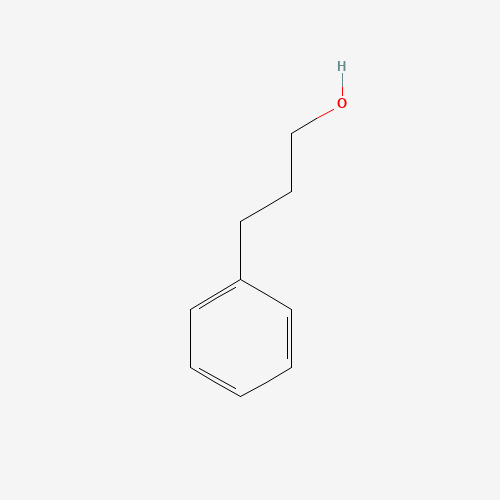
3-Phenyl-1-propanol is a monocyclic arene.
科学粮草官-词典编辑部,修订于:2026-07-06
Toxicity
ToxicityFate Summary
ATMOSPHERIC FATE: According to a model of gas/particle partitioning of semivolatile organic compounds in the atmosphere(1), 3-phenylpropanol, which has an extrapolated vapor pressure of 0.0234 mm Hg at 25 °C(2), is expected to exist solely as a vapor in the ambient atmosphere. Vapor-phase 3-phenylpropanol is degraded in the atmosphere by reaction with photochemically-produced hydroxyl radicals(SRC); the half-life for this reaction in air is estimated to be 1.4 days(SRC), calculated from its rate constant of 1.2X1-11 cu cm/molecule-sec at 25 °C(SRC) (that was derived using a structure estimation method(3). 3-Phenylpropanol does not contain chromophores that absorb at wavelengths >290 nm(4) and, therefore, is not expected to be susceptible to direct photolysis by sunlight(SRC).
Soil Adsorption / Mobility
Using a structure estimation method based on molecular connectivity indices(1), the Koc of 3-phenylpropanol can be estimated to be 71(SRC). According to a classification scheme(2), this estimated Koc value suggests that 3-phenylpropanol is expected to have high mobility in soil.
Environmental Biodegradation
AEROBIC: Using the static Zahn-Wellens test, 3-phenylpropanol was determined to be biodegradable based on 100% biodegradation over a 4-day incubation period(1). 3-Phenylpropanol had a 5-day theoretical BOD of 76.8% using a sewage inoculum and a respirometric dilution method(2).
Environmental Bioconcentration
An estimated BCF of 4.5 was calculated in fish for 3-phenylpropanol(SRC), using a log Kow of 1.88(1) and a regression-derived equation(2). According to a classification scheme(3), this BCF suggests the potential for bioconcentration in aquatic organisms is low(SRC).
Volatilization from Water / Soil
The Henry's Law constant for 3-phenylpropanol has been measured as <5.6X10⁻⁸ atm-cu m/mole(1). This Henry's Law constant indicates that 3-phenylpropanol is expected to be essentially nonvolatile from water surfaces(2). 3-Phenylpropanol's Henry's Law constant indicates that volatilization from moist soil surfaces is not expected to occur(SRC). Even though the extrapolated vapor pressure is low environmentally at standard temperature and pressure, 0.0234 mm Hg at 25 °C(4), there is a detectable odor; therefore, 3-phenylpropanol may volatilize from dry soil(SRC).
Environmental Abiotic Degradation
The rate constant for the vapor-phase reaction of 3-phenylpropanol with photochemically-produced hydroxyl radicals has been estimated as 1.2X10⁻¹¹ cu cm/molecule-sec at 25 °C(SRC) using a structure estimation method(1). This corresponds to an atmospheric half-life of about 1.4 days at an atmospheric concentration of 5X10+5 hydroxyl radicals per cu cm(1). 3-Phenylpropanol is not expected to undergo hydrolysis in the environment due to the lack of functional groups that hydrolyze under environmental conditions(2). 3-Phenylpropanol does not contain chromophores that absorb at wavelengths >290 nm(2) and, therefore, is not expected to be susceptible to direct photolysis by sunlight(SRC).
Food Survey Values
3-Phenylpropanol was detected in the skin and pulp of Queen Anne's pocket melon (Cucumis melo var. dudaim (L.) Naudin) at respective concentrations of 365.3 and 216.5 ug/kg(1). 3-Phenylpropanol is reportedly found in heated blackberry, rum, and white wine(2).
Effluent Concentrations
3-Phenylpropanol was detected in wastewater effluents from the rum and timber products industries(1).
Natural Pollution Sources
3-Phenylpropanol occurs naturally both in the free and esterified form in resins and balsams (e.g., benzoe resin and Peru balsam)(1). It has been identified in fruit and cinnamon(1). It occurs in a variety of fruits and berries(2).
Artificial Pollution Sources
3-Phenylpropanol's production and use in the synthesis of flavor and fragrance compounds(1), as a flavoring agent in foods(2) and as a preservative in cosmetics(3) may result in its release to the environment through various waste streams(SRC). Its use as a perfume(1,2) may result in its direct result to the environment(SRC). 3-Phenylpropanol has been identified as a component of tobacco smoke(4).
Probable Routes of Human Exposure
NIOSH (NOES Survey 1981-1983) has statistically estimated that 12,309 workers (7,936 of these were female) were potentially exposed to 3-phenylpropanol in the US(1). Occupational exposure to 3-phenylpropanol may occur through inhalation and dermal contact with this compound at workplaces where 3-phenylpropanol is produced or used. Monitoring and use data indicate that the general population may be exposed to 3-phenylpropanol via inhalation of ambient air (in the vicinity of perfumes containing the compound or tobacco smoke), ingestion of food, and dermal contact with consumer products containing 3-phenylpropanol(SRC).
Other Environmental Concentrations
3-Phenylpropanol is reported to occur in tobacco smoke(1).
Environmental Fate / Exposure Summary
3-Phenylpropanol's production and use in the synthesis of flavor and fragrance compounds, as a flavoring agent in foods and as a preservative in cosmetics may result in its release to the environment through various waste streams. Its use as a perfume may result in its direct result to the environment. 3-Phenylpropanol occurs naturally both in the free and esterified form in resins and balsams and it has been identified in a variety of fruits and berries. 3-Phenylpropanol has been identified as a component of tobacco smoke. If released to air, an extrapolated vapor pressure of 0.0234 mm Hg at 25 °C indicates 3-phenylpropanol will exist solely as a vapor in the atmosphere. Vapor-phase 3-phenylpropanol will be degraded in the atmosphere by reaction with photochemically-produced hydroxyl r...
Toxicity Summary
IDENTIFICATION AND USE: 3-Phenylpropanol is a colorless liquid. It smells like hyacinths and tastes similar to apricot. It occurs in many fruits and berries, cinnamon and some types of balsam. 3-Phenylpropanol occurs in tobacco smoke. 3-Phenylpropanol is typically used as a perfume for applications such as antiperspirants, creams-lotions, lipsticks, talcum powder, tablet soap, shampoo, hair conditioner, bath/shower gel, detergent powder, liquid detergent, fabric softener, candles, incense. Also used in blossom compositions for balsamic and oriental notes. It is not registered for current pesticide use in the U.S., but approved pesticide uses may change periodically and so federal, state and local authorities must be consulted for currently approved uses. HUMAN EXPOSURE AND TOXICITY: In...
Average Daily Intake
The dermal systemic exposure to 3-phenylpropanol in cosmetic products is estimated as 0.0204 mg/kg-day(1).
Human Toxicity Excerpts
/HUMAN EXPOSURE STUDIES/ Irritation was evaluated during the induction phase of a human repeated insult patch test (HRIPT) which was conducted on 50 healthy volunteers. 3-Phenyl-1-propanol at 4% in petrolatum was applied to a 3 sq cm patch, which was then applied to the upper arm of each volunteer for 24 hr under occlusion. A total of 15-24 hr applications were made. Reactions were read at patch removal. No irritation was observed.
Non-Human Toxicity Values
LD50 Rat oral 2300 mg/kg
Antidote and Emergency Treatment
/SRP:/ Advanced Treatment: Consider orotracheal or nasotracheal intubation for airway control in the patient who is unconscious, has severe pulmonary edema, or is in severe respiratory distress. Positive-pressure ventilation techniques, with a bag-valve-mask device, may be beneficial. Consider drug therapy for pulmonary edema ... . Monitor cardiac rhythm and treat arrhythmias as necessary ... . Start IV administration of D5W /SRP: "To keep open", minimal flow rate/. Use 0.9% saline (NS) or lactated Ringer's (LR) if signs of hypovolemia are present. For hypotension with signs of hypovolemia, administer fluid cautiously. Consider vasopressors if patient is hypotensive with a normal fluid volume. Watch for signs of fluid overload ... . Monitor for signs of hypoglycemia (decreased LOC, tach...









