


 一键配货
一键配货
化合物详情
CAS122-99-6
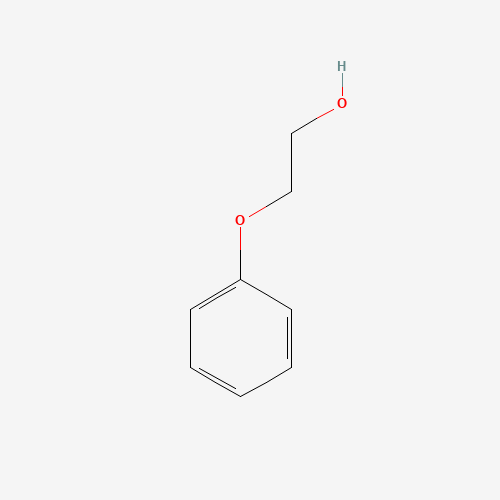
分子式C8H10O2
分子量138.16 g/mol g/mol
危化品
Physical Description | Ethylene glycol phenyl ether is a colorless liquid with a pleasant odor. Density 1.02 g / cm3. An irritant.
科学粮草官-词典编辑部,修订于:2026-07-06
Toxicity
ToxicityEcotoxicity Values
LC50; Species: Pimephales promelas (fathead minnow); Conditions: flow-through bioassay with measured concentrations, 26.6 °C, dissolved oxygen 6.0 mg/L, hardness 45.0 mg/L calcium carbonate, alkalinity 42.0 mg/L calcium carbonate, and pH 7.62; Concentration: 344 mg/L for 96 hr (confidence limit 337-352 mg/L)
Fate Summary
ATMOSPHERIC FATE: According to a model of gas/particle partitioning of semivolatile organic compounds in the atmosphere(1), 2-phenoxyethanol, which has a estimated vapor pressure of 0.007 mm Hg at 25 °C(2), is expected to exist solely as a vapor in the ambient atmosphere. Vapor-phase 2-phenoxyethanol is degraded in the atmosphere by reaction with photochemically-produced hydroxyl radicals(SRC); the half-life for this reaction in air is estimated to be about 11.8 hours(SRC), calculated from its rate constant of 3.27X10⁻¹¹ cu cm/molecule-sec at 25 °C(SRC) that was derived using a structure estimation method(3). Monitoring data have shown that 2-phenoxyethanol can be removed from the atmosphere via precipitation such as snow(4). 2-Phenoxyethanol does not absorb at wavelengths >290 nm(5), a...
Soil Adsorption / Mobility
Using a structure estimation method based on molecular connectivity indices(1), the Koc of 2-phenoxyethanol can be estimated to be 15(SRC). According to a classification scheme(2), this estimated Koc value suggests that 2-phenoxyethanol is expected to have very high mobility in soil.
Environmental Biodegradation
AEROBIC: For 2-phenoxyethanol, theoretical BODs of 2% (5-day), 71% (10-day), and 80% (20-day) have been measured(1); a theoretical 20-day BOD of 50% indicates a compound will largely be removed during biological waste treatment(1).
Environmental Bioconcentration
An estimated BCF of 1.5 was calculated in fish for 2-phenoxyethanol(SRC), using a log Kow of 1.16(1) and a regression-derived equation(2). According to a classification scheme(3), this BCF suggests the potential for bioconcentration in aquatic organisms is low(SRC).
Volatilization from Water / Soil
The Henry's Law constant for 2-phenoxyethanol is estimated as 4.9X10⁻⁸ atm-cu m/mole(SRC) derived from its vapor pressure, 0.007 mm Hg at 25 °C(1), and water solubility, 2.6X10+4 mg/L(2). This Henry's Law constant indicates that 2-phenoxyethanol is essentially nonvolatile from water surfaces(3). 2-Phenoxyethanol's Henry's Law constant indicates that volatilization from moist soil surfaces is not expected to occur(SRC). 2-Phenoxyethanol is not expected to volatilize from dry soil surfaces(SRC) based upon the vapor pressure of 0.007 mm Hg at 25 °C(3).
Environmental Abiotic Degradation
The rate constant for the vapor-phase reaction of 2-phenoxyethanol with photochemically-produced hydroxyl radicals has been estimated as 3.27X10⁻¹¹ cu cm/molecule-sec at 25 °C(SRC) using a structure estimation method(1). This corresponds to an atmospheric half-life of about 11.8 hours at an atmospheric concentration of 5X10+5 hydroxyl radicals per cu cm(1). The UV spectrum for an aqueous solution of 2-phenoxyethanol does not show any absorbance above 290 nm(2) which indicates that 2-phenoxyethanol will not directly photolyze in the environment(SRC). 2-Phenoxyethanol is not expected to undergo hydrolysis in the environment due to the lack of functional groups that hydrolyze under environmental conditions(3).
Environmental Water Concentrations
GROUND WATER: 2-Phenoxyethanol concentrations of less than 5 ppm were detected in well waters collected in the vicinity of two industrial factories in Spain in 1984(1).
Ecotoxicity Excerpts
/AQUATIC SPECIES/ THE APPROX TIMES TO 50% MORTALITY OF JUVENILE RAINBOW TROUT (SALMO GAIRDNERI) EXPOSED TO 2-PHENOXYETHANOL AT 0.75, 0.50, & 0.25 ML/L WERE 10.7 MINUTES, 26.3 MINUTES, & 3.7 HR, RESPECTIVELY. THE AVERAGE IMMOBILIZATION TIMES AT THE ABOVE 3 CONCN WERE 2, 3, & 4 MINUTES, RESPECTIVELY, & RECOVERY TIMES WERE APPROX 14, 9, & 6 MINUTES, RESPECTIVELY, FOR FISH THAT SURVIVED. 2-PHENOXYETHANOL THUS APPEARS TO BE A SUITABLE ANESTHETIC FOR JUVENILE SALMONIDS BUT ONLY FOR LIMITED DURATIONS, ESPECIALLY AT HIGHER CONCN.
Effluent Concentrations
2-Phenoxyethanol has been detected in wastewater effluents from the following industries: paint and ink, organics & plastics, photographic, and mechanical products(1). 2-Phenoxyethanol was detected in samples collected from oil reclaiming wastewaters(2). 2-Phenoxyethanol was qualitatively detected in wastewater samples collected from the Iona Island municipal treatment facility (British Columbia) in 1983(3).
Atmospheric Concentrations
RAIN/SNOW: Snow samples collected in early March (year not specified) at Lapland, Finland and Moscow, Russia contained 2-phenoxyethanol concentrations of 0.28 and 0.04 ug/kg respectively(1).
Artificial Pollution Sources
2-Phenoxyethanol's production and use as a solvent for cellulose acetate and dyes, in inks and resins, as a perfume fixative, as a bactericidal agent, in organic synthesis of plasticizers, germicides and pharmaceuticals and in insect repellents(1) may result in its release to the environment through various waste streams(SRC).
Probable Routes of Human Exposure
NIOSH (NOES Survey 1981-1983) has statistically estimated that 111,040 workers (46,637 of these were female) were potentially exposed to 2-phenoxyethanol in the US(1). Occupational exposure to the 2-phenoxyethanol occurs through inhalation of vapor and dermal contact. Its use as solvent for inks, resins and cellulose acetate and its use as a perfume fixative could expose the general population through dermal contact and inhalation of vapor(SRC).
Environmental Fate / Exposure Summary
2-Phenoxyethanol's production and use as a solvent for cellulose acetate and dyes, in inks and resins, as a perfume fixative, as a bactericidal agent, in organic synthesis of plasticizers, germicides and pharmaceuticals, and in insect repellents may result in its release to the environment through various waste streams. If released to air, a vapor pressure of 0.007 mm Hg at 25 °C indicates 2-phenoxyethanol will exist solely as a vapor in the atmosphere. Vapor-phase 2-phenoxyethanol will be degraded in the atmosphere by reaction with photochemically-produced hydroxyl radicals; the half-life for this reaction in air is estimated to be 11.8 hours. Monitoring data have shown that 2-phenoxyethanol can be removed from the atmosphere via precipitation including snow. 2-Phenoxyethanol does not...
Symptoms
May cause vomiting and diarrhea.
Adverse Effects
Skin Sensitizer - An agent that can induce an allergic reaction in the skin.
Exposure Routes
Dermal (A15201); ingestion
Toxicity Summary
2-Phenoxyethanol is a glycol ether. Glycol ethers can produce toxicity following oxidation to the corresponding aldehyde and alkoxyacetic acid by alcohol dehydrogenase (ADH; EC 1.1.1.1) and aldehyde dehydrogenase (ALDH; EC 1.2.1.3), respectively. (A15201) 2-Phenoxyethanol causes reduction of NMDA-induced membrane currents, indicating a neurotoxic potential for 2-phenoxyethanol. (A15202)
Carcinogen Classification
No indication of carcinogenicity to humans (not listed by IARC).
Antidote and Emergency Treatment
/SRP:/ Advanced treatment: Consider orotracheal or nasotracheal intubation for airway control in the patient who is unconscious, has severe pulmonary edema, or is in severe respiratory distress. Positive-pressure ventilation techniques with a bag valve mask device may be beneficial. Consider drug therapy for pulmonary edema ... . Consider administering a beta agonist such as albuterol for severe bronchospasm ... . Monitor cardiac rhythm and treat arrhythmias as necessary ... . Start IV administration of D5W /SRP: "To keep open", minimal flow rate/. Use 0.9% saline (NS) or lactated Ringer's if signs of hypovolemia are present. For hypotension with signs of hypovolemia, administer fluid cautiously. Watch for signs of fluid overload ... . Treat seizures with diazepam or lorazepam ... . Use...









