

 一键配货
一键配货
化合物详情
CAS123-03-5
分子式C21H38N+
分子量304.5 g/mol
危化品
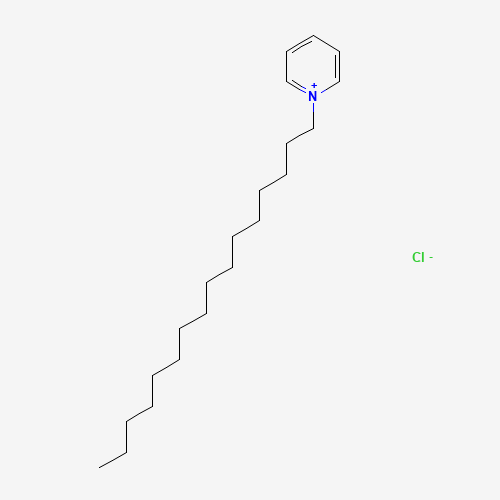
Cetylpyridinium chloride is a pyridinium salt that has N-hexadecylpyridinium as the cation and chloride as the anion. It has antiseptic properties and is used in solutions or lozenges for the treatment of minor infections of the mouth and throat. It has a role as a surfactant and an antiseptic drug. It is a chloride salt and an organic chloride salt. It contains a cetylpyridinium.
科学粮草官-词典编辑部,修订于:2026-07-06
Toxicity
ToxicityEPA Ecotoxicity
Pesticide Ecotoxicity Data from EPA: 3
Fate Summary
ATMOSPHERIC FATE: Cetylpyridinium chloride will exist as the ion in the environment and, thus, will be present solely in the particulate phase in the atmosphere. Particulate-phase cetylpyridinium chloride may be removed from the air by wet and dry deposition. (SRC)
Soil Adsorption / Mobility
The Koc of cetylpyridinium chloride is estimated as 200(SRC), using a measured log Kow of 1.71(1) and a regression-derived equation(2). According to a classification scheme(3), this estimated Koc value suggests that cetylpyridinium chloride is expected to have moderate mobility in soil. However, quaternary ammonium compounds are known to sorb strongly, and rapidly in well-mixed systems, to a wide variety of materials (such as sewage sludge, sediment, clay)(4) and the mobility of cetylpyridinium chloride in soil may be considerably less than estimated(SRC).
Environmental Biodegradation
AEROBIC: Biodegradation data for cetylpyridinium chloride were not located although, based on data for structurally-similar compounds, this compound is expected to biodegrade rapidly in the environment(SRC). Structurally-similar compounds, dodecyl and tetradecylpyridinium chloride, were biodegraded in the Spanish official test (93 and 94%, respectively) and in the OECD Confirmatory test (91 and 92%, respectively)(1). Mean cetylpyridinium (counterion unspecified) removal of 96.0 and 77.2%, respectively, was observed at an activated sludge and a trickling filter wastewater treatment plant in England; in the Heidelsheim plant in Germany, 95% removal was reported(1). Cetylpyridinium bromide is readily biodegraded in sewage, particularly when the inoculum has been previously acclimated(2,3).
Environmental Bioconcentration
Whole body BCF values of 21, 22, and 13, were measured for clams, fathead minnows, and tadpoles, respectively, under flow-through conditions over a 7-day period, for a structurally-similar compound, cetylpyridinium bromide(1). An estimated BCF of 2 was calculated for cetylpyridinium chloride(SRC), using a log Kow of 1.71(2) and a regression-derived equation(3). According to a classification scheme(4), these BCF values suggest the potential for bioconcentration in aquatic organisms is low(SRC).
Volatilization from Water / Soil
Cetylpyridinium chloride is expected to exist in the dissociated form in the environment and, therefore, volatilization from water surfaces or moist soil surfaces will not an important fate process. Cetylpyridinium chloride is not expected to volatilize from dry soil surfaces as it exists as an ion in the environment and ions do not volatilize. (SRC)
Environmental Abiotic Degradation
Cetylpyridinium chloride is not expected to undergo hydrolysis in the environment due to the lack of hydrolyzable functional groups(1). Pyridine has a weak absorption band that extends into the environmental UV spectrum(3), which suggests that direct photolysis is not likely to be an important fate process for cetylpyridinium chloride (SRC).
Artificial Pollution Sources
Cetylpyridinium chloride's production and use as an antiseptic, as a preservative in cosmetics and pharmaceuticals(1) and as an ingredient in external deodorants(2), and in mouthwash(3) may result in its release to the environment through various waste streams(SRC).
Probable Routes of Human Exposure
NIOSH (NOES Survey 1981-1983) has statistically estimated that 98,375 workers (86,013 of these are female) are potentially exposed to cetylpyridinium chloride in the US(1). Occupational exposure to cetylpyridinium chloride may occur through inhalation and dermal contact with this compound at workplaces where cetylpyridinium chloride is produced or used(SRC). The general population may be exposed to cetylpyridinium chloride predominantly via ingestion or dermal contact due to its use in consumer products, such as mouthwash, external deodorants, and cough lozenges and syrups(SRC).
Environmental Fate / Exposure Summary
Cetylpyridinium chloride's production and use as an antiseptic, as a preservative in cosmetics and pharmaceuticals, and as an ingredient in external deodorants and in mouthwash may result in its release to the environment through various waste streams. If released to air, cetylpyridinium chloride will exist as an ion and, thus, will be found solely in the particulate phase in the ambient atmosphere. Particulate-phase cetylpyridinium chloride will be removed from the atmosphere by wet and dry deposition. If released to soil, cetylpyridinium chloride is expected to have moderate mobility based upon an estimated Koc of 200. However, quaternary ammonium compounds are known to sorb strongly, and rapidly in well-mixed systems, to a wide variety of materials (such as sewage sludge, sediment, c...
Interactions
ETHANOL ACTIVATED UDP-GLUCURONOSYLTRANSFERASE ACTIVITY (P-NITROPHENOL SUBSTRATE) IN RAT LIVER IN VITRO, BUT INHIBITED ACTIVITY @ HIGHER ETHANOL CONCN. ACTIVATION NOT SEEN IN MICROSOMES PRETREATED IN VITRO WITH CETYLPYRIDINIUM CHLORIDE.
Toxicity Data
LC50 (rat) = 90 mg/m3/4h
Adverse Effects
Skin Sensitizer - An agent that can induce an allergic reaction in the skin.
Human Toxicity Excerpts
Large quantities may cause nausea, vomiting, collapse, convulsions and coma.
Antidote and Emergency Treatment
/SRP:/ Advanced treatment: Consider orotracheal or nasotracheal intubation for airway control in the patient who is unconscious, has severe pulmonary edema, or is in respiratory arrest. Positive pressure ventilation techniques with a bag valve mask device may be beneficial. Monitor cardiac rhythm and treat arrhythmias as necessary ... . Start an IV with D5W /SRP: "To keep open", minimal flow rate/. Use lactated Ringer's if signs of hypovolemia are present. Watch for signs of fluid overload. Consider drug therapy for pulmonary edema ... . For hypotension with signs of hypovolemia, administer fluid cautiously. Watch for signs of fluid overload ... . Treat seizures with diazepam (Valium) ... . Use proparacaine hydrochloride to assist eye irrigation ... . /Poison A and B/