


 一键配货
一键配货
化合物详情
CAS123-07-9
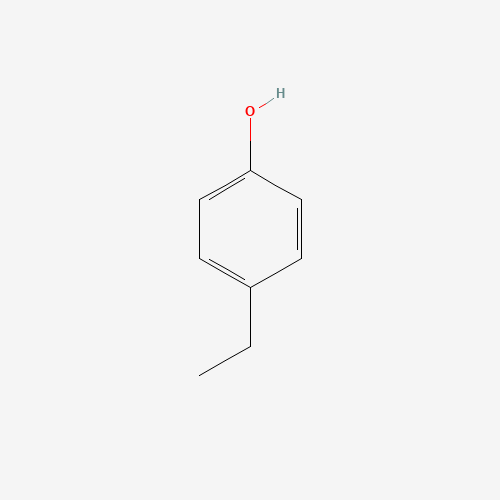
分子式C2H5C6H4OH
分子量122.16 g/mol g/mol
危化品
4-ethylphenol is a member of the class of phenols carrying an ethyl substituent at position 4. It has a role as a fungal xenobiotic metabolite.
科学粮草官-词典编辑部,修订于:2026-07-06
Toxicity
ToxicityBody Burden
6 of 46 human adipose tissue composite samples, collected in 1982, contained p-ethylphenol at unreported concentrations(1).
Fate Summary
ATMOSPHERIC FATE: According to a suggested classification scheme(1), a measured vapor pressure of 0.0372 mm Hg at 25 °C(2) indicates that p-ethylphenol will mainly exist in the vapor phase in the ambient atmosphere(SRC). Vapor-phase p-ethylphenol is degraded in the atmosphere by reaction with photochemically produced hydroxyl radicals(SRC); the half-life for this reaction in air is estimated to be about 9 hours(3,SRC).
Soil Adsorption / Mobility
The Koc of p-ethylphenol is estimated as approximately 600(SRC), using a measured log Kow of 2.58(1) and a regression-derived equation(2,SRC). According to a recommended classification scheme(3), this estimated Koc value suggests that p-ethylphenol has low mobility in soil(SRC).
Environmental Biodegradation
A lab-scale, upflow aerated column receiving water that had first passed through a soil sample, obtained from a former asphalt production plant, (p-ethylphenol influent initially at 4000 ug/l) was capable of 76% removal of this compound within 37 days(1). An on-site (at the production plant) upflow aerated column and trickling filter, after 38 days of operation, removed 49% and 15% of the initial concentration of p-ethylphenol, respectively(1). Differences between lab scale and on-site reactors was due to differences in the hydraulic load(1).
Environmental Bioconcentration
An estimated BCF value of 54 was calculated for p-ethylphenol(SRC), using a measured log Kow of 2.58(1) and a recommended regression-derived equation(2). According to a recommended classification scheme(3), this BCF value suggests that bioconcentration in aquatic organisms may be an important fate process(SRC).
Volatilization from Water / Soil
The Henry's Law constant for p-ethylphenol is estimated as 1.2X10⁻⁶ atm-cu m/mole(SRC) from its experimental values for vapor pressure, 0.372 mm Hg at 25 °C(1), and water solubility, 4900 mg/L at 25 °C(2). This value indicates that p-ethylphenol will volatilize from water surfaces(3,SRC). Based on this Henry's Law constant, the volatilization half-life from a model river (1 m deep, flowing 1 m/sec, wind velocity of 3 m/sec) is estimated as approximately 33 days(3,SRC). The volatilization half-life from a model lake (1 m deep, flowing 0.05 m/sec, wind velocity of 0.5 m/sec) is estimated as approximately 245 days(3,SRC). p-Ethylphenol's values for vapor pressure(1) and Henry's Law constant(1,2,SRC) indicate that volatilization from dry and moist soil surfaces is not likely to be a major f...
Environmental Abiotic Degradation
The rate constant for the vapor-phase reaction of p-ethylphenol with photochemically produced hydroxyl radicals has been estimated as 4.2X10⁻¹¹ cu cm/molecule-sec at 25 °C(SRC) using a structure estimation method(1,SRC). This corresponds to an atmospheric half-life of about 9 hours at an atmospheric concentration of 5X10+5 hydroxyl radicals per cu cm(1,SRC). p-Ethylphenol has a measured pKa of 10.0, indicating that under most environmental conditions this compound will exist mainly as the non-dissociated form(2).
Environmental Water Concentrations
GROUNDWATER: p-Ethylphenol was measured in groundwater from a site near a former asphalt production plant in Deventer, The Netherlands, at 4550 ug/L(1). p-Ethylphenol was detected in a leachate sample from the Southington landfill site in Connecticut at 0.1 mg/L(2).
Effluent Concentrations
p-Ethylphenol was detected in industrial wastewater from the following industries: timber products (1 in 30 extracts), iron and steel manufacturing (1 in 7 extracts), petroleum refining (1 in 21 extracts), organics and plastics (1 in 49 extracts), rubber processing (1 in 18 extracts), mechanical products (1 in 26 extracts), and publicly-owned treatment works (1 in 44 extracts)(1). A coal-derived liquid taken from a non-catalytic direct liquefaction pilot plant contained p-ethylphenol at unreported concentrations(2). m- and p-ethylphenol (mixed) were detected in cigarette smoke at 1.2-2.8 mg/100 cigarettes(3). p-Ethylphenol was detected in a sample of finished water from the Blue Plains advanced waste treatment plant, Washington, DC in September 1974(4).
Natural Pollution Sources
REPORTED FOUND IN YELLOW PASSION FRUIT.
Artificial Pollution Sources
p-Ethylphenol is extracted from brown coal low temperature tar(1).
Environmental Fate / Exposure Summary
p-Ethylphenol's production and use in the manufacture of phenolic resins and varnishes, as an intermediate for pharmaceuticals and dyes, as a starting material for the production of antioxidants used in rubber and polymers, and its use as a food flavoring may result in its release to the environment through various waste streams. p-Ethylphenol may be released to the environment during its extraction from coal or from the smoke in cigarettes. If released to the atmosphere, p-ethylphenol will mainly exist in the vapor phase based on a experimental vapor pressure of 0.0372 mm Hg at 25 °C. Vapor-phase p-ethylphenol is degraded in the atmosphere by reaction with photochemically produced hydroxyl radicals with an estimated half-life of about 9 hours. An estimated Koc of 600 suggests that p-et...
Symptoms
Systemic manifestations of toxicity may include nausea, vomiting, diarrhea, dyspnea, tachypnea, pallor, and profuse sweating (T36).
Treatment
Consider activated charcoal. Monitor for respiratory distress in case of inhalation exposure. Irrigate exposed eyes with copious amounts of room temperature water for at least 15 minutes. (T36)
Interactions
VITILIGO MAY BE DUE TO INHIBITION OF MELANOGENESIS BY PHENOLIC DEGRADATION PRODUCTS PRODUCED IN VIVO. P-ETHYLPHENOL WAS ACTIVE IN INHIBITING PIGMENT FORMATION FROM DOPA BY HUMAN & GUINEA PIG SKIN IN VITRO.
Health Effects
Respiratory distress, cardiovascular collapse, shock, ventricular tachycardia, and coma in an adult. Liver, lung, central nervous system and renal injury may also occur (T36).
Exposure Routes
Dermal (T36); inhalation (T36); oral (T36)
Toxicity Summary
Metabolized to 1- and 2- phenylethanol (A622).
Carcinogen Classification
No indication of carcinogenicity (not listed by IARC). (L135)
Non-Human Toxicity Excerpts
MUTAGENICITY OF 4-ETHYLPHENOL WAS ASSAYED BY USING REVERSION OF HISTIDINE-REQUIRING AUXOTROPHS OF SALMONELLA TYPHIMURIUM STRAINS TA 98 & TA 100 AND DOES NOT APPEAR TO BE MUTAGENIC.









