


 一键配货
一键配货
化合物详情
CAS123-11-5
分子式C8H8O2
分子量136.15 g/mol g/mol
危化品
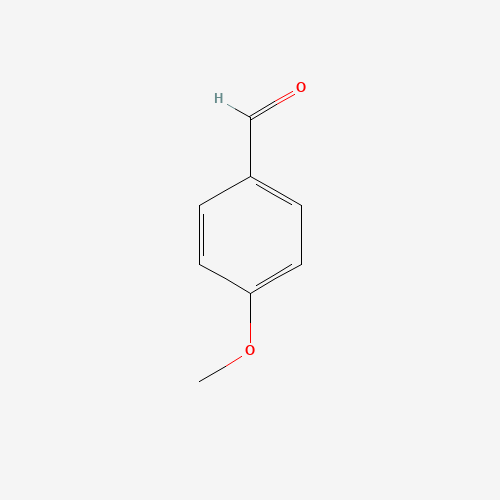
P-methoxybenzaldehyde is a member of the class of benzaldehydes consisting of benzaldehyde itself carrying a methoxy substituent at position 4. It has a role as an insect repellent, a plant metabolite, a bacterial metabolite and a human urinary metabolite.
科学粮草官-词典编辑部,修订于:2026-07-06
Toxicity
ToxicityFate Summary
ATMOSPHERIC FATE: According to a model of gas/particle partitioning of semivolatile organic compounds in the atmosphere(1), p-anisaldehyde, which has a vapor pressure of 3.29X10⁻² mm Hg at 25 °C(2), is expected to exist solely as a vapor in the ambient atmosphere. Vapor-phase p-anisaldehyde is degraded in the atmosphere by reaction with photochemically-produced hydroxyl radicals(SRC); the half-life for this reaction in air is estimated to be 15 hours(SRC), calculated from its rate constant of 2.5X10⁻¹¹ cu cm/molecule-sec at 25 °C(SRC) that was derived using a structure estimation method(3). p-Anisaldehyde absorbs UV light at wavelengths >290 nm(4) and, therefore, may be susceptible to direct photolysis by sunlight(SRC).
Soil Adsorption / Mobility
The Koc of p-anisaldehyde is estimated as 53(SRC), using a log Kow of 1.76(1) and a regression-derived equation(2). According to a classification scheme(3), this estimated Koc value suggests that p-anisaldehyde is expected to have high mobility in soil.
Environmental Biodegradation
AEROBIC: p-Anisaldehyde, present at 100 mg/L, reached 99 of its theoretical BOD in 14 days using an activated sludge inoculum at 30 mg/L in the Japanese MITI test(1).
Environmental Bioconcentration
An estimated BCF of 6.7 was calculated in fish for p-anisaldehyde(SRC), using a log Kow of 1.76(1) and a regression-derived equation(1). According to a classification scheme(2), this BCF suggests the potential for bioconcentration in aquatic organisms is low(SRC).
Volatilization from Water / Soil
The Henry's Law constant for p-anisaldehyde is estimated as 1.4X10⁻⁵ atm-cu m/mole(SRC) derived from its vapor pressure, 3.29X10⁻² mm Hg(1), and water solubility, 4.29X10+3 mg/L(2). This Henry's Law constant indicates that p-anisaldehyde is expected to volatilize from water surfaces(3). Based on this Henry's Law constant, the volatilization half-life from a model river (1 m deep, flowing 1 m/sec, wind velocity of 3 m/sec)(3) is estimated as 20 days(SRC). The volatilization half-life from a model lake (1 m deep, flowing 0.05 m/sec, wind velocity of 0.5 m/sec)(3) is estimated as 230 days(SRC). p-Anisaldehyde's estimated Henry's Law constant indicates that volatilization from moist soil surfaces may occur(SRC). p-Anisaldehyde has a vapor pressure of 3.29X10⁻² mm Hg at 25 °C(1) and exists a...
Environmental Abiotic Degradation
The rate constant for the vapor-phase reaction of p-anisaldehyde with photochemically-produced hydroxyl radicals has been estimated as 2.5X10⁻¹¹ cu cm/molecule-sec at 25 °C(SRC) using a structure estimation method(1). This corresponds to an atmospheric half-life of about 15 hours at an atmospheric concentration of 5X10+5 hydroxyl radicals per cu cm(1). p-Anisaldehyde is not expected to undergo hydrolysis in the environment due to the lack of functional groups that hydrolyze under environmental conditions(2). p-Anisaldehyde absorbs UV light at wavelengths >290 nm(3) and, therefore, may be susceptible to direct photolysis by sunlight(SRC).
Food Survey Values
p-Anisaldehyde was detected at mean concentrations of 74.2, 47.4,.and 16.3 ug/kg, in honeydew honey extracts from holm-oak, oak, and forest honeys, respectively(1).
Effluent Concentrations
In 1999, ortho-, meta-, and para-anisaldehyde, had a reported combined emission factor of 0.38 mg/L for light duty passenger vehicles, emissions were measured in inside the Caldecott tunnel on Highway 24 near San Francisco Bay, California(1); a study conducted in July and August 2006, measuring emissions from inside the Caldecott tunnel omitted isomers of anisaldehyde due to analytical method limitations(2). Anisaldehyde (as the combined isomers ortho-, meta-, and para-) was detected in light- and heavy-duty vehicle exhaust at the Pennsylvania Tuscarora Mountain Tunnel inlet at 0.0058 ug/m cu and outlet at 0.014 ug/m cu with a calculated emission factor of 0.017 mg/km(3).
Natural Pollution Sources
p-Anisaldehyde is a metabolic product of odoriferous fungus Lentinus Lepidus; of wood rotting fungus Polyporus benzoinus; of Daldaldea juniperina(1). p-Anisaldehyde occurs in many essential oils, often together with anethole(2). The compound is reportedly found in essential oils and extracts of vanilla, acacia farnesiana, magnolia salicifolia maxim, eric arborea, pirus communis, and boswellia serrata; also in anise, fennel and star anise (especially when aged due to oxidation of anethol), cranberry, black current, cinnamon and basil(3).
Atmospheric Concentrations
URBAN/SUBURBAN: p-Anisaldehyde was detected in ambient air samples collected from Roseville, California, in summer 2006 and winter 2006/2007, at average concentrations of 6.9-7.4 ng/m cu and 1.2-2.1 ng/m cu, respectively(1).
Artificial Pollution Sources
p-Anisaldehyde's production and use in perfumery and toilet soaps, in organic synthesis, as an intermediate for antihistamines, electroplating(1,2), and in flavor compositions for confectioneries and beverages(3) may result in its release to the environment through various waste streams(SRC).
Probable Routes of Human Exposure
NIOSH (NOES Survey 1981-1983) has statistically estimated that 100,333 workers (61,328 of these are female) were potentially exposed to p-anisaldehyde in the US(1). Occupational exposure to p-anisaldehyde may occur through inhalation and dermal contact with this compound at workplaces where p-anisaldehyde is produced or used. Use data and limited monitoring data indicate that the general population may be exposed to p-anisaldehyde via inhalation of ambient air, ingestion of food, smoking cigarettes and dermal contact with plant essential oils and consumer products containing p-anisaldehyde. (SRC)
Other Environmental Concentrations
p-Anisaldehyde has been identified as a constituent of tobacco, tobacco smoke, and tobacco smoke substitute(1).
Environmental Fate / Exposure Summary
p-Anisaldehyde's production and use in perfumery and toilet soaps, in organic synthesis, as an intermediate for antihistamines, electroplating, and in flavor compositions for confectioneries and beverages may result in its release to the environment through various waste streams. p-Anisaldehyde is a metabolic product of odoriferous fungus Lentinus Lepidus, of wood rotting fungus Polyporus benzoinus, and of Daldaldea juniperina. p-Anisaldehyde occurs in many essential oils, it is reportedly found in essential oils and extracts of vanilla, acacia farnesiana, magnolia salicifolia maxim, eric arborea, pirus communis, and boswellia serrata, also in anise, fennel and star anise, cranberry, black current, cinnamon and basil. If released to air, a vapor pressure of 3.29X10⁻² mm Hg at 25 °C indi...
Interactions
It has been suggested that aromatic aldehydes may reduce cytochrome c. Therefore, interaction of the aromatic aldehydes, p-anisaldehyde, benzaldehyde, p-tolualdehyde, p-carboxybenzaldehyde, p-chlorobenzaldehyde and p-nitrobenzaldehyde, with rat liver mitochondria was examined in vitro. Although both pyruvate/malate- and succinate-mediated respiration, as well as that mediated by other citric acid cycle intermediates, were inhibited by the aromatic aldehydes (0.5 to 1.0 mM), cytochrome c oxidase was not inhibited by aromatic aldehydes (1.0 to 20 mM). There was a marked inhibition of succinic dehydrogenase and both ADP- and DNP-stimulated respiration by benzaldehyde (2 to 20 mM). Since both pyruvate/malate- and succinate-mediated respiration were inhibited by the aromatic aldehydes withou...
Adverse Effects
Occupational hepatotoxin - Secondary hepatotoxins: the potential for toxic effect in the occupational setting is based on cases of poisoning by human ingestion or animal experimentation.
Toxicity Summary
IDENTIFICATION AND USE: p-Anisaldehyde is oily liquid. It is used in perfumery and toilet soaps. It is also used in organic syntheses. p-Anisaldehyde is also an intermediate in many industrial processes. HUMAN STUDIES: When tested at 10% in petrolatum, it produced no irritation after a 48 hr closed-patch test on human subjects. A maximization test was carried out on 25 volunteers. The material was tested at a concentration of 10% in petrolatum and produced no sensitization reactions. p-Anisaldehyde was positive for sister chromatid exchange in human lymph oocytes but not Chinese Hamster Ovary (CHO) cells in vitro. ANIMAL STUDIES: In a combined oral repeated-dose/reproductive/developmental toxicity screening test in rats, decreased body weights, decreased platelets and hypertrophy of hep...
Average Daily Intake
Annual consumption is 5550.00 lb. Individual consumption is 0.004703 mg/kg/day.
Human Toxicity Excerpts
/GENOTOXICITY/ /Benzaldehyde, 4-methoxy/ was positive for sister chromatid exchange in human lymph oocytes but not Chinese Hamster Ovary (CHO) cells in vitro.
Non-Human Toxicity Values
LD50 Rabbit dermal >5 g/kg
Antidote and Emergency Treatment
/SRP:/ Advanced treatment: Consider orotracheal or nasotracheal intubation for airway control in the patient who is unconscious, has severe pulmonary edema, or is in respiratory distress. Intubation should be considered at the first sign of upper airway obstruction caused by edema. Positive-pressure ventilation techniques with a bag-valve-mask device may be beneficial. Consider drug therapy for pulmonary edema ... . Considering administering a beta agonist such as albuterol for severe bronchospasm ... . Start IV administration of D5W TKO /SRP: "To keep open", minimal flow rate/. Use 0.9% saline (NS) or lactated Ringer's (LR) if signs of hypovolemia are present. For hypotension with signs of hypovolemia, administer fluid cautiously. Consider vasopressors if patient is hypotensive with a...









