


 一键配货
一键配货
化合物详情
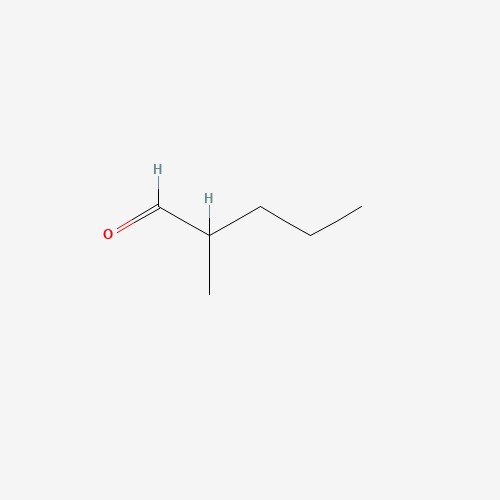
CAS123-15-9
分子式C6H12O
分子量100.16 g/mol
危化品
Physical Description | Alpha-methylvaleraldehyde appears as a colorless liquid. Less dense than water. Used to make rubber and artificial flavorings.
科学粮草官-词典编辑部,修订于:2026-07-06
Toxicity
ToxicityFate Summary
ATMOSPHERIC FATE: According to a suggested classification scheme(1), an estimated vapor pressure of 18 mm Hg at 25 °C(2,SRC) indicates that 2-methylpentaldehyde will exist in the vapor phase in the ambient atmosphere. Vapor-phase 2-methylpentaldehyde is degraded in the atmosphere by reaction with photochemically produced hydroxyl radicals(SRC); the half-life for this reaction in air is estimated to be about 13 hours(3,SRC).
Soil Adsorption / Mobility
The Koc of 2-methylpentaldehyde is estimated as approximately 44(SRC), using an experimental water solubility of 4200 mg/L at 25 °C(1) and a regression-derived equation(2,SRC). According to a recommended classification scheme(3), this estimated Koc value suggests that 2-methylpentaldehyde has very high mobility in soil(SRC).
Environmental Bioconcentration
An estimated BCF value of 5.6 was calculated for 2-methylpentaldehyde(SRC), using an experimental water solubility of 4200 mg/L at 25 °C(1) and a recommended regression-derived equation(2). According to a recommended classification scheme(3), this BCF value suggests that bioconcentration in aquatic organisms will not be an important fate process(SRC).
Volatilization from Water / Soil
The Henry's Law constant for 2-methylpentaldehyde is estimated as 3.7X10⁻⁴ atm-cu m/mole(SRC) using a fragment constant estimation method(1). This value indicates that 2-methylpentaldehyde will volatilize from water surfaces(2,SRC). Based on this Henry's Law constant, the volatilization half-life from a model river (1 m deep, flowing 1 m/sec, wind velocity of 3 m/sec) is estimated as approximately 5.3 hours(2,SRC). The volatilization half-life from a model lake (1 m deep, flowing 0.05 m/sec, wind velocity of 0.5 m/sec) is estimated as approximately 4.7 days(2,SRC). 2-Methylpentaldehyde's vapor pressure, 17.9 mm Hg(3,SRC) and Henry's Law constant(1,SRC) indicate that volatilization from dry and moist soil may occur(SRC).
Environmental Abiotic Degradation
The rate constant for the vapor-phase reaction of 2-methylpentaldehyde with photochemically produced hydroxyl radicals has been estimated as 2.9X10⁻¹¹ cu cm/molecule-sec at 25 °C(SRC) using a structure estimation method(1,SRC). This corresponds to an atmospheric half-life of about 13 hours at an atmospheric concentration of 5X10+5 hydroxyl radicals per cu cm(1,SRC).
Environmental Water Concentrations
SURFACE WATER: 2-Methylpentaldehyde was qualitatively detected in the sea near Holbaek, Denmark using blue mussel as an indicator organism(1).
Food Survey Values
2-Methylpentaldehyde has been tentatively identified as a volatile component of raw chicken breast muscle and caecum(1), fried bacon(2), and chicken, beef and pork meat(3).
Natural Pollution Sources
2-Methylpentaldehyde is a volatile component in onion, garlic, milk, meat, and roasted peanuts(1).
Artificial Pollution Sources
2-Methylpentaldehyde's production and use as a flavoring ingredient(1) and an intermediate for dyes, resins, and pharmaceuticals(2) may result in its release to the environment through various waste streams(SRC).
Probable Routes of Human Exposure
The general population can be exposed to 2-methylpentaldehyde in foodstuffs based on its natural existence as a volatile component in onion, garlic, milk, meat, and roasted peanuts(1), its use as a flavoring ingredient(1), and through ingestion, inhalation, and dermal contact(SRC). Occupational exposure to aldehydes, such as 2-methylpentaldehyde(SRC), can occur through dermal contact, inhalation, and ingestion(2).
Environmental Fate / Exposure Summary
2-Methylpentaldehyde's production and use as a flavoring ingredient and an intermediate for dyes, resins, and pharmaceuticals may result in its release to the environment through various waste streams. 2-Methylpentaldehyde is a volatile component in onion, garlic, milk, meat, and roasted peanuts. 2-Methylpentaldehyde has also been found in sea water near Denmark. If released to soil, 2-methylpentaldehyde will have very high mobility. Volatilization of 2-methylpentaldehyde may be important from moist and dry soil surfaces. Insufficient experimetnal data are available to determine the rate or importance of biodegradation of 2-methylpentaldehyde in soil or water, but simple aldehydes are generally biodegradable. If released to water, 2-methylpentaldehyde may not adsorb to suspended solids...
Toxicity Data
LC (rat) > 1,500 ppm/6h
Human Toxicity Excerpts
The mucus membranes of the nasal and oral passages and the upper respiratory tract are affected, producing a burning sensation ... bronchial constriction, choking, and coughing. The eyes tear, and a burning sensation is noted on the skin of the face. /Aldehydes/









